
Recalling the days when a new radio was a ‘must have’ for U.S. households
October 2026
Vintage Discoveries
Recalling the days when a new radio was a ‘must have’ for U.S. households
by Ken Weyand
A year after my parents’ wedding on New Years’ Day, 1928, my mother saved an issue of the Clark County Courier, the weekly newspaper that served her hometown, Kahoka, in northeast Missouri. For months she had been driving about 20 miles from their farm to give piano lessons to several Kahoka residents, and the front page included a notice of a recital to be held the following Sunday at a local church.
In the paper, there were several auction ads placed by farm families who had given up as the October financial crash loomed. Benteco Store, a grocery, offered “fruit granulated sugar” in 10-pound cloth bags for 63 cents, and Kellogg’s Rice Krispies for 10 cents. A large ad by Martin Bros, a Chevrolet dealer, touted the new Chevrolet Six Sedan, offered at $595. Other models, a Roadster, and a Phaeton, were priced at $525.
What caught my eye, however, were ads for radios. Limited by the fact that few stations were available, the radio had nevertheless caught everyone’s attention as “the latest thing.” Unlike the practical forms they later took, early radios were pieces of furniture.
A large ad by the Kahoka Jewelry and Music House featured the latest Crosley radios. The Model 32, touted as the “lowest cost of all,” was a cabinet model, resting on graceful legs, designed to “harmonize with any scheme of interior decoration.” Offered at the “lowest cost of all,” it was priced at $99.50, “without tubes.” The total cost of getting the radio up and running was not revealed in the ad.
Another advertiser, Martin Elec. & Supply Co., featured the “Majestic Electric Radio,” that had been chosen to entertain “Graff Zepp” passengers on their return trip to Germany. The store chose not to disclose the price, but urged readers to “let us give you a free home demonstration.” (The era of Graff Zeppelins ended with the crash of the Hindenburg, May 6, 1937 at Lakehurst, NJ.)
In 1921, when radio was even more of a novelty, my aunt had written of a “road trip” she had taken with friends in northeast Arkansas. She reported they stopped at one town for the evening an attended a “radio concert,” but didn’t mention any details.
In 1926, on a Chautauqua tour in Ohio, my mother reported attending a “demonstration of a new radio outfit,” and heard a violin and voice broadcast originating from Pittsburgh. “Towards the end of the concert,” she wrote, “the air conditions became ‘static’ as they express it in ‘radio language,’ and we had a little trouble getting everything, but on the whole, everything was as plain as could be. How wonderful to be able to hear through the air like that.”
In A 1929 letter, my mother congratulated my dad’s sister and her husband on getting their new radio. “In the absence of one of our own,” she wrote, “we have been enjoying several Sunday evening programs at a neighbor’s. I’m interested in the Chicago Symphony Orchestra programs sponsored by Standard Oil.”
My parents would later acquire a battery-powered Atwater-Kent radio, a few years before their farmhouse was wired for electricity in the early 1940s. My mother would eventually get her “classical music fix” by listening to Public Radio on WOI-FM from Iowa City, Iowa.
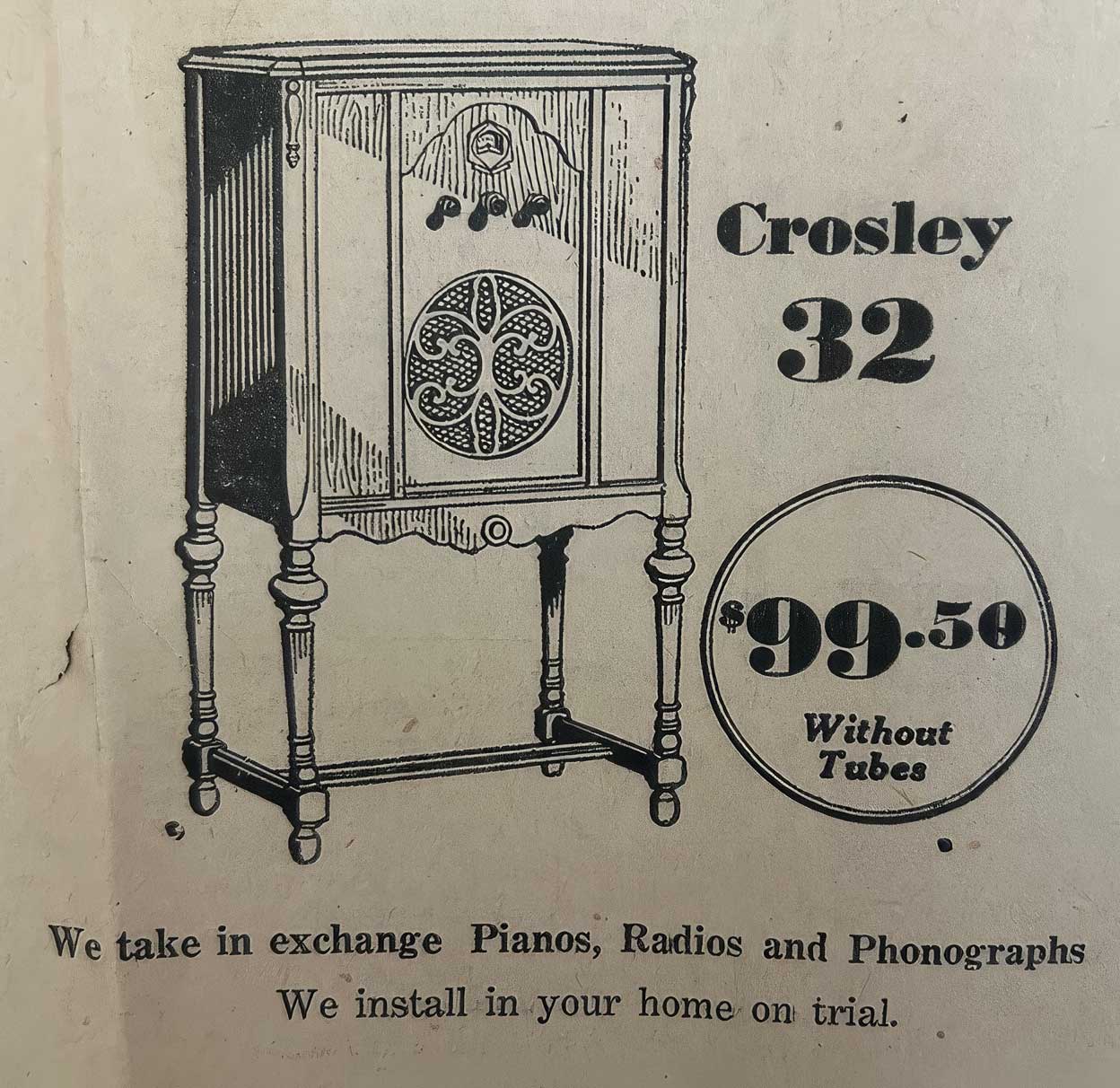
Advertisement for radio
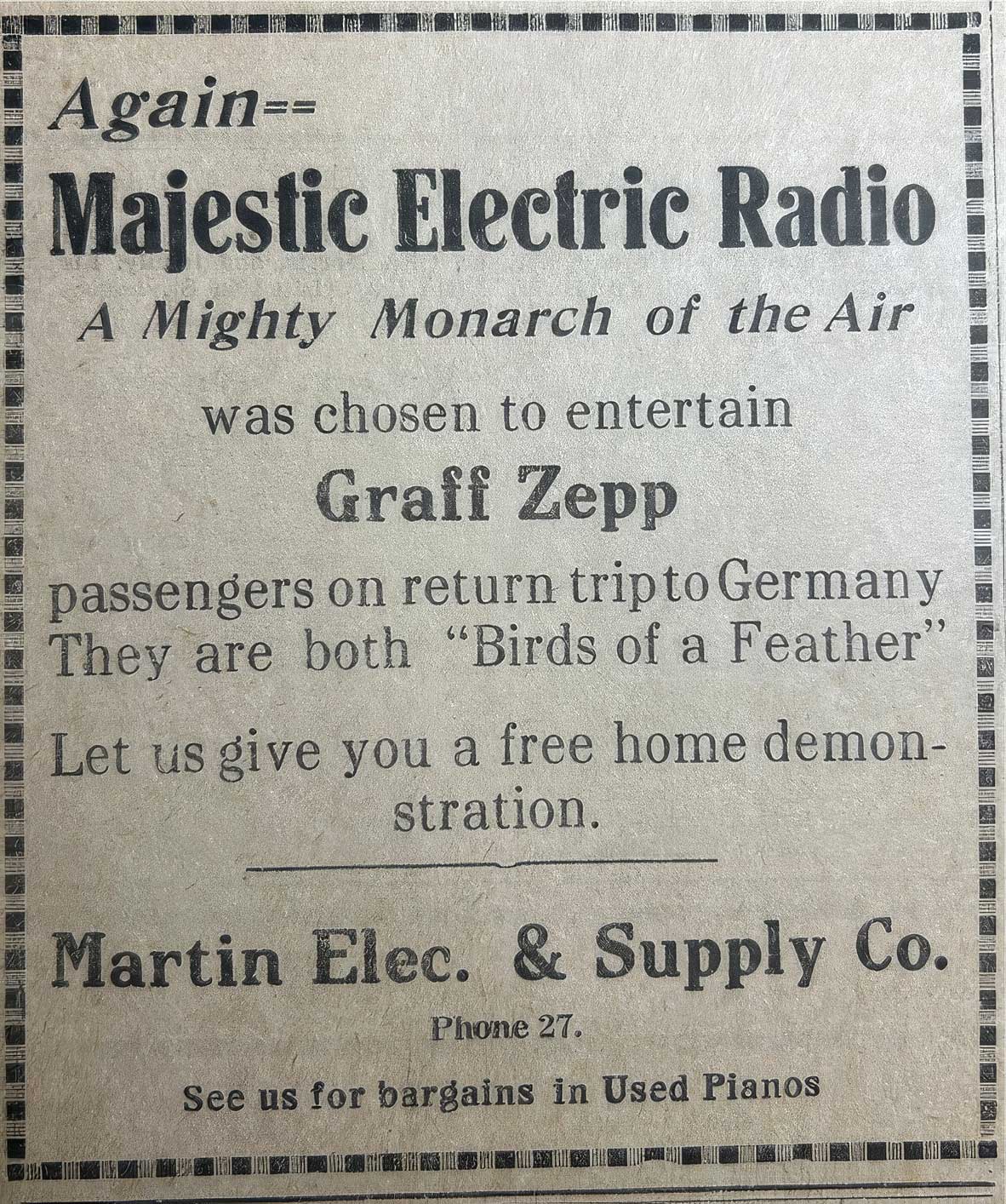
Advertisement for radio home demonstration
Ken Weyand is the original owner/publisher of Discover Vintage America, founded in July 1973 under the name of Discover North.
Ken Weyand can be contacted at kweyand1@kc.rr.com Ken is self-publishing a series of non-fiction E-books. Go to www.smashwords.com and enter Ken Weyand in the search box.
Old theater posters gave notice of big entertainment to come
July 2022 Vintage Discoveries Old theater posters gave notice of big entertainment to come by Ken Weyand Late 1800s and early 1900s Back in the late 1800s and early 1900s, before the days of Chautauqua or Vaudeville, an assortment of show-people performed on theater…
Toy car had the look of a Chrysler “Airflow”
June 2022 Vintage Discoveries Toy car had the look of a Chrysler “Airflow” by Ken Weyand Back in the mid-1940s Back in the mid-1940s, my wife’s dad, a physician in Hamilton, IL, had acquired a couple of toy metal cars. My wife, Karen, said her dad gave the…
Ancient geography textbook reveals a lot
May 2022 Vintage Discoveries Ancient geography textbook reveals a lot by Ken Weyand Old Geography Book One of the few records of my grandfather’s early life and that of his brothers is an old geography book I re-discovered recently in a cedar chest full of…
Solving a jigsaw puzzle—80 years later
April 2022 Vintage Discoveries Solving a jigsaw puzzle—80 years later by Ken Weyand Bored Youngster When I was a youngster, we would occasionally spend Sundays with my dad’s stepmother and his two sisters in Hamilton, IL, across the river from Keokuk, IA. I…
Old nursery rhyme book fondly remembered
March 2022 Vintage Discoveries Old nursery rhyme book fondly remembered ~ by Ken Weyand ~ My first books One of my first books – saved by my mother over the years – recently turned up in my attic. “Three Little Pigs” is a nursery rhyme classic, and it…
Donald Duck pull toy was a 1940s hit
February 2022 Vintage Discoveries Donald Duck pull toy was a 1940s hit ~ by Ken Weyand ~ As a youngster, one of my favorite comic-strip characters was Donald Duck, a creation of the Walt Disney Co. in the 1930s. Like many of his contemporaries, Donald…
Old book charmed children in its day
January 2022 Vintage Discoveries Old book charmed children in its day by Ken Weyand “Bugaboo Bill and Other Wonders” I came across an old book the other day that has me stumped. Was it part of the accumulation of “old stuff” my parents never threw away? Was it…
Century-old high chair served three generations
December 2021 Vintage Discoveries Century-old high chair served three generations by Ken Weyand The high chair, a device for aiding in the feeding of very young children and infants, has been around for decades. As a separate piece of furniture marketed to…
‘Single Tree’ was part of old-time farming
November 2021 Vintage Discoveries ‘Single Tree’ was part of old-time farming by Ken Weyand Early in the 1940s, after years of “horse-farming,” my dad bought a tractor and sold his team of draft horses. Soon after that, much of the horse-drawn equipment was…
Visiting Chicago’s Century of Progress Exposition, 1934
September 2019 Vintage Discoveries Visiting Chicago’s Century of Progress Exposition, 1934 by Ken Weyand On Sept. 16, 1934, my mother, Mabel Weyand, and her parents, Charles and Carrie Forrester, boarded a train at Medill, MO, for Chicago to attend the Century…
Flying ‘back in time’ in a vintage biplane
~ October 2018 / Traveling with Ken ~ Vintage Discoveries Flying ‘back in time’ in a vintage biplane ~ by Ken Weyand ~ Flying in an open-cockpit biplane is a forgotten part of our history. It was an era when pilots flew “tail-dragger” aircraft from…
Only ghosts remain in Arkansas mining town
~ December 2017 / Traveling with Ken ~ Vintage Discoveries Only ghosts remain in Arkansas mining town ~ by Ken Weyand ~ Unlike the many pop-ulated hamlets that dot the Ozarks countryside, the old mining town of Rush is a true ghost town. Located 16…