Growing Asian dominance in a global marketplace

July 2022

Good Eye

Growing Asian dominance in a global marketplace

by Peggy Whiteneck

Asia-based buyers

For this month’s column, I’ve been especially interested to see the impact of Asia-based buyers on the market for American-made antiques and collectibles. While you can find articles documenting the highs and lows of this impact from as far back as 10 years or more, Asia-based buyers retain a very current impact on the global secondary market, including here in the U.S. Today’s Asian buyers buy what they like regardless of cost, often paying exorbitant “Buy It Now” prices on eBay for items posted by crafty sellers who have already noticed what Asian buyers are willing to pay. And those buyers are picking up everything from art glass to real estate, not just within China but beyond it. In online auctions, most Chinese bidders “tend to be younger Millennials and Gen-Zers with higher disposable incomes or wealthier social backgrounds” (“Why Online Auction Marketplaces Could Become Key to Chinese e-Commerce,” The China Guys, 11/4/21).

What’s going on with Asia?

With the loosening of restrictions on private wealth as communist China seeks to grow its economy, private affluence has become a real possibility. According to the online journal “The Art Newspaper, “ In March [2021] there were 626 billionaires in mainland China, a 62% increase from 2020, according to Forbes’s Billionaires 2021 report. There were a further 71 in Hong Kong, bringing the total number of billionaires in greater China to just 26 fewer than in the U.S. And then, of course, there is South Korea (43), Taiwan (47), Singapore (27) and Japan (49)” (“Young, monied, and keen to gamble on art: the super power of Asian collectors,” The Art Newspaper).

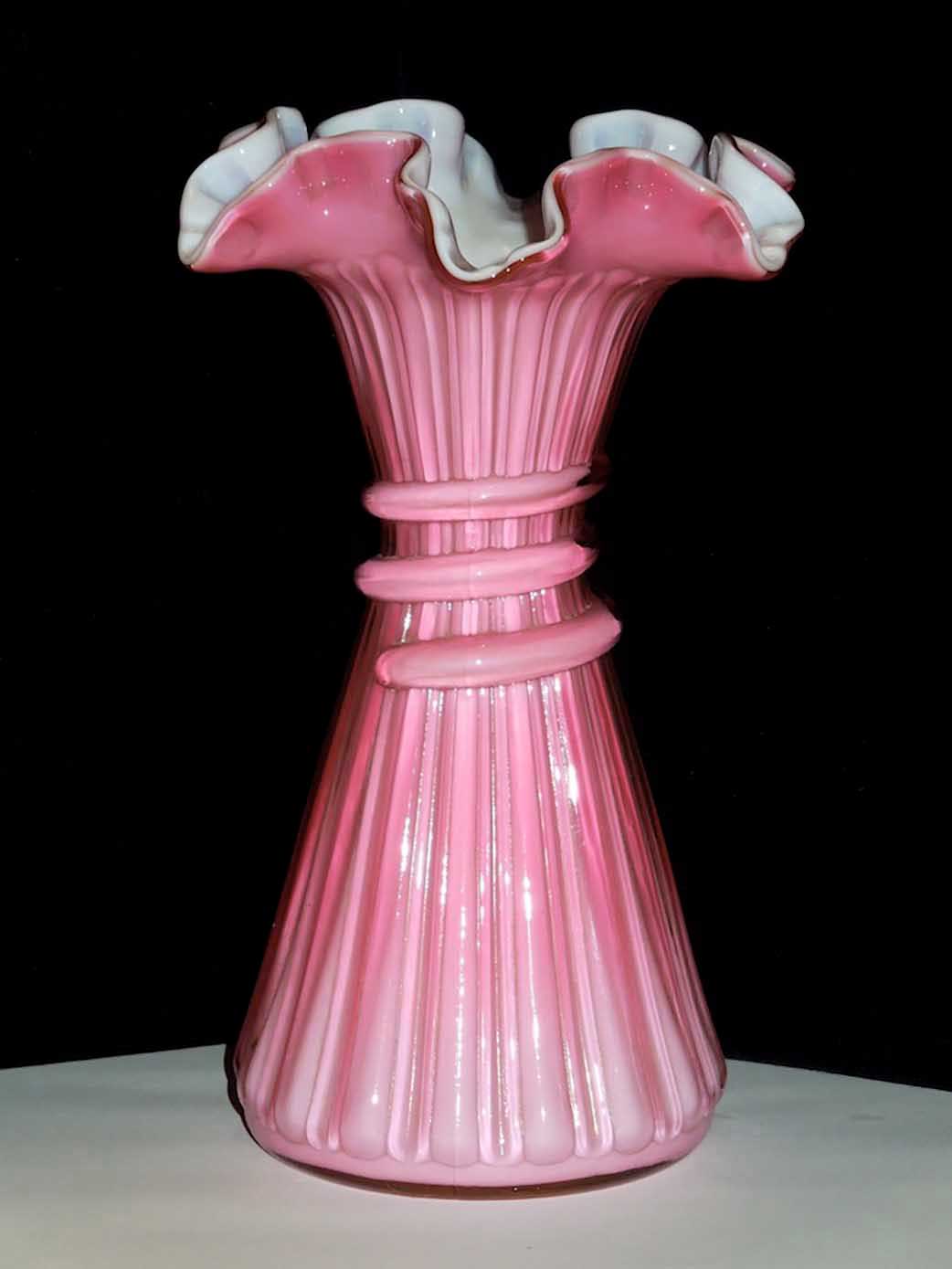
Fenton Wild Rose Wheat Vase

Fenton Wheat Vase in a deep Wild Rose

This Fenton Wheat Vase in a deep Wild Rose color is among the two items from the earlier issue of this shape that have been most highly sought by American collectors. Once considered pricey at $60-$80, this item now goes out at well into three figures, driven by the interests from Asian buyers. In fact, a search of Fenton wheat vases that have recently sold on eBay will show several examples of various colored wheat vases in the $300-$400 range! In private seller online auctions elsewhere, the winners of wheat vases often have Asian surnames, and while names are hidden on eBay, we can probably safely assume high prices are driven by Asian buyers there as well. Image courtesy of the author

Buyers interested in Asian antiques

These buyers remain interested in Asian antiques in porcelain and furniture, but as authenticity issues abound in porcelain and the available supply of genuine Asian antiques has tightened, young buyers have begun to look elsewhere. Online auctions for Fenton Art Glass, for example, have seen prices jacked up by hungry Asian buyers, sometimes well beyond U.S.-based collectors’ willingness to pay. As recently as earlier this year, items such as Fenton wheat vases were considered “pricey” in the U.S. at half or much less of what Asian buyers are today bidding on them at eBay auctions. These vases were produced in two different batches at different times and distinguished by color. In the 1960s, they were made in Wild Rose and Coral (the two hardest colors to find), Powder Blue, Honey Amber, and Apple Green. This first series is not labeled on the bottom with the Fenton oval mark, which wasn’t used until 1970. A set of lighter colors was issued with the Fenton mark in the 1980s. Traditionally, collectors were willing to pay high prices only for the scarcer colors in the early edition. More recently, even the commonly available colors in the later issue are selling in three figures. Affluent Asian millennials are simply bidding up what they like until they win it, without regard to color, scarcity, age, and history that have usually mattered to older collectors.


The same Asia-dominated trend is observable for antique paintings and sculptures at affluent auction houses such as Sotheby, Christie, and Phillips. Dr. Clare McAndrew of Art Economics, a research and consulting firm, reports on what she understatedly describes as a “dynamism in collecting by global millennials” (“Crazy Rich Asian Millennials Pounce on Art Markets, As Most Young People Are ‘Looking’ Before Buying,” Forbes).

Permanent trend - or just a bubble?

Is this Asia-induced price inflation in some secondary market antiques and collectibles a bubble or a long-term trend? Right now, it’s hard to say. The media have been predicting an imminent bubble burst for nearly two decades. There’s no way to predict how the fortunes of affluent young Asians will be affected by economic conditions at home – any more than economic conditions in the U.S. are predictable. For Americans still hoping to buy antiques and collectibles at affordable prices, hold onto your hats!


Peggy Whiteneck is a writer, collector, and dealer living in East Randolph, VT. If you would like to suggest a subject that she can address in her column, email her at  allwritealready2000@gmail.com.
Wanted: Experts & expertise

June 2022

Good Eye

Wanted: Experts & expertise

by Peggy Whiteneck

Reliable dealer/seller Expertise in Antiques and Collectibles

Many years ago, I wrote a column for Discover on the need for reliable dealer/seller expertise in antiques and collectibles, and it seems to me time to revisit that topic. A resurgent online marketplace has been not just fueled but vastly expanded by the COVID epidemic as both buyers and sellers have, by necessity, become more comfortable dealing in online commerce.

While this has made lots more space for both dealing and selling in antiques and collectibles, it has also introduced more potential for the marketplace version of “fake news” when it comes to correct identification of items being offered for sale. For some sellers, every piece of art glass is Steuben or Fenton, every piece of silverware is sterling, and every piece of ceramic is a thing of beauty and, therefore, worthy of a high price.

As muddled as the market sometimes is, it presents, now as much as ever, a good opportunity for knowledgeable dealers and sellers to differentiate themselves through their reliability and expertise.

The word expert is the root of the word expertise (AKA a body of knowledge and competence in applying it), which, in our context, is acquired through study of and experience with a given category or subcategory of antiques. An “expert,” then, is not someone who knows everything that can possibly be known about a field. Genuine experts are also aware there are things they don’t know about their field and are always open to learning new things.

Expert vs Braggart

What distinguishes an expert from a mere braggart is the time the expert has invested in learning the field and acquiring competence in it – and an openness to being proven wrong. To expose my own vulnerabilities in this regard, I have written books on Fenton glass but have recently been proven wrong in identifying specific items on one or two online message boards where my ignorance was exposed by those more knowledgeable than I. It’s a humbling but necessary learning process – and no one ever outgrows the need for it. I remind myself, when I feel too cringy about this, that even members of the Fenton family have had their expertise corrected by collectors who were more knowledgeable about a given piece than they were.

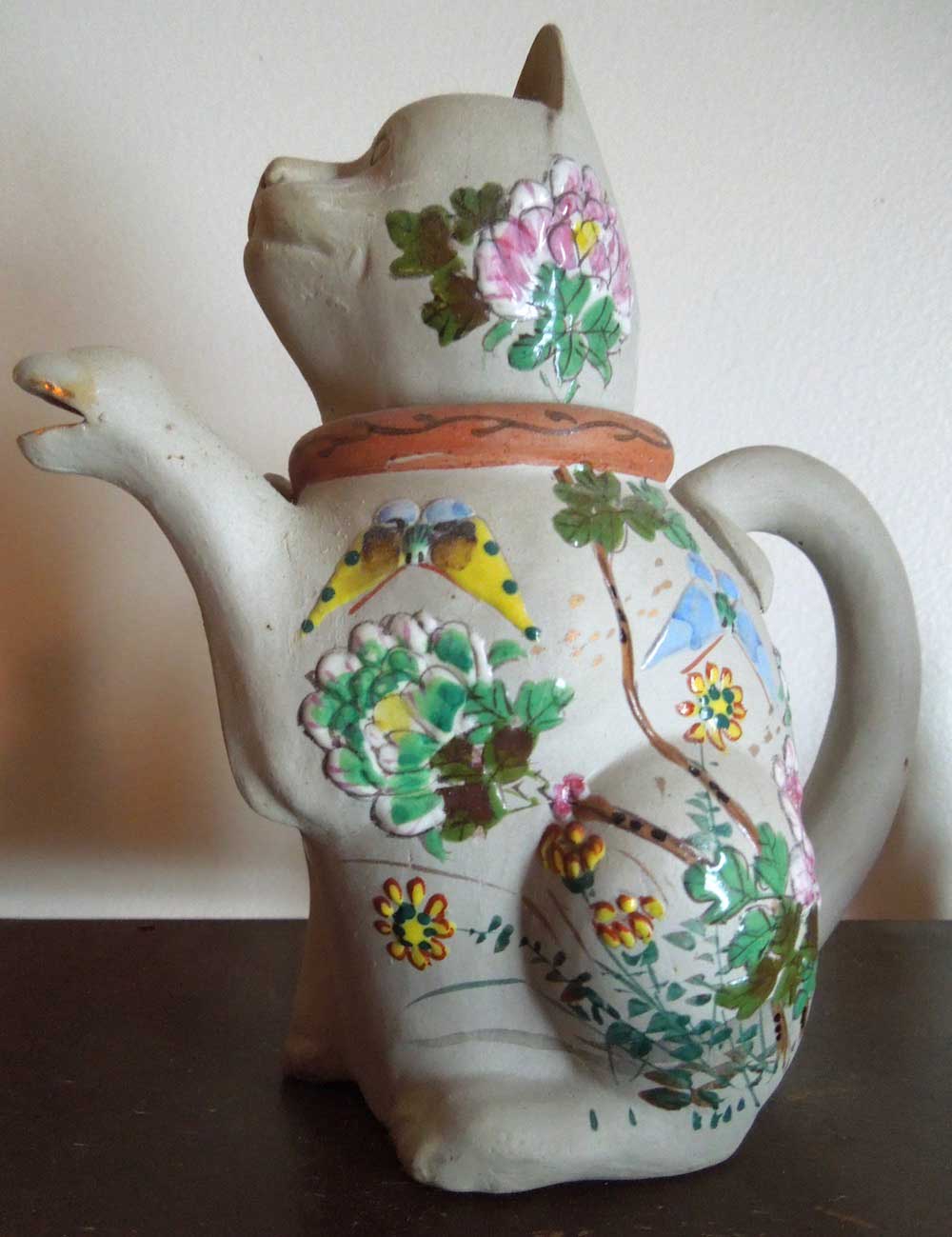
antique Japanese Banko “Beckoning Cat” teapot

Antique Japanese Banko “Beckoning Cat” teapot

I bought this antique Japanese Banko “Beckoning Cat” teapot, made c. 1900, in gray-body clay with enamel floral and butterfly painting, at an antique shop in 2010. In Japanese, the name of this cat form is “Manekineko” – in English, “Lucky Cat.” My research on it found a model in the same decoration in Nancy Schiffer’s Imari, Satsuma, and Other Japanese Export Ceramics, 2nd ed. (Schiffer Publishing, 2000), p. 180. Sandra Andacht’s book Oriental Antiques and Art, gives a verbal description of a similar, perhaps identical teapot. Included also in the collection of the Art Gallery of Greater Victoria (CA) and in the collections of Great Britain’s National Trust. I paid $83 for it. Sources price it in the $300-$400 value range. I have also seen online examples of this Banko teapot style done in the form of a dog and a fox. (Image courtesy of the author)

Score great buys

Still, I manage to score a lot of great buys as a shopper in antique stores from sellers who didn’t have time (perhaps) or inclination (perhaps more often) to learn about what they were selling. I’ve found some real treasures that were marked on tags with the barest information, e.g., “bowl” or “cup” or “vase” -- rudimentary information that would be obvious to shoppers without being told on a tag. What’s important to the buyer is what the seller knows about the item, and the shopper’s hope, if not expectation, is that the seller knows more about the item than what is obvious by looking at it (i.e., it’s a cup or bowl or vase). What is the significance of this particular cup or bowl or vase? Why does it matter? Who made it? When was it made? Buyers hope the dealer will find the answers to these questions and if the seller has to guess, that the guess is a truly informed one.


My advice

My advice to fellow dealers would be to pick one category (maker, shape, color, whatever) in the kind of inventory you like to sell. Then become a self-taught expert in that category. It will take some time because one doesn’t gain expertise overnight. Even if you’re a generalist as a dealer, develop an expertise in at least one area and then make it the majority of your inventory. The more you know about what you sell, the better your reputation, the greater consumer trust in your inventory, and the better equipped you’ll be to price it at an amount that will yield a good profit for you while still letting customers feel, “Hey, that’s a good deal!”


Peggy Whiteneck is a writer, collector, and dealer living in East Randolph, VT. If you would like to suggest a subject that she can address in her column, email her at  allwritealready2000@gmail.com.
Missing the old antiquing haunts

May 2022

Good Eye

Missing the old antiquing haunts

by Peggy Whiteneck

Losing Favorite Antiquing places

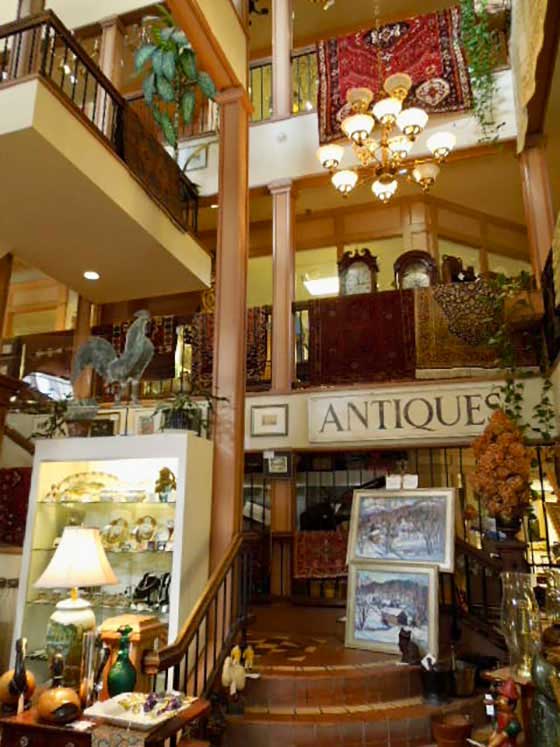
I guess anyone over the age of 30 has had the experience of losing favorite places for antique shopping - you know, the unforgettable places that you loved visiting but that closed down or burned down or were otherwise lost. I’m of an age now where nearly all my favorite antiquing haunts have become … well, haunts.

For my parents and I, our favorite place to shop was the Burlwood Antique Center in Meredith, NH. This three-story mall was unheated and, therefore, closed every fall and opened again every May 1. There were lots of things that made this place special, and although we visited it several times each summer, we never failed to find something to buy.

Opening day at Burlwood, May 1 of every year, was an event! People arrived early to make sure there was still space in the usually adequate parking lot at the side of the great building. On opening day, if you didn’t get there well before the place opened, you’d have to park on the street a mile or more away. You likewise wanted to get there early enough to be among the first in a waiting line that snaked out into the street.

As early as we got there, we never managed to be among the several people in line who got to enter and shop first. My dad was always afraid that everything would be “picked over” by the time our section of the line was allowed to go in, but we never failed to walk out of Burlwood with a haul on opening day.

On our several visits to Burlwood over the summer, my dad practically ran through the place so he could be the first to see whatever it was he thought he was looking for. My mom and I actually looked at the displays and often found what would become some of Dad’s best treasures that he’d missed while breezing through. I remember my mom often calling him back gleefully to show him some item for his collection that he’d passed right by: “Oh, Geo-o-orge!”

“How in hell did I miss that!” he’d ask as my mom and I laughed at his pleasure at now “finding” what he’d missed.

The owners had the best vetting program I’ve ever seen in a multi-dealer shop: no born-yesterday, tacky, cheap junk allowed! Oh, the owners caught heat from some dealers, who kept pushing the boundaries in an effort to get rid of crappier, born-yesterday stuff. But the young couple who owned the place held firm in making them take it out.

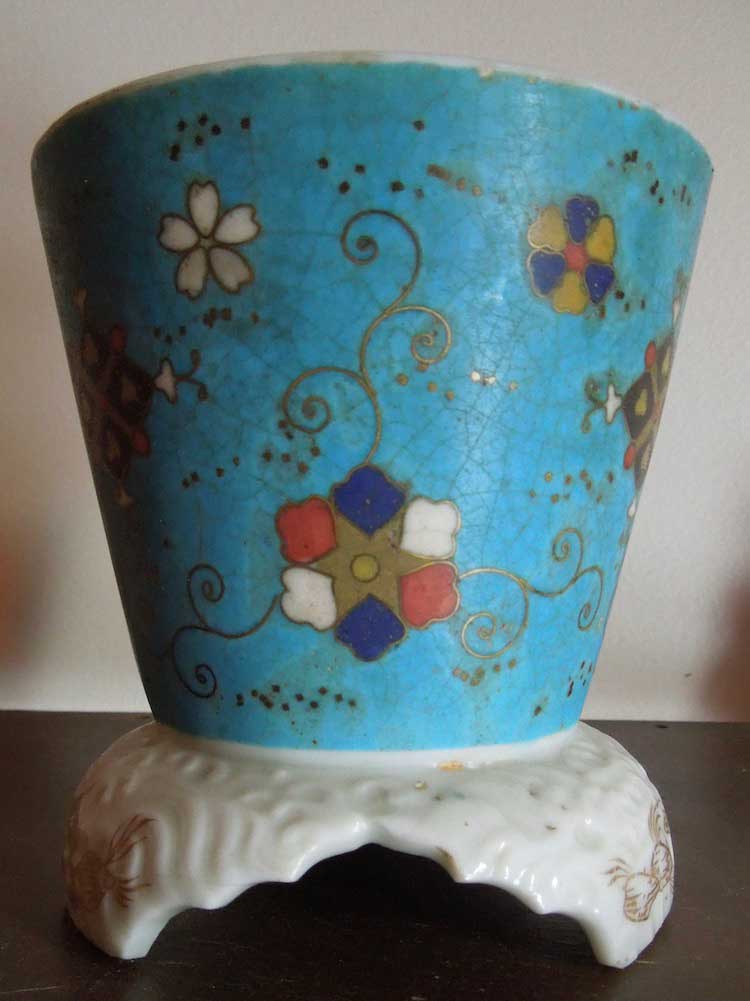
Totai Shippo (cloisonne on porcelain) bonsai pot

Totai Shippo (cloisonne on porcelain) bonsai pot

I remember what floor it was on at Burlwood Antique Center – even where it was in the floor - when I found this Totai Shippo (cloisonne on porcelain) bonsai pot priced at just $10. When I got it home and did the research, I discovered its mark identifies it as the work of Takeuchi Chubei, 19th-century practitioner of Totai Shippo, who also established and worked at a porcelain factory open for only three years (1887-1890). While many Asian character marks are notoriously unreliable, minor flaking and crackling in the turquoise glaze tend to confirm this item’s age. (Image courtesy of the author)


Burlwood had great stuff on all three stories, and some of our best acquisitions were found on the basement floor. Consequently, we never went to Burlwood without visiting all three floors (lack of an elevator be danged!).

In 2008, Burlwood closed for the season with everyone, including the owners, expecting it to open again the following May. How depressing it was to have the owners announce, in spring 2009, that they were closing permanently after exploring the costs of needed improvements to the building and discovering that the expense was just too rich for their resources.


While most of the antique stores, sole or multi-dealer, that my parents and I visited have closed, I remain thankful for an exception close to my home, the Vermont Antique Mall in Quechee, VT, with its hundreds of dealers and two stories, where my late parents and I often shopped and “scored” some wonderful things for our collections. Today, I rent dealer space there myself - though I spend most of my profits shopping there! I’ve also found some great multi-dealer malls in New York State and Ohio while traveling to my annual Fenton Art Glass Collectors of America convention.

Wherever your own favorite antique hangouts are, enjoy them while they last - and I’m sure you’ll also discover, as I have, new haunts along your way.

Peggy Whiteneck is a writer, collector, and dealer living in East Randolph, VT. If you would like to suggest a subject that she can address in her column, email her at  allwritealready2000@gmail.com.
Slag Glass pieces are first class and one of a kind

April 2022

Good Eye

Slag Glass pieces are first class and one of a kind

by Peggy Whiteneck

Slag Glass

One of my favorite decorative glass types is slag glass, made in a number of different colors by a number of 19th- to 20th-century American glassmakers (including Northwood, Imperial, Westmoreland, Akro Agate, and Fenton) and still made by surviving glass companies of the 21st century, such as Boyd, Summit, and Mosser. Among the earliest U.S. producers of slag glass, beginning in the 1860s, were Atterbury & Co. and Challinor, Taylor & Co. England also had a few late 19th-century slag glassmakers, including Sowerby, Greener, and Davidson. The Greener company called its green slag glass “Malachite” after the dark green striated mineral of the same name.

According to the online Glass Encyclopedia (glassencyclopedia.com), slag glass is most commonly found in purple and less often in blue, green, and brown (AKA caramel). This may depend on the section of the country, however, as I see more of the caramel slag where I am in northern New England than I do any of the other colors.

The Corning Museum of Glass (libanswers.cmog.org/faq/143759) has a pretty good theory about the origins of slag glass; it may have been a kind of “end of day” glass in which individual workers were allowed to experiment with leftover colored glass batches to make items of their own. If that was the case, it didn’t take company brass long to see the market potential in producing deliberate recipes of slag glass.

I recently discovered, in an estate sale buy, that Westmoreland, in addition to making slag glass with milk glass, also mixed colored glass with a creamier off-white usually called almond. For example, at a recent local estate sale where I live in Vermont, I purchased a large, perfect-condition hen on nest in which the alternating complement of the caramel is a cream-colored glass, probably almond. Westmoreland often made items in the almond color alone, which is a very light tan color, but in the items in which the lighter non-white color is mixed with caramel, it takes on a deeper, almost golden color.

Westmoreland hen on nest

Westmoreland hen on nest

I recently bought this large Westmoreland hen on nest at an estate sale in a very old farmhouse. It displays well my extensive collection of Hull and McCoy brown drip pottery! It is in perfect condition, without the chips one often finds around the inside of the lid and the inside rim of the base on such items (The line in front of the lid is a seam). Westmoreland made its slag in two forms, one using milk glass as the complement and the other, as here, a creamier color, probably almond. The mark dates from 1940 until the company’s closing in 1984. I paid a very reasonable $20 for it.
(Image courtesy of the author)

Imperial’s caramel-colored slag glass

One of the most prolific makers of slag glass in various colors was Imperial, which made it in purple, green, brown (caramel), and red. My parents had a collection of Imperial’s caramel-colored slag glass that I was only too happy to help them collect over the years as it made great presents from me for special occasions. A crucial information resource on Imperial slag is Volume II of the three-volume book set on Imperial Glass, titled Imperial Glass Encyclopedia by James Measell, an unparalleled expert in many types of collectible glass.

In the 1990s, Fenton had production trouble with a cobalt slag glass it called “Almost Heaven,” in which the blue would not fuse well with the milk glass and usually broke apart in the kiln; those items that made it out were sold in the Fenton Gift Shop.

Some Fenton colors from the 1930s, such as Mandarin Red, Mongolian Green, and Periwinkle Blue also have a slightly “streaky” appearance, but these are not referred to as slag glass in which the alternating white or cream glass is thicker and most clearly its own color. Similarly, Fenton also made, in the 1980s, many items in a glass it called “Blue Marble” (light blue with white streaks) that is not known as slag.

For collectors, an attractive characteristic of slag glass is that every piece made in it, of whatever color, is a “one of a kind” since there is no way to control the amount of streaking nor which of the two colors will predominate in the finished glass. In some cases, the glass is primarily white with just a few streaks of color. In other examples from the same mould, the colored glass will predominate. Collectors tend to prefer specific color mixes, although the comparative scarcity of some of the items made in slag glass may mean buying what color mix you can get!

Peggy Whiteneck is a writer, collector, and dealer living in East Randolph, VT. If you would like to suggest a subject that she can address in her column, email her at  allwritealready2000@gmail.com.
Fire King glass is still king

March 2022

Good Eye

Fire King glass is still king

by Peggy Whiteneck

Fire King

I caught the Fire King bug from my parents, who had one of the largest Jadeite (light green) Fire King collections I’ve ever seen, including rare pieces such as egg cups. That set has come down to my sister and is still center stage in family gatherings. When I started collecting Fire King myself, I decided to concentrate on other options in its line. I now have small sets of Fire King in basic plates, mugs, and bowls in three colors: pink, ivory, and turquoise. I also found a complete set of four nested serving bowls in ivory, which I use often, while my sister has a full set in Jadeite.

Vase from online seller

Fire King sets

Here are two of the items from my own Fire King sets, at left in ivory and at right in turquoise blue. The shapes are pleasingly simple, and the handles on the cups are large enough to accommodate most hands and durable enough to withstand breakage. (Image courtesy of the author)

These lines were called Fire King because the glass is oven safe. Still, I try to avoid putting any of my Fire King pieces in the oven, though I find the mugs and plates especially convenient for microwave heating of cups of coffee and leftover foods.

Perhaps the best known of the Fire King lines is Jadeite, originally made in two different forms for homeware and for restaurant use. The Jadeite color is a deep pastel green color that went well with the kitchen décor of the 1940s and ‘50s. A restaurant version has thicker glass. In the 1990s, the original Fire King Jadeite was re-popularized when Martha Stewart came out with a similar jadeite line, today made by Mosser Glass in Ohio. Suddenly, prices on the original Anchor Hocking jadeite went through the roof: $25 for a mug or a cereal bowl when, just a year earlier, you could find plenty of it on the secondary market for $5 or less per item.

Prices also tend to be high on at least some other Fire King colors, and while prices have moderated somewhat, there is also much less of this glass around today. The least expensive Fire King on the secondary market tends to be the white and iridized peach items. Among my sets, the easiest to find, at least in isolated items, is ivory (sometimes called Clam Broth), with turquoise a bit harder to find, and pink hardest of all (Fire King was actually made in two versions of pink, one with the color flashed over white and the other with the pink actually in the glass itself, which I much prefer but which is very difficult to find). The items that appear most often on the secondary market are mugs and bowls; plates are much harder to find.

  1.  

As durable as Fire King is, it is susceptible to scratching on the interiors if users aren’t reasonably careful with it. Coffee does tend to stain the rims after multiple washings, but I find this is easily removed with a bit of moistened baking soda.

All the original Anchor Hocking glass is emboss-marked on the bottom “Fire King Oven Ware,” which means it can be readily identified on the secondary market and distinguished from newer Martha Stewart glass. I find the glass in my mugs holds the heat better in my morning coffee than any pottery or ceramic mug I’ve ever used. The handles on the mugs are large enough to accommodate hands of various sizes, and the cereal bowls have a pleasing round shape that just seems ideal for holding everything from cereal to chowder to ice cream. The Fire King style fits easily not only into a vintage kitchen décor but also into the modernist look preferred by some younger collectors.

When shopping for this glass, watch for scratching on the inside surfaces, and hold out for pristine examples; Fire King is rugged, but it won’t stand up to abuse such as scouring with metal scrubbers or use as a substitute flowerpot.

Otherwise, if you’re looking for a kitchen and table collectible you can actually use, you could do a lot worse than Fire King glassware!

Peggy Whiteneck is a writer, collector, and dealer living in East Randolph, VT. If you would like to suggest a subject that she can address in her column, email her at  allwritealready2000@gmail.com.