
Antique Advertising

December 2022

Good Eye

Antique Advertising

by Peggy Whiteneck

Old advertising items

Old advertising items can be a fun and affordable collecting gig, and there are many useful and interesting ways to enjoy them! The graphics are often colorful and the taglines are catchy.

Back in the days when books on collecting interests were being produced in greater numbers than they are today, there were collecting guides on advertising collectibles featuring everything from Cracker Jacks to automobiles. These can still be purchased on eBay and other online sites.

Wooden Boxes

Among the most functional old advertising collectibles are the wooden boxes that were used to transport vegetables, produce, and other consumables in the age before cardboard. Advertising for the inside product was often papered or painted on the wooden box ends. These boxes can be very functional for modern use as containers for cookbooks and other hard-to-contain household items. Crates with original labels still attached, and with both wood and label in fine condition, can be surprisingly expensive, probably due to their relative scarcity as items that were purely functional at their inception and not necessarily intended to last.

Cans and Can Labels

Years ago, in my favorite antique shop haunts in Vermont, I found a dealer who had happened upon a stash of what’s called “new old stock” consisting of original but never used paper labels for canned fruits and vegetables. These dated from the very late 19th and early 20th centuries. They were exceptionally colorful and detailed. I bought several of them that I still use to decorate the walls of my kitchen (A caution for serious collectors: original advertising labels, such as those this dealer was offering, have solid color; modern reprints feature telltale dot-matrix printing that is easily detected under a magnifying glass).

Many of these labels were produced by Olney & Floyd, which, before it morphed into its current identity as G.J. Olney Machinery (still family-owned by the third generation of Olneys), was a vegetable canning factory started by George F. Olney and C. Frank Floyd. The oldest of their canning labels date from the 1880s. By 1915, though, Olney & Floyd was already focusing, as it does today, pretty much exclusively on producing food processing machines. This makes the original labels from the early years of the company antique by any definition.

Metal Signs

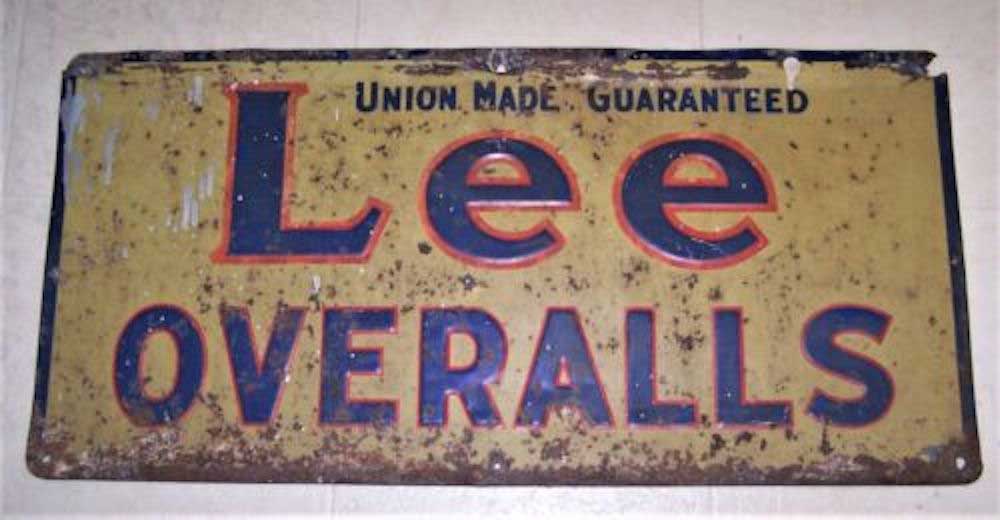
Old metal advertising signs can also be found in antique shops. Collectors look for signs in good condition without serious paint damage. These can range from relatively small to signs that were large enough to be posted outside buildings, such as signs for automotive products made for use in commercial garages or signs for soda brands made to post outside general stores. As with paper labels, these have been widely reproduced, especially signs advertising Coca-Cola, so look for metal signs with signs of wear (which can also be produced by artificial stressing) such as rusting and other markers around fastening corners. Prices on these range from modest to close to outrageous. 

Kitchen Ceramics

The Pillsbury Co. was especially successful in getting its name before the public not only in baking products but in a series of ceramic kitchen sets featuring items such as cookie Jars, napkin holders, utensil holders, and salt and pepper shakers. These were made in two or three series, the most desirable to collectors being the first in 1988; these were actually marked on the base with the year of production. Later versions show design changes over time, ranging from slight to marked. All these official Doughboy issues had the name Pillsbury in a blue logo on the front of the chef’s hat’s rim. Even before that, Pillsbury made a Doughboy bank marked 1985 on the base and, in 1972 and 1973, a family of Doughboy toys in vinyl. Later versions of these vinyl dolls were also made, again with various design changes. All the Pillsbury Doughboy items are very affordably priced on the secondary market.

metal sign for Lee Jeans

Metal sign for Lee Jeans

A metal sign for Lee Jeans from the 1930s and taken from a building and measuring 11 3/8” X 23 ¾” sold on eBay in early November of this year. The seller wasn’t pulling any punches on its condition: ”Lots of Wear from over the years, Minor Bends, Surface Rust Thru-out, Some Old Paint Spatter & Drips and it is Filthy Dirty.” The hyper-honest description didn’t deter bidders: the item sold for $390 in a bidding war involving 57 bids! (Image courtesy of eBay)

Peggy Whiteneck is a writer, collector, and dealer living in East Randolph, VT. If you would like to suggest a subject that she can address in her column, email her at  allwritealready2000@gmail.com.
Collectibles Commemorating British Royalty

November 2022

Good Eye

Collectibles Commemorating British Royalty

by Peggy Whiteneck

The year 2022 was the 70th anniversary of the coronation of Queen Elizabeth II, who was still mentally robust but, at age 96, physically frail in the few photos taken of her this year. As it turned out, and as so often happens with close couples, she also died that same year, after losing her husband, Prince Philip, the year before. Not many have lived, as they did, to celebrate 74 years of marriage!

Elizabeth reigned for 70 years, nearly the lifetime of many Discover Vintage America readers, including me! That made her the longest reigning monarch in British history. As we know, those seven decades were tumultuous, not just in terms of what was happening in the world in general (first hydrogen bomb test, discovery of DNA, the Berlin Wall, etc.) but also within the royal family itself (divorce, tragedy, castle fire, etc.). Amid all the controversies, consternations, and calamities that would befall her family during her reign, Queen Elizabeth kept her royal counsel and her self-possession. Her unflappability, not to be confused for a moment with a lack of feeling, appears to have been part of what endeared her to so many of her countrymen: she was an emblem of stability even amidst unstable times.


Queen Elizabeth II

Queen Elizabeth’s photo on memorabilia

Queen Elizabeth’s photo can be found on everything from tree ornaments to fridge magnets. This photo was taken not long before her death. She famously owned and loved horses and Corgi dogs. Image courtesy of Henry Ballal/Twitter

Royal Collectibles

Collectibles devoted to British royalty have long graced the antique trade. In fact, Queen Victoria and her lifelong devotion to her deceased husband, Prince Albert, whose life departed from hers after 21 years of marriage, inspired an entire era in the latter 19th century that was named after her. Victoria had one of England’s longest reigns, although, at 63 years, still short of Elizabeth’s. Examples of Victoriana can still be found in the antique trade, ranging from china to furniture. Victorian furniture even has a distinct look, heavy and made of dark wood and wood stains, that seems to reflect Victoria’s grief.

Among the commemorative items most found in antique stores are plates and mugs celebrating coronations, marriages, and royal births. Somewhat less often seen are pieces of commemorative silverware. There is also a collecting market for images of British kings and queens adorning coins minted in the era in which they reigned. Then, of course, there is the ephemera related to royals, from photographs to autographs. Due in no small part to both her glamor and her early demise, Princess Diana commemoratives are especially popular.

Because Elizabeth is the only British monarch to have reached the milestone of a Platinum Jubilee on the throne, collectibles related to that milestone are expected to increase in value. Second to her image in future value are collectibles celebrating the marriage of Prince Charles (now King Charles III) and the late Princess Diana. Biscuit tins, however, are common and not terribly valuable, though they could still be an interesting collectible for those more interested in what they commemorate than what they cost (https://www.hobbsonlinenews.net/most-demand-royal-memorabilia/).


Even Stamps!

Queen Victoria’s son was the first royal known to have collected stamps. The collection came down through Victoria’s heirs, who were often indifferent to it, until it reached King George V, who was quite passionate about adding to it. Eventually, the collection was bequeathed to our own Queen Elizabeth, who made occasional gifts from it to other prominent philatelists. But even with such departures, the Royal Philatelic Collection remains the largest single collection of stamps from Great Britain and the Commonwealth (https://www.catawiki.com/en/stories/4083-celebrity-collections-queen-elizabeth-and-her-passion-for-stamps).

Unusual Collectibles

Some royal collectibles can be unusual. A bicycle owned by Princess Diana when she was still Lady Di, before her marriage to Charles, sold in 2018 for 10,400 pounds ($11,500 in U.S. dollars) - and a pair of bloomers attributed to Queen Victoria sold for 12,000 pounds ($13,300) in 2012 (Not sure how a collector would display a pair of royal bloomers for which the buyer had paid that much, but “whatever!”). Despite these singular items, royal memorabilia celebrating coronations and jubilees remains both available and (mostly!) still affordable.


Peggy Whiteneck is a writer, collector, and dealer living in East Randolph, VT. If you would like to suggest a subject that she can address in her column, email her at  allwritealready2000@gmail.com.
Adventures in antique selling

October 2022

Good Eye

Adventures in antique selling

by Peggy Whiteneck

She was not your typical buyer. She looked more like my inner stereotype of a “biker chick” in her leather jacket, boots, and dark makeup. I had my doubts that she’d be a paying customer when she came into the Antiques Collaborative, where I was temporarily working as a desk manager and cashier while the owners, Bill and Isabel Bradley (featured in my last month’s article), were away attending a family wedding in Isabel’s homeland, Great Britain.

The young woman – let’s call her Sally - seemed scattered and unfocused. Adding to the impression she gave of flightiness were the number of pieces she wanted me to call the dealer and “make an offer” on. But I made it a point to be courteous and friendly to her as I and the other staffer opened cases for her to inspect merchandise.

The offers weren’t a small annoyance; as we neared closing time, a couple of other customers heard her making offers and saw me and my fellow staffer making phone calls to dealers. So they decided they’d like to make offers, too (In those cases, we could not reach the dealer, and the customers bought the items anyway). 

Fenton Wild Rose Wheat Vase

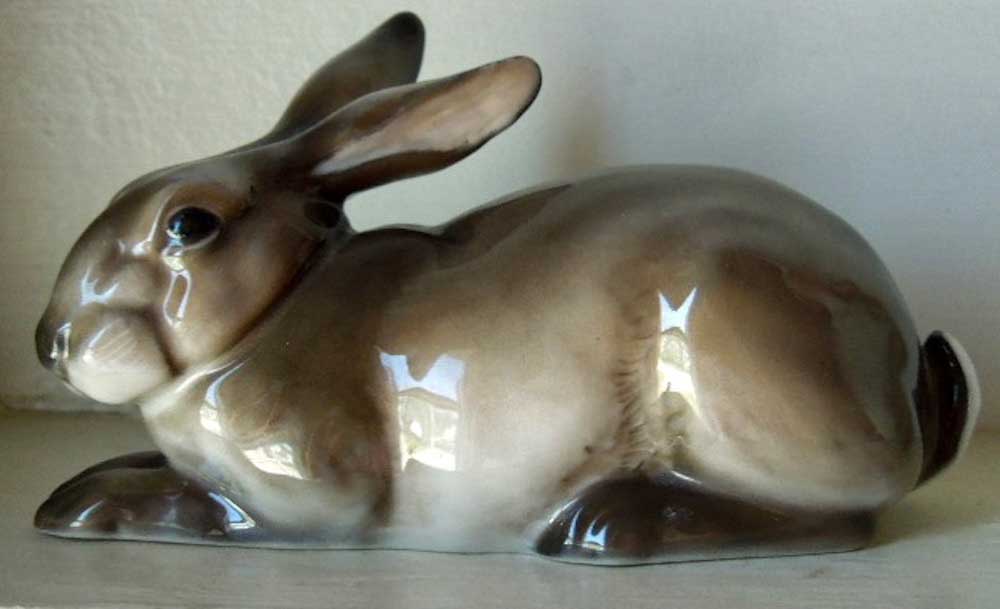
Rosenthal bunny

I bought this Rosenthal bunny, #H252 modeled by E. Karl Himmelstoss around 1940, for a very affordable $30 when I was working at the Collab this month. The dealer from whose case I bought it had many high-quality, modestly priced items interspersed with his high-ticket items. This consistent quality within broad appeal may have much to do with his month-to-month status as one of the Collab’s top sellers. (Image courtesy of the author)


Meanwhile, Sally left the building to chat with her husband, a few times and for lengthy periods, about the things she was considering buying. Once or twice, she seemed to disappear altogether from the parking lot! We had just about decided that she’d left without buying anything at all when she finally returned with her husband and his checkbook – and bought just under $2,000 worth of items! For me, the experience was a lesson in not making assumptions about other people based on their appearance or behavioral quirks.


Younger Buyers

I also learned a few other things about the state of the trade while I was there running the shop for a few days. While the visitors were mostly lookers and “tire kickers,” there were quite a few young buyers, a trend that has recently been remarked upon in the trade journals. In fact, the two four-figure sales I made, the one just mentioned and one other, by a couple with an infant and a five-year-old in tow, were both to couples in their 20s to early 30s. There didn’t seem to be a pattern to what they were buying, which was pretty eclectic; if they liked it, they bought it.


Merchandise Vetting Matters

I made it a point to greet everyone who came through the door, to welcome them, and to ask if they’d ever been in before so that I could direct their traffic to all three floors if they were first-timers. And, as it turned out, more than half of them were new to the shop.

I also made it a point to say a cordial goodbye and thanks to browsers as they left, and several told me, in commenting on the merchandise, how much they appreciated seeing an antique shop that actually is one. They said they’d never seen anything like it for the age and quality of the offerings. This is consistent with my own shopping experience, where the majority of antique shops I’ve visited are actually not much above an old-time second-hand shop, where “antique” just means more than five years old. (I’ve written at length on this topic in other articles for this column, so I won’t beat the hobby horse to death again now!)


Fewer Dealers, More Consignors

There were fewer dealers and more consignors at the shop as the Bradleys continue fighting to maintain the quality of what the shop offers. This also means that good quality smalls were also more affordable than I remember them from when I first worked full-time at the Antiques Collaborative many years ago.

All things considered, it was a great experience to be back in the Collab again – even just for a limited time only…now that I’m retired!


Peggy Whiteneck is a writer, collector, and dealer living in East Randolph, VT. If you would like to suggest a subject that she can address in her column, email her at  allwritealready2000@gmail.com.

Back at work again!

September 2022

Good Eye

Back at work again!

by Peggy Whiteneck

Years ago - actually, more years than I can count! - I worked at the Antiques Collaborative, off Exit 1 of I-89 on Route 4 in Quechee, VT, as the front desk manager. That high-end business www.antiquescollaborative.com/catalog is still owned by the couple I worked for then, Bill and Isabel Bradley. Having myself reached the post-retirement age of 71, it was my pleasure to make myself available in late August this year to run the multi-dealer shop, widely and affectionately known as “the Collab,” while Bill and Isabel take a much-deserved vacation.

What makes this shop unique among all those I have visited in my career as a collector is the age and quality of the merchandise. Much of the inventory in the three-story mall, artfully renovated from an old farmhouse, is genuinely antique (as in, past the 100-year mark) from the 18th through the 20th centuries. Bill himself specializes in merchandise made of pure silver, but other dealers feature furniture, glass, old books, and almost anything else of fine quality that may come to mind. While the inventory is deeper and there seems much more of it than I remember from my earlier days at the Collab, it still manages to be artfully displayed, avoiding the “tossed in” effect of so many multi-dealer displays in other shops.

For years, the Antiques Collaborative has done a healthy business in fine paintings by name New England artists, the most famous of which sell quickly. Bill and Isabel also feature high-end Native American pottery and artifacts as well as a collection of fine Oriental rugs, historically a big seller for the business.

Bill reports that one of the changes in inventory is the increased percentage of consignment merchandise at the shop; there aren’t as many dealers buying and selling directly. Since he and Isabel vet all the merchandise, the quality remains high whether consigned or brought in by dealers for their own displays. I did notice that on small items such as jewelry, many prices were more affordable than I remember from when I first worked there. Famous names and high-end stuff (e.g., Georg Jensen silver jewelry) still command the premium, but there’s plenty of quality stuff there also for those focused on affordability.

Fenton Wild Rose Wheat Vase

The Antiques Collaborative,

The three-story entryway of the Antiques Collaborative,
artfully renovated from an old farm house and barn to show off the quality inventory of this business.
(Image courtesy of the author)

COVID Impact

Like most Vermont businesses, the Collab was shut down from mid-March through latter May in 2020 as COVID struck. Bill still went to the shop nearly every day, making Facebook posts on the shop’s inventory and conducting web sales. The shop was open to one occasional customer at a time and did some curbside business as well, but Bill reports the volume was nowhere close to keeping the business afloat. Government COVID subsidies helped keep it going.

Remarkably, the business didn’t lose dealers during the shutdown despite the quietest two months of the year. Now, two years later, a larger percentage of the business income is from consignments rather than dealer rental spaces.

Thanks to the state’s handling of the pandemic, Vermont had the lowest COVID rate in the country, and Bill reports that, when the doors reopened, customers “came flocking in.” The Bradleys have noted a change in the customer base since I first worked there.


Even as older customers have been “downsizing,” younger customers have become the mainstay of the business as they are buying and redecorating new homes. These younger collectors “aren’t as concerned or knowledgeable about history,” Bill reports. “They’re more interested in practical, rugged, functional pieces such as harvest tables and repurposed dry sinks. They’re looking for lighter-color woods and are less put off by renovated pieces.”

Business at the Collab has slowed a bit as people freed from pandemic restrictions are now more interested in traveling vs. buying stuff for the home. The business has fewer floor staff than it used to have. But the business remains healthy – and it’s a great place to visit if you’re ever in town.

Peggy Whiteneck is a writer, collector, and dealer living in East Randolph, VT. If you would like to suggest a subject that she can address in her column, email her at  allwritealready2000@gmail.com.
What’s hot in antiques and collectibles for 2022?

August 2022

Good Eye

What’s hot in antiques and collectibles for 2022?

by Peggy Whiteneck

What's new and what's not

Each year, my column revisits this theme for any changes from prior year in the popularity of various antiques and collectibles. There were some surprises in trends for 2021-2022 over those for 2019-2020, but perhaps most surprising were categories unchanged by the pandemic.

Furniture, for instance, from Art Deco to Mid-Century Modern, has remained a popular seller across buyer age groups although it would seem to involve buyer pickup rather than shipping.

For 2021, I want to cite again the listing by the Asheford Institute of Antiques (www.asheford.com/2021-survey-results.html), which breaks down nationwide popular buying trends by three age groups, 20-40, 30-60, and 60-80. Although the survey notes that some categories may have experienced a drop in buying popularity as a result of the pandemic, Mid-Century Modern furniture still remained popular across all three age groups, despite the pandemic and despite predictions of a waning interest.

Costume jewelry was popular among the youngest two groups, whereas Art Deco was sought after by the older two groups. Youngest buyers shared with the oldest group an interest in lighting items. Other categories of collectible were more age-dependent.

Youngest buyers liked outer space collectibles, toys (especially toy cars and vintage board games), kitchen and barware, and “the 1970s” (especially furniture). The 40-60 age group liked antique and vintage watches, ephemera, Victoriana, paintings and sculpture, automobilia and petrolina, and glass (i.e., art glass and milk glass). It shared with the older age group an attraction to Victorian furniture as a particular opportunity for cash-strapped buyers. Also attractive for the oldest age group were vintage outdoor furniture, Georgian style furniture, Chinese antiques, lighting, Victorian paintings, Art Nouveau, and silver (especially flatware and belt buckles).

Fenton Wild Rose Wheat Vase

Fenton Wheat Vase in a deep Wild Rose

Name-maker costume jewelry remained popular in 2022 as it had in 2021. Shown here, a bracelet with emerald rhinestones and faux green-striated agate marked WEISS on the clasp. Caution: Weiss and other name costume jewelers have been subject to counterfeiting. Modern costume jewelry, including fakes attributed to famous makers, will have a textured back; authentic items will generally have flat, smooth backs. Image courtesy of the author

In other sources, sales reports depended on types of inventory particular shops offer. According to Sandy Erdman, columnist for the online Post Bulletin in Minnesota (www.postbulletin.com/lifestyle/what-was-hot-in-2021-should-remain-hot-in-2022), “farmhouse style” is especially popular in the Midwest. The following categories were also popular with her readers: automobile and petrol-related items, vintage Pyrex, farm and other toys from the ‘80s, older advertising pieces, cast iron pans and toys, stoneware crocks, vinyl records, camping and hunting items, fishing-related items, vintage clothing, and Fenton Art Glass.

Terry Kovel's take

No consideration of recent trends in sales would be complete without reference to Terry Kovel. On her website (www.kovels.com), she notes what’s hot in antiques and collectibles for 2022, some of which echoes the Asheford survey but others of which are unique to her (probably because her list is more item-specific):
• Copper pots and pans
• Modern copper jewelry
• Name-brand costume jewelry
• Very early Meissen porcelain
• Anything by Georg Jensen (silver), L. C. Tiffany (glass, metal, lamps, jewelry), and Georg Ohr (pottery)
• Photographs by name artists like Edward S. Curtis (1868-1952) and Ansel Adams (1902-1984
• Neon signs
• Early American blown glass flasks
• Fashion handbags by Chanel, Judith Lieber, Hermès, etc.
• Pedal cars
• 1930s oak furniture (for repainting!)


Some of the categories that appeal especially to younger collectors aren’t mentioned on these other websites, illustrating that “what’s hot” is a judgment that depends on the inventory of the evaluators as well as their shops’ position in the national geography.

For the younger collectors

According to the American Collectors Community website (www.americancollectors.com), what’s hot among the youngest collectors includes coins and currencies, stamps, and sports cards. It’s interesting to note how consistently popular these have been, across generations, with younger collectors.According to the website Adirondack Girl at Heart (www.adirondackgirlatheart.com), the top trends include practical items that can actually be used by the buyer and not just displayed:
• ironstone
• costume jewelry
• baskets
• canning jars
• tools
• farmhouse style furniture
• leather books
• flower frogs
• toothpick holders
• old luggage
• Christmas decorations
• Pyrex
• cookbooks

This particular list is focused on practical household use, as would be consistent with the cultural impact of having lived for two years with a COVID epidemic that kept so many of us restricted to our homes. We’ll have to see how 2023, with its own challenges, shakes out.


Peggy Whiteneck is a writer, collector, and dealer living in East Randolph, VT. If you would like to suggest a subject that she can address in her column, email her at  allwritealready2000@gmail.com.