These are the days for online sales

February 2022

Good Eye

These are the days for online sales

by Peggy Whiteneck

Online auctions

As COVID-19 continues to rock our regular world, adaptive changes are becoming more common – including in the world of antiques and collectibles. Online auctions can compensate for the loss of sales opportunities on the ground, whether that loss is due to closure (temporary or otherwise) of live venues or the loss of customers who are choosing to stay home rather than risk infection. Here, for example, is a list of some of the Facebook groups offering auctions and straight sales:

  • Antiques and Collectibles for Sale (482,000 members)
  • Antiques and Collectibles for Sale or Wanted (31,000 members)
  • Fenton Art Glass (several sales groups with several thousands of members)
  • Mid-Century Modern Furniture for Sale (25,000 members)
  • Vintage Clothing and Accessories (24,000 members)
  • Antique and Vintage Silver for Sale (4,700 members)
  • Vintage Clothing and Accessories (24,100 members)
  • The Vintage Marketplace (34,400 members)
  • Cast Iron Cookware Buy-Sell-Trade (29,000 members)
  • Buy and Sell Vintage Toys (15,600 members)
  • Vintage Sterling Silver Gems (Buy, Sell, and Trades) (6,700 members)
Vase from online seller

Online auction seller

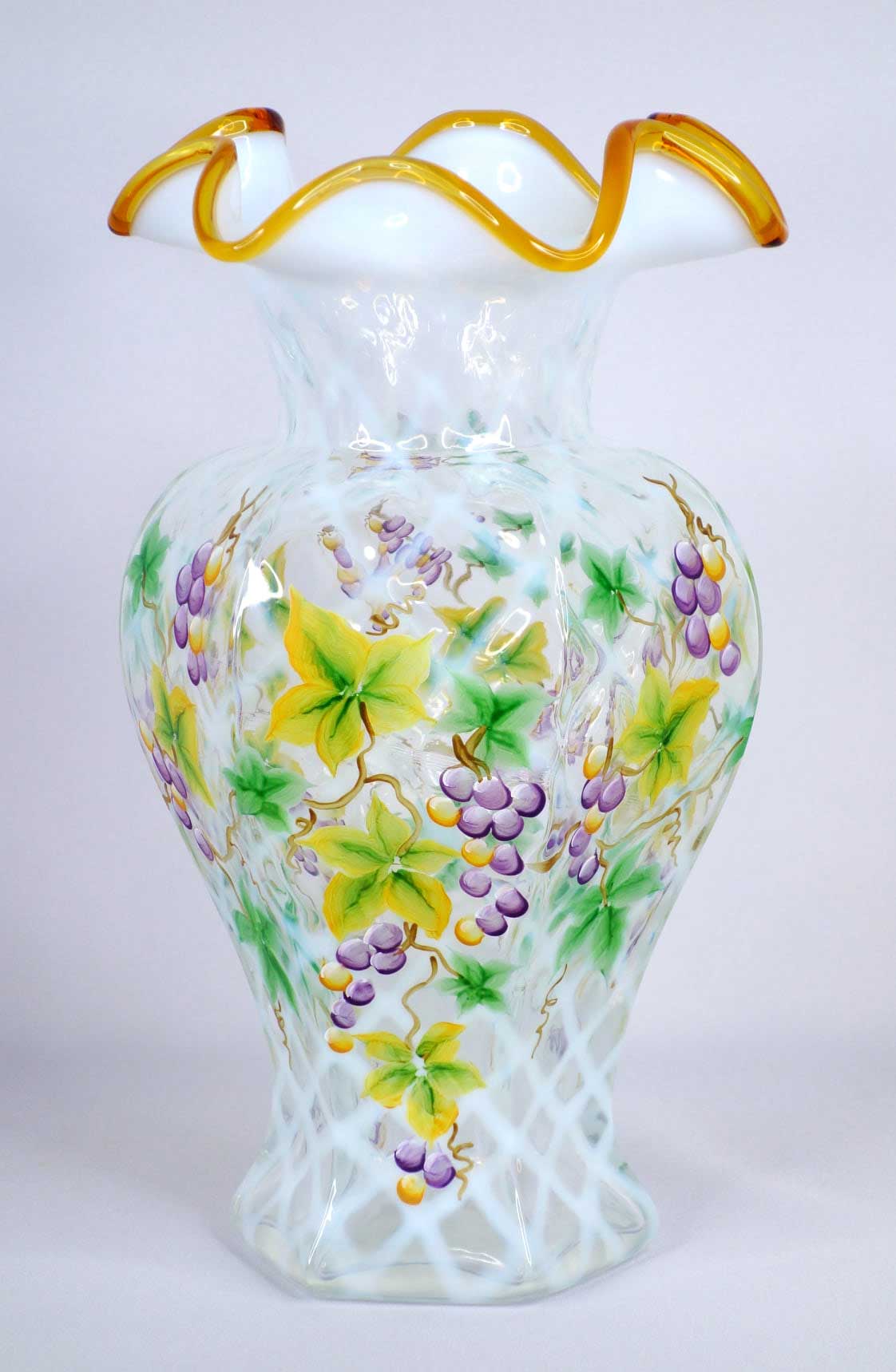
From an online auction seller whom I trusted to pack it well, I purchased this Fenton Diamond Optic French Opalescent vase with a gold crest and colorful grape vine painted by noted Fenton artist CC Hardman. It’s believed to be one of a kind. (Image courtesy of the author)

Quickly researched sample list of sales and buying opportunities on Facebook

This is just a quickly researched sample list of online sales and buying opportunities on Facebook. In fact, there’s probably a Facebook sales group for anything you collect or sell. And, of course, there’s always eBay.

Taking advantage of these opportunities can be both fun and frustrating. Here are some of the things to watch for.


    1. Reputation of the Seller. When dealing with mailed sales from any of these groups, you’ll want to be sure you can trust the seller to deliver your purchased item as described and as mailed to arrive in one piece. I’m a member of two of the Fenton Facebook groups, but of the hundreds of sellers in these groups, there are three that I know I can trust to pack items safely for mailing. Online interest groups often have heart-rending posts from buyers about items that arrived unsafely packaged and in smithereens. For eBay sellers, there is also a system for buyers to rate a seller, and the reputation is worth paying attention to before buying.
    2.  

    3.  Accurate Item Description. Just as with dealers in antiques and collectibles on the ground, there is a range of seller expertise on any given item from professional to rank amateur. And just as with live sales, there are varying levels of seller interest in describing their items accurately. Applying maker names to items that aren’t is a common problem, so buyers need to be on their guard.
  1. Shipping Cost. If you’re not picking up the item yourself, you’ll need to be mindful of this often “hidden” cost. The few sellers from whom I buy all have reasonable shipping costs. Mind the size and weight: too big or heavy may be better bought or picked up at an in-person venue.
  2.  

  3.  Making Sure Your Computer Can Handle the Load. Sellers and buyers both need to be sure their equipment can handle clear images of items being sold. They also need to be sure they can stay online for auction bidding and not get kicked off because their hard- or software is too outdated to handle the job.
  4.  

  5. Time Limits on Facebook Auctions. Having to reboot an auction and getting all bidders back online again is a lengthy hassle for a seller. Don’t waste time with small talk about your pets and the weather. Find out as much as you can about the items you’re selling and talk about that.
  6.  

  7. Asking Questions. If the seller doesn’t offer enough of a description for you to buy or make an informed bid, ask questions. Is the item marked and how? What is the actual color? (Photos can be misleading.) In an online auction, it is usually possible to post questions even amid brisk bidding. The best eBay posts include multiple photos, including the mark, which tends to change over time and can often be used to date items, at least within a range of years.​

Peggy Whiteneck is a writer, collector, and dealer living in East Randolph, VT. If you would like to suggest a subject that she can address in her column, email her at  allwritealready2000@gmail.com.

Challenges in writing books on antiques and collectibles

January 2022

Good Eye

Challenges in writing books on antiques and collectibles

by Peggy Whiteneck 

Three books in print

Currently, I have three books in print, one on Lladró Spanish porcelain and two on Fenton Art Glass.

Publishers were keenly interested in my first Lladró book proposal because Lladró was very popular among collectors in the 1990s and early 2000s. I went with Krause Publications, then one of the big names in publishing on antiques and collectibles (It later became F&W Publications before going bankrupt and being bought out by Penguin Random House in 2001).

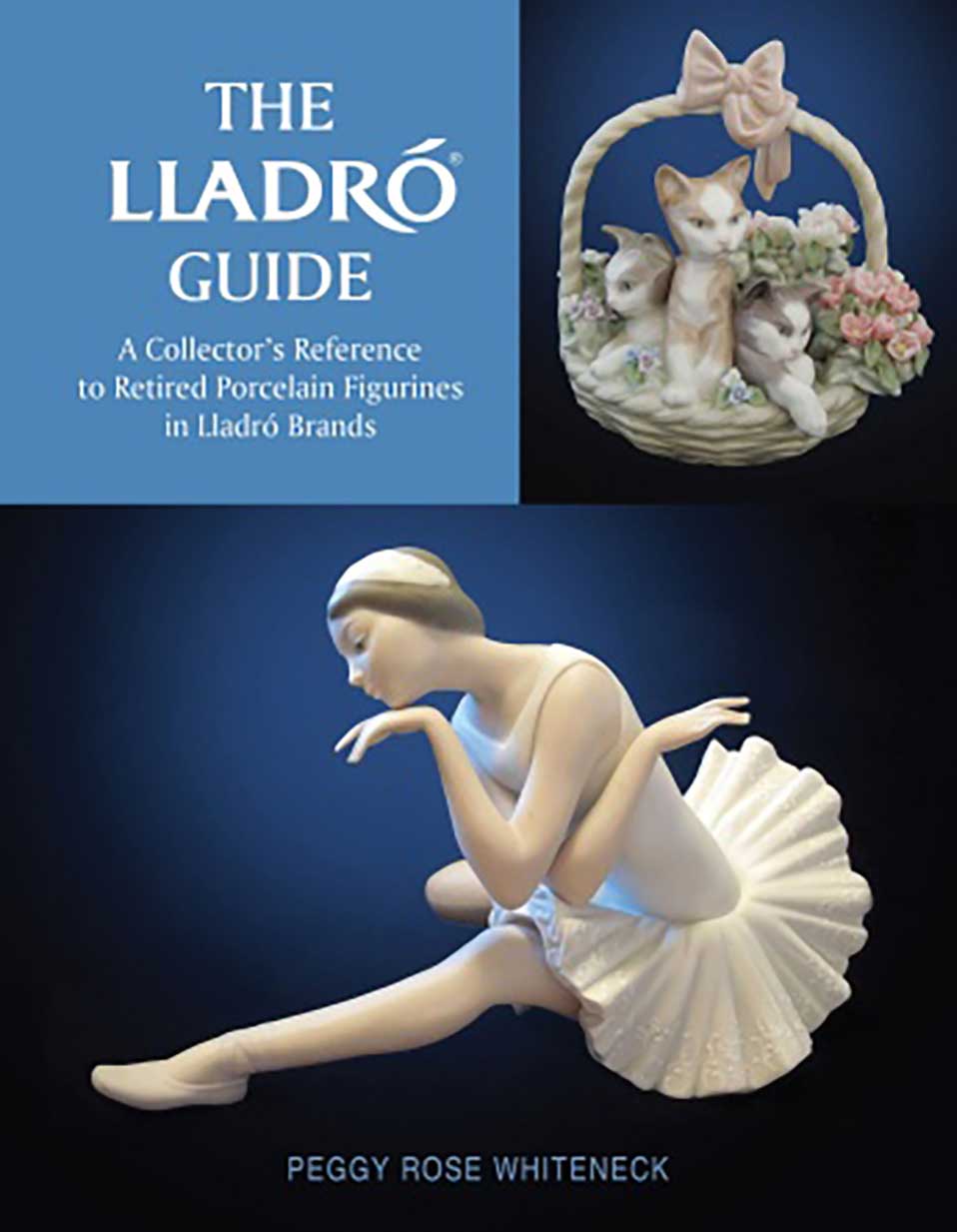
I was limited in what I could write, by that publisher’s infatuation with the “price guide” format in its books and by the Lladró company’s initial resistance to having my book include any of its brands other than the core collection. Not until my current book, brought out by Schiffer Publishing in December 2019, The Lladró Guide; A Collector’s Reference to Retired Porcelain Figurines in Lladró Brands, could I write the book I wanted.

The first publisher, in 2012, for my two Fenton Art Glass books (one on animal, bird, and insect figurines and the other on fairy lights) was Old Line Publishing, which later went out of business. In 2020, I was contacted out of the blue by Lemur Press, which was interested in reissuing these books. That relationship has been both rewarding and challenging, as this start-up publisher could not print revised editions but only reproduce the originals under its own imprint. While I had trouble promoting the books in their original publication back in 2012, sales of the Lemur printings with the same content have been brisk as the collecting market in Fenton glass has heated up.


My latest hard-cover book on Lladró

My latest hard-cover book on Lladró

My latest hard-cover book on Lladró, The Lladró Guide; A Collector’s Reference to Retired Porcelain Figurines in Lladró Brands, Schiffer Publications, 2019, is available on Amazon or directly from the publisher. (Image courtesy of the author)

What’s involved in publishing

Getting a book published in antiques and collectibles poses many challenges, not the least of which is the contraction (fewer publishers) in the publishing field. Here’s what I learned about the steps in the process.

Finding a publisher. How broad is the interest in the field you want to write about? What kind of/how broad of a reputation does the writer have among other collectors? How strong is the publisher’s business? That is, is it a startup, or does it have a reputation based on many years in business?

Reviewing the contract. What percentage of the total cost of book sales is reserved to the author? (10% is about standard for this). Most publishers will be open to negotiating some aspects of the contract. For example, who retains the rights to the work? As a writer who wants to be published, I nevertheless have a nonnegotiable bottom line: I avoid contracts that do not leave with me, as the author, the basic rights to the work.

Doing my own editing

In the “olden days,” one could count on an editor in the publishing company to review the work and make suggestions for changes or to correct obvious errors in spelling, grammar, punctuation, and sentence structure. Today, one has to be able to edit and proofread one’s own work as modern publishers are much busier and their editors typically don’t provide extensive copy review.

Being prepared for delays in publication

For each of my recent books, considerable time elapsed from my submission of the manuscript to actual publication. In between, there were various proofs (of the cover design and contents) for the author to review. In the case of the Lladró book, since Schiffer is a big company with many books in process at any given time, it took about a year and a half from my submission of the manuscript to its actual release as a book! The delay was particularly costly because the actual publication date, December 2019, coincided with the beginning of the COVID epidemic – which meant no book shows or signings. I’ve had to get creative in promoting the book online. Lucky for me, I love to write and am willing to put up with complexity in bringing my work into the world!

Peggy Whiteneck is a writer, collector, and dealer living in East Randolph, VT. If you would like to suggest a subject that she can address in her column, email her at  allwritealready2000@gmail.com.

Dealing in miniatures and other smalls

December 2021

Good Eye

Dealing in miniatures and other smalls

by Peggy Whiteneck 

Small and Miniature items

Recently, I’ve begun to face what every dealer or collector eventually must: an ever-growing collection of acquisitions with limited display or storage space. Still, if you’re a collector-dealer like me, you’ll probably be able to relate: the lack of space doesn’t seem to prevent us from acquiring the next great item we see! To address limitations in display space, I’ve recently come upon a strategy, for gift-giving for my sisters with their own space challenges as well as for myself, of purchasing small and miniature items that can fit in just about anywhere.

The challenge is collecting worthwhile smalls while avoiding dime store, no-name riffraff, so I’ve made it my business to develop a trained eye for quality in small details. If it isn’t marked or I suspect I won’t be able to find it identified in my several books on antiques and collectibles, I don’t buy it.


Miniatures for Christmas presents

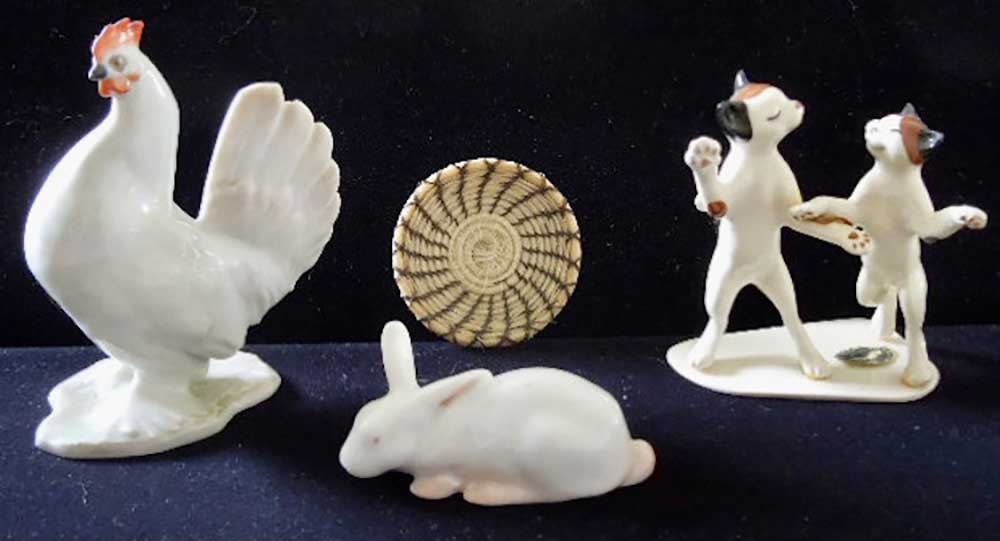
Clockwise from left, a Rosenthal porcelain rooster (2.5” tall); an unusual example of Native American, probably Papago, basketry woven from horsehair (1.5” diameter); Hagen Renaker miniature dancing cats (2.5” tall, in production late 1999-2007 and hard to find in undamaged condition); and a Bing & Grondahl rabbit #1874 (2.25” long, with mark from 1970-1983). Prices on such miniatures can range broadly from $10-$20 for the Hagen-Renaker example here to about $50 for the B&G rabbit and Rosenthal Hen (which also has a matching rooster I haven’t found yet). Tiny baskets woven of horsehair can be priced even higher, some of them with varied designs produced by various colors of horsehair. A similar, more common Native American basketry is made with grass or reeds.

Examples of great smalls

Quality pottery and porcelain produced by companies from Rosenthal, Lladró, Royal Copenhagen, and Staffordshire on the high end to Freeman-McFarlin, Josef’s Originals, and Hagen Renaker at the more affordable end are good examples of small to tiny items worth buying and/or re-selling. Small glass items by companies such as Fenton or Mosser, from miniature mugs and pitchers to small glass animals, would be good candidates for acquisition by either children or adults and don’t take up a lot of display room. Any of these very small items can command an outsized value, making them worthwhile for dealers to acquire

(The most desirable Fenton small animal figurines, for example, are hot right now; those that used to sell a few years ago for $35-$45 are now selling for $75-$100, even on the bargain paradise of eBay. Older Fenton miniatures that are 2” tall or less, such as tiny vases, mugs, and baskets from the #37 mould, can be found on eBay for prices from the affordable to the astronomical, depending on age and glass treatment).

Some miniature clay and ceramic animal options that are very affordable, especially for children starting a collection, were made by Wade, Josef’s Originals, and Hagen-Renaker. Most of the name brands have at least one collector book focused on identifying individual models (For Hagen-Renaker, for example, I use Gayle Roller’s Hagen-Renaker: The Charlton Standard Catalogue. And I have a small library of reference books on everything else I collect!).

Jewelry, of course, is inherently size-limited, and even some vintage costume jewelry by known designers such as Miriam Haskell, Dior, and Weiss can command big prices. Jewelry by known makers, whether in costume or finer materials, is often marked on the inside of rings or the clasps of neckpieces and bracelets.

Victorian silversmiths loved making small, prettily decorated table utensils such as elaborate sugar spoons, the oldest examples of which were done in sterling silver. (Plated silver came into vogue in the mid-19th century). Again, research is important for distinguishing the junk from valuable items. Wealthy Victorians might lay out as many as 10 individual silver utensils at each table setting.

Careful: there’s a lot of junk out there!

There are many more high-quality smalls and miniature types than I am able to mention in a short article. I’ve found that dealers who sell quality smalls and miniatures are too few and far between. Most of the miniatures I see in antique stores are large displays selling stuff worth about as much as pieces of roughly-used plastic doll house furniture. It’s hard to find dealers who restrict their acquisitions to quality items that are so small they’re sometimes hard to identify except with a “good eye.”

I’ve learned to look at the junk displays anyway, since every once in a while, I find a diamond in the rough among the stuff-not-worth-buying. I spend most of my shopping time, though, looking at displays by dealers whose inventory shows they know how to distinguish the good from the bad.

Peggy Whiteneck is a writer, collector, and dealer living in East Randolph, VT. If you would like to suggest a subject that she can address in her column, email her at  allwritealready2000@gmail.com.

Fenton Art Glass continues to heat up the market

November 2021

Good Eye

Fenton Art Glass continues to heat up the market

by Peggy Whiteneck

As a collector, I came late to Fenton Art Glass, just a decade or two before the company closed in 2011. In those years, I bought Fenton affordably on the retail and secondary markets. Now, here we are at 2021, and the market in Fenton glass is super hot - and not just online. I can barely keep my two Fenton glass booths restocked in a local Vermont antique mall.
What’s up with that? Well, Fenton glass is beautiful and very well made, but the company is no longer making it. Recently, also, the Asian market has discovered Fenton, and buyers from Asian countries are scarfing it up on the secondary market as fast as they can find it in online auctions. That all means Fenton prices are up dramatically.

Fenton glass animals are particularly pricey right now. Years ago, you could buy them for $35 apiece or less, but the price has doubled, even tripled since then. One of the reasons is that veteran Fenton collectors here in the States are running out of space, and the animal models are easy to fit into display areas. That means more buying competition for the figurines available. I have a lot of Fenton animal figurines, most of which I’m keeping. Some I’m moving to my antique mall booths, pricing them at half what the going price is just about anywhere online and still selling them for more than what I paid for them 20 or so years ago.

Buying considerations

Older undecorated Fenton glass, especially in colors such as Red Carnival, Mandarin Red, Topaz (AKA Vaseline), tends to be very pricey. Studio Glass by artists such as Dave Fetty or Kelsey Murphy and Robert Bomkamp is highly desired. Glass that Fenton made for other companies is also in high demand as it was usually made in very limited production runs.
Beginning in 1970, glass made by Fenton, was marked on the bottom, usually with a Fenton logo. Fenton started making its own glass as early as 1907, however, and anything made before 1970 is not marked.

One of the decisions Fenton collectors have to make is whether they want to buy glass made by companies such as Mosser that have bought up the Fenton moulds at auction. Clearly, many Fenton collectors do. But I have so much original Fenton glass (and still can’t help buying more when it catches my eye in an antique shop) that I’ve pretty much decided not to buy Mosser Glass from Fenton moulds – even though Mosser is a perfectly fine company that makes excellent glass.


Fenton Snails

Snail model made in Fenton glass, clockwise from top: Rosalene, Periwinkle Blue, Chocolate, and Cobalt Marigold Carnival. This model is very finely detailed, from the shell to the face and rippling body of the snail. As one example, the Chocolate snail was made in 2005 for the Fenton Art Glass Collectors of America at $25 for members. I managed to collect 10 sold prices for it in 2021, in a range from $55 to $110 (average price just under $80). Prices on the other three in the photo were comparable. Photo courtesy of the author

Another collecting factor

Another collecting factor is whether the painter in decorated glass was originally employed by Fenton, as there are now non-Fenton glass painters, of varying levels of expertise, who are buying up Fenton blanks (unpainted glass) to decorate. Some of the best of these painters, such as Vicki Carpenter, have a huge market demand for their pieces, which drives the prices for their work to astonishing levels. Also, some former Fenton artists, such as Michelle Kibbe, JK Spindler, and Kim Barley, are still employed at the Fenton Gift Shop in West Virginia, which now deals in Mosser glass made from Fenton molds and painted by these artists. These also command high prices, on both retail and secondary markets. Most Mosser-made glass is marked, but Mosser made for the Fenton collector clubs is not.

It will be interesting to see whether the super-heated market in Fenton holds. We’re not talking about Beanie Babies here, a flash in the pan that was born one year, enjoyed two or three years on the secondary market, and then pretty much fizzled. Still, secondary market prices for Lladró porcelain, for example, have been in the doldrums lately after years of a once-hot but now cooling Asian market. As far as the quality of American glass goes, Fenton can certainly hold its own, but we’ll just have to see whether today’s hot market in it can sustain itself.


Peggy Whiteneck is a writer, collector, and dealer living in East Randolph, VT. If you would like to suggest a subject that she can address in her column, email her at allwritealready2000@gmail.com.
Fenton art glass attracting new interest

October 2021

Good Eye

Fenton art glass attracting new interest

by Peggy Whiteneck 

Dark brown dinnerware

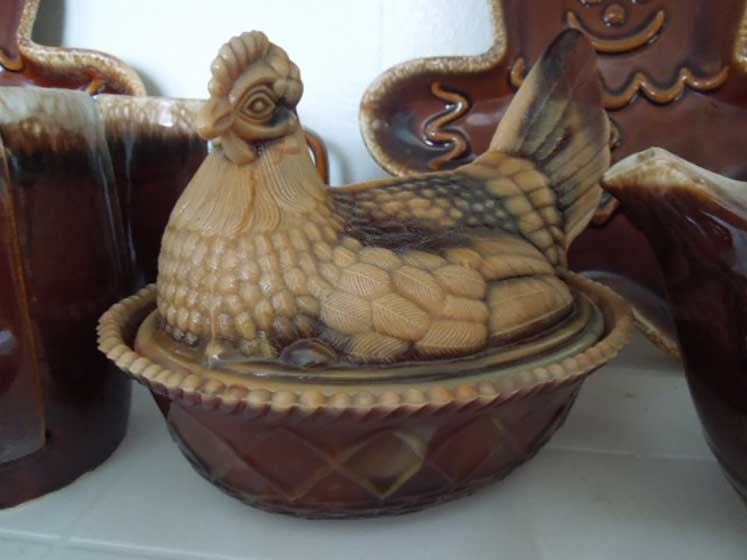
Dark brown dinnerware with a foam drip edge? It may not sound appetizing, but seeing is believing, and, in the 1960s through the 1980s, a few American pottery companies were producing a shiny-glaze, dark brown dinnerware with an ivory foam trim to meet a growing consumer demand. I started collecting this Brown Drip pottery about three decades ago when my mom was still alive. She had an entire collection of it herself, stashed in the cellar of my parents’ home, which she gave to me when she heard I was collecting it. So now I have what I’m quite sure is one of the largest collections of Brown Drip pottery anywhere.

Most of it was made by Hull, which called it House ‘n Garden, which the company also made in other drip colors under the brand name Crestone, including sand, gray, olive green, agate green, turquoise, and tangerine. McCoy Pottery made a Brown Drip indistinguishable from Hull’s, so I tend to mix and match them (A Pfaltzgraff version has a noticeably darker brown that doesn’t blend well with the other two).

Here are two colors of an exaggeratedly whimsical Hull frog planter in foam drip designs, Brown Drip at left and Green Agate at right. Most Hull House ‘n Garden on eBay is very modestly priced (basic tableware under $10), but recent eBay sold prices on this seldom-seen model were $40-$55, with the equally scarce Brown Drip Hippo planter gaining similar prices. While these two frog examples are pristine, many existing copies have chips on the protruding eyes or legs – which, of course, drastically reduces both value and the availability of good examples. (Photo courtesy of the author)

American brown glazed pottery

American brown glazed pottery is marked with the maker and brand. Anything that has a red clay ring base but otherwise looks like Brown Drip is probably Asian (usually unmarked) or Canadian.
The American companies also made brown drip decorative pieces such as planters. Although Hull and McCoy potteries are better known for a variety of multi-colored decorative wares, American-made Brown Drip pottery is still popular with collectors. There’s even a Facebook group for it: www.facebook.com/groups/721067218053951/.

You can find a lot of the Brown Drip, mostly bowls, coffee cups and mugs, and a few of the larger oval-shaped serving dishes. Dinner plates are harder to find in unmarred condition; those that have been used for their intended purpose tend to be scratched by the metal utensils with which they were used at meals. As with most collectible tableware, many homes bought only what they needed to set a basic table. Consequently, much of what one finds in antique stores today are the basic starter pieces such as cups and individual serving bowls. Some of the harder-to-find pieces (e.g., cookie jars, cannisters, and unusually shaped platters and planters) can command high prices.

Hull or McCoy Brown Drip

Most Hull or McCoy Brown Drip is marked as oven safe and also distributes heat well, which is why I use my Hull pie plates when I’m baking pies and some of my casserole dishes when I want to serve directly from oven to table. However, these wares are heavier than most tableware, which can make them more difficult to handle. The Hull covers on everything from sugar bowls to serving pieces have attenuated cover knobs that can make them difficult to hold onto. The Hull teapot also has a shortened spout that makes it difficult to pour cleanly, for which reason I prefer the McCoy teapot.

When the Shawnee Pottery closed, Terrace Ceramics bought the molds from Shawnee’s corn ware lines and made them in a Brown Drip form it called “Maizeware Colonial Brown.” The color is indistinguishable from the Hull and McCoy Brown Drip and matches up very nicely with them (Shawnee originally made these molds in colors it called “Corn King” with bright yellow ear kernels and dark green leaves, “Corn Queen” with light yellow kernels and light green leaves, and white corn ware with two-color green husks. Along with its Colonial Brown color, Terrace Ceramics also made the corn ware in paler versions of the original Shawnee corn colors).

Hull Pottery went out of business in 1986, and McCoy (under various names and ownership) went out in 1991. Terrace Ceramics itself went out of business in 1965, just four years after the Shawnee Pottery closed in 1961. As with American glass companies, the second half of the 20th century was not kind to American potteries as cheap imports became more popular in the retail marketplace.

Peggy Whiteneck is a writer, collector and dealer living in East Randolph, VT. If you would like to suggest a subject that she can address in her column, email her at allwrite@sover.net.