Collecting California Figural Pottery

August 2023

Good Eye

Collecting California Figural Pottery

by Peggy Whiteneck

Even though most of the best-known are no longer operating, the sheer number of potteries born in California could well have made it the ceramic capitol of America. The earliest California company was Pacific Clay Products, founded as early as 1892, but even it didn’t begin making figurines until the early 1930s. While it’s the oldest, Pacific Clay is also one of the few potteries still open in that state today.

Pottery is distinguished from porcelain and other ceramics by appearance and manufacturer. Generally speaking, pottery is heavier and more opaque than porcelain and tends also to be visually distinct from porcelain. It has been said that porcelain “allows the light to pass through it,” but I haven’t found that distinction to be especially helpful (perhaps except for dinnerware) as most figurines and vases tend to be too dense and solid for light to pass through them.

The Big Names in Figural California Pottery

Among the California potteries that made at least some figurines were Metlox Manufacturing, Kay Finch, and Sasha Brastoff. But the best known of the figural potters were Freeman-McFarlin, Hagen-Renaker, and Josef Originals.

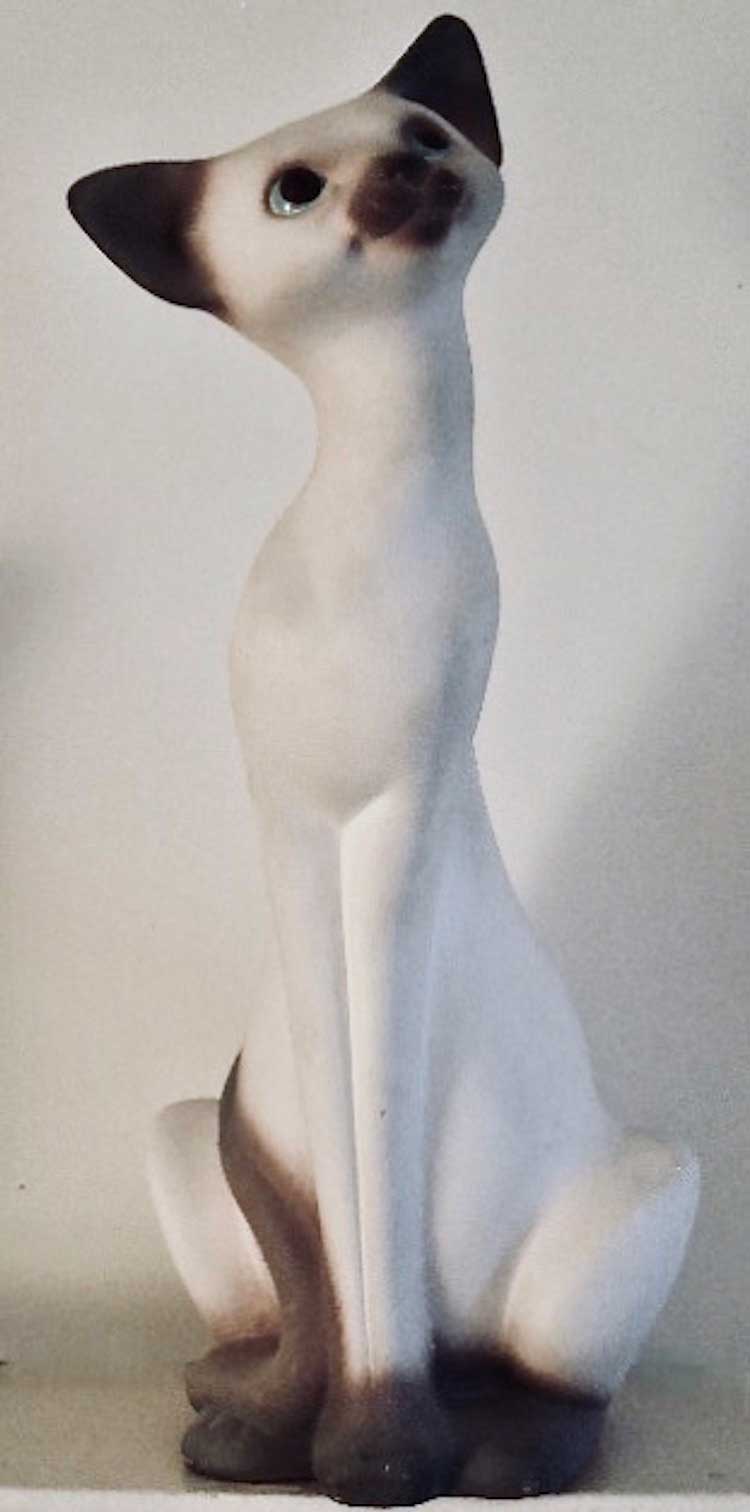
Freeman-McFarlin Pottery, named for its owners Maynard Anthony Freeman and Gerald McFarlin, operated from 1951 through 1980 (when it was sold to Hagen-Renaker, which operated it until 1985). Among Freeman McFarland’s most iconic and easily identifiable models are its cats, from the very large to the quite tiny. Characterized by large ears and eyes, a few of these were designed by Maynard Anthony Freeman, sometimes identified by the name “Anthony” in the impressed mark.

Larger Freeman McFarlin cat models were sometimes gilded entirely in gold, while others had a more natural glaze. The smaller models were sometimes made as bobble heads.

Hagen-Renaker was founded in 1944 and is one of the few California potteries still operating today. It is perhaps best known for its miniature animal models. Retail price points on its miniature animals are accessible to a child’s pocketbook at $3-$5 for many of those models, and even the more expensive of them can cost as little as $15-$20. Larger models can sell anywhere from $50 to a few hundred dollars. H-R had an entire stable of talented artists working for it. In addition to animal figurines, H-R also made some wonderful bird models.

Many of the most desirable Hagen-Renaker figurines can now be found only on the secondary market. For example, H-R made several models commissioned by the Walt Disney Co., including a tiny Thumper figurine, issued in fall 1956 and closed in spring 1960, that I bought at an antique shop for $2. Designed by Helen Perrin Farnlund, it can be priced as high as $65 to a seller who recognizes it.

Some Hagen-Renaker figurines have been counterfeited (for example, the miniature spotted fawn reclining model with big eyes made at HR in 1949-52 and 1965), and it can be difficult to authenticate them if they are separated from the cardboard H-R tags glued to their underside at retail sale. As the genuine versions of copied H-R models generally retail for less than $10 on the secondary market, it may be that these were copies made by hobbyists for their own use rather than by counterfeiters for profit.

Although it is perhaps best known for its small ceramic doll models, Josef Originals, in business from 1946 to 1985, also made some small miniature animals and birds. Among them is a series of cartoon brown mouse models in various positions and holding various objects. These cuties can be found on the secondary market for $10 or less apiece.


Coudersport Duck on Nest

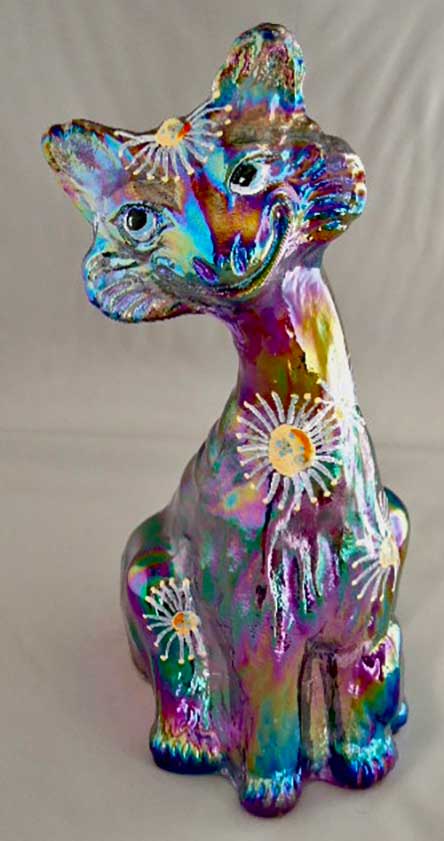
Freeman McFarlin Cat

I purchased this very tall (14”) Freeman McFarlin Cat for $10 in 1999 at an antique store. The large cat has very thin walls, and surviving models are nearly impossible to find undamaged. This one has a tiny paint chip on the back tip of one ear, making its condition unusually good. Incised mark, Freeman McFarlin Potteries, c1958. Conservative value: $50-$100. (Image courtesy of the author)

Take Advantage!

California Pottery figurines can be especially attractive to and affordable for kids. Adults can look for “vintage” collections for their kitchen and dining areas; many of the California potteries, such as Bauer, Gladding-McBean, and Metlox, made colorful housewares. Whatever their shape, items made by California potteries are definitely “have fun” collectibles!

And… Happy Anniversary Discover Vintage America!

I’m privileged to have been a columnist for this publication for just a year shy of 20 of those years. Didn’t want to miss this opportunity to express my gratitude and congratulations to Editor Corbin Crable and his staff for keeping this periodical alive and flourishing!

Peggy Whiteneck is a writer, collector, and dealer living in East Randolph, VT. If you would like to suggest a subject that she can address in her column, email her at  allwritealready2000@gmail.com.
The abiding appeal of Depression Glass

July 2023

Good Eye

The abiding appeal of Depression Glass

by Peggy Whiteneck

Depression glass is one example of a collector category that, despite its historic denigration by many in the antiques trade, has staying power with collectors even though it was cheaply made and wasn’t considered worth much at the time of its manufacture. It must have been better made than intended, though, as much of it has survived long enough to have approached the classic definition of an antique (i.e., at least 100 years old). Entire sets of this glass (produced during the Great Depression, 1929-1939, hence the name “Depression”) are available today in various colors and patterns through such sources as auctions and antique malls. Individual pieces available on the secondary market can help a collector build or fill out a set.

Some patterns are rarer than others, though, and large sets in any pattern aren’t as easy to find as they were a few years ago. Some collectors may want to collect just a piece or place setting of multiple patterns or colors rather than trying to assemble an entire set. Imagine the striking impact of a table with a pattern in a different color of Depression glass set at each place!

I have two sets of Depression glass, American Sweetheart and Petalware, made in the 1930s in the milky white Monax color. They were given to me by my Depression glass collector mom well before she died. I prefer these two patterns because their white color shows up well on any print tablecloth of whatever season. Both sets had been assembled piece by piece whenever my parents found cups or plates at reasonable prices on the secondary market. For my parents, giving me these sets had a double positive effect: they got to experience my obvious pleasure in them and made more room for their own several other antique and not-quite-antique collections!

A Brief History of Depression Glass

Because of the time period in which this tableware was produced, an inexpensive cost to consumers at retail was tantamount. Much of Depression glass was actually given away – entire sets as premiums in sale of larger items such as appliances and others just piece by piece in oatmeal or other kitchen product boxes. According to an article in the online shop Vip Art Fair (www.vipartfair.com/most-valuable-depression-glass-patterns), American Sweetheart was an exception to this giveaway distribution as every piece in that pattern was sold.

Cheaply acquired meant one of two ultimate fates for this glass: retention for passing down in families or consignment to the trash heap. Collectors of this glass shudder to think of the vast number of pieces that ended up shattered in dumps and landfills.
It’s interesting to note that we don’t see many sets of glass tableware produced today, when most of this market is made in china, other ceramics, or plastic. In part, this is a function of relative durability of those materials – making the survival of Depression glass to the present day all that much more impressive.

Coudersport Duck on Nest

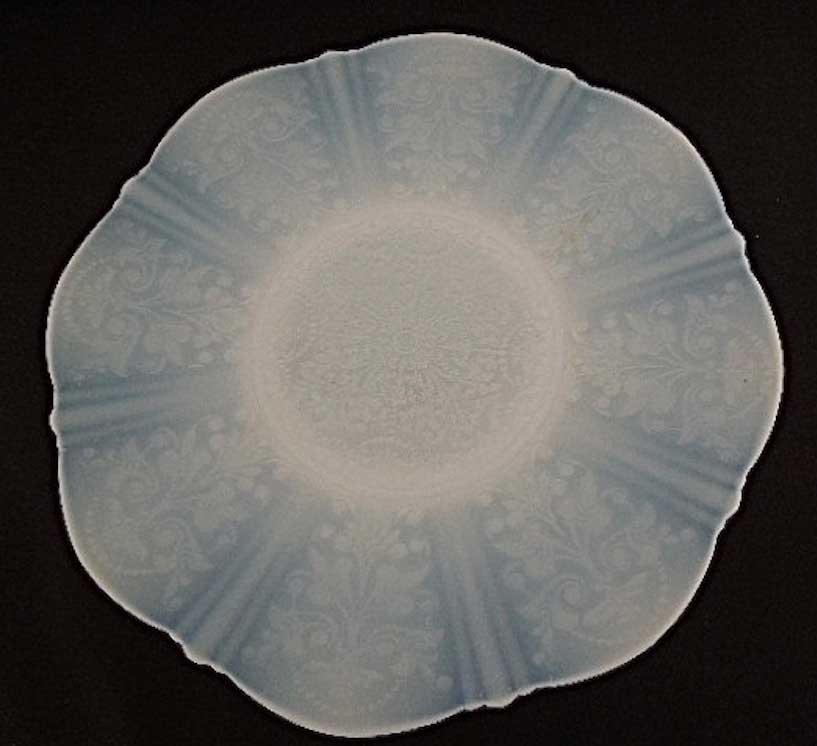
Monax American Sweetheart plate

Large dinner plates in this Monax American Sweetheart pattern are hard to find. Smaller plates and bowls keep the pattern to the rims while the pattern on the large pieces such as dinner plates continues to the center. This color is opalescent with a see-through effect on the rims. (Image courtesy of the author)

Price Considerations

Most Depression glass was produced in lighter colors such as pink, yellow, and light green. My theory about this is that lighter colors tended to show the glass decoration to best advantage. Darker colors such as amber and (especially) cobalt tend to be a bit more expensive today because they weren’t made as often.

Color can matter in availability even within each pattern or set. While pink in MacBeth Evans Glass Co.’s American Sweetheart pattern was the color produced at retail in the greatest amount, the opposite is true in the Cameo pattern produced by Anchor Hocking, where pink and yellow are today considered expensive colors since they were produced in limited amounts.

Actually, though, you can find online citations for “rare” Depression colors that run the gamut of just about any color imaginable. So, as with all purchases of antiques and collectibles, instead of focusing on “value,” just buy what you like – if you can find it!

Peggy Whiteneck is a writer, collector, and dealer living in East Randolph, VT. If you would like to suggest a subject that she can address in her column, email her at  allwritealready2000@gmail.com.
Consolidation, contraction and closing

June 2023

Good Eye

Consolidation, contraction and closing

by Peggy Whiteneck

Recently, national news sources have highlighted consolidation in American industries. Reports have focused, for example, on the airline industry, whose flight arrival and departure times have often been difficult to predict and whose customer service charges on everything from food service during flight to baggage check have challenged passenger disposition.

Such trends have also hit the antiques and collectibles industry. The 1980s, when I first began writing about antiques and collectibles, was an era when there was a heightened interest in collecting. Today, customer options have contracted with consolidation and closings in the industry.

Contraction and closings in antique sales venues

We can still find places with many shops. In other areas, though, many shops have gone out of business. I remember shopping on Antique Alley in Concord, NH, when my parents were still alive. Today, there are so many fewer shops along that route that I less often make the trip from my home in Central Vermont. Elsewhere, some of my favorite shopping venues have also closed. I still keenly miss the high-quality Burlwood Antique Center in Meredith, NH, which closed in 2009 under pressure of building upgrades that would have been required to keep it open.

Consolidation in antiques and collectibles publishing

In the 1980s, there were entire sections in bookstores devoted to antiques and collectibles, from price guides to works that gave in-depth information and analysis about particular items and manufacturers. Today, there has been so much consoli-dation in the publishing field that … well, good luck finding a publisher if you have a book to put out into the world.

There used to be at least three big book publishers in the field (Krause, Collectible Books, and Schiffer) plus a host of smaller ones. Today, Schiffer is the only publisher left among those big three. In the heyday of publishing on antiques, entire shelves and magazines racks in any large bookstore were devoted to the field. Now, there are few of these publications, if you can find them at all, tucked between the hobbyist offerings.

I currently have one book in print (on Lladró Spanish porcelain) with Schiffer. Two of my other books, focused on Fenton Art Glass, had been in print with three different publishers that all went out of business! The only options open to me seemed to be the so-called “vanity publishers” where an author has to pay them for the privilege of being in print. Finally, I found a more traditional organization that has other collector education interests than just putting out books. My two books on Fenton Art Glass have been accepted there, with about a two-year waiting period before they can begin working on either. 

Coudersport Duck on Nest

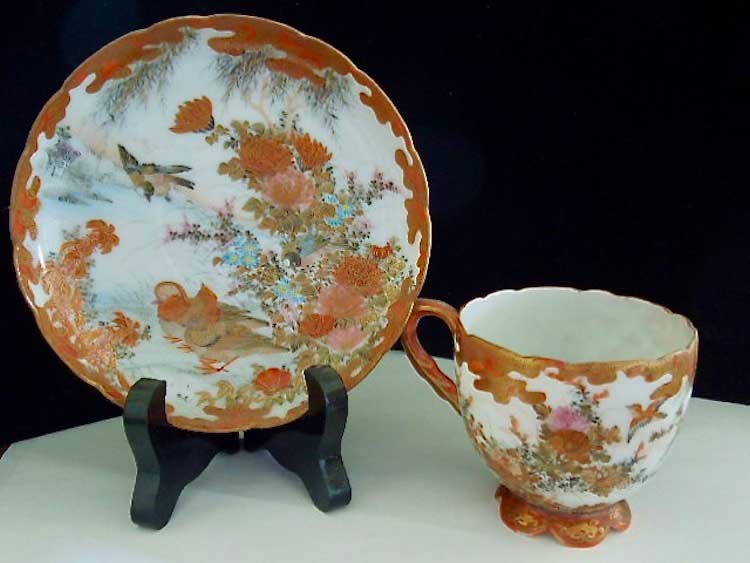
Kutani painting

One of many quality items I bought over the years from the now-closed Burlwood Antique Center was a cup and saucer that dates from the late 19th to early 20th century, English translation of the Japanese characters in the mark: “Painted by Menzan from Watano Kiln” with a Kaga mark used in the years before the Japanese character for Kutani appeared in marks. While Kutani painting can sometimes be slapdash, this early example is carefully and exquisitely detailed. (Images courtesy of the author)

Changes in companies making collectibles

Speaking of waiting periods, many manufacturers, the largest of which had been in business since the early 20th century, have gone out of business. That means the field is left to smaller companies that cannot absorb all the new demand still being generated by collectors. The waiting period for orders of new glass (e.g., at Mosser Glass) is now nearly as long as the waiting list for publishing projects. Glass and other collector clubs that have pre-ordered in bulk are in the best position to wait this out.

Expansion, anyone?

Today, the expansion in antique and collectibles sales seems to be among private, individual sellers on eBay and Facebook groups. Sellers vary in accuracy of their knowledge about what they’re selling and their ability to get auction sales out in a timely manner after a sale.

Reputable auction firms such as Randy Clark’s Dexter City Auction Gallery in Ohio and Matthew Wroda Auctions in New York are my own favorite go-to options today for new acquisitions. I also haunt the antique centers still left … And I guess it’s a good thing I don’t find more to buy as I’ve run out of room in my house to display it!

Peggy Whiteneck is a writer, collector, and dealer living in East Randolph, VT. If you would like to suggest a subject that she can address in her column, email her at  allwritealready2000@gmail.com.
Feathered nests – in glass!

May 2023

Good Eye

Feathered nests – in glass!

by Peggy Whiteneck

In May, we celebrate Mother’s Day, not just for human moms but for birds – and not just feathered birds on twigged and grassy nests but moulded birds on glassy nests! In my last column, I shared a photo of my Caramel Slag Westmoreland hen on its nest. I thought I’d continue exploring that nesting theme in my article for this month’s column.

Birds and animals on nests were produced by a variety of companies, going at least as far back as the 19th century. Some of these seem odd to those of us with actual farming backgrounds since most of us never saw real animals, such as a cow, lambs, rabbits, cats, dogs – and even a frog – sitting on nests, so I’ll stick to the birds for this article!

Many older glass companies, most of them no longer working, made hens or other birds on nests, notably Atterbury, Westmoreland, Fenton, Imperial, and Indiana. There are a few examples of the form from even older companies, such as Coudersport Glass in Pennsylvania (in business for only four years, 1900-1904), whose operations were cut short, often by factory fires. Birds on nests were also made by newer glass companies, such as Summit Art Glass (founded in 1972 and closed in 2006), Boyd’s Crystal Art Glass (founded in 1978 and closed in 2014), and Mosser Glass (still very much alive and operating in Cambridge, OH, and still using some of the old methods of producing decorative glass).

Fenton appears to have been the most prolific maker of hens on nest, usually coming out with them annually for the company’s spring catalogs. In fact, until recently, I’ve avoided many of the hens on nest because I really wanted to focus my collection on Fenton glass (in order to have living space for myself!) and didn’t trust myself to be able to distinguish older, unmarked Fenton versions rom those produced by other companies. Then I was alerted to the existence of an online source that allows one to distinguish even the older, unmarked Fenton from those of other makers (www.fentonaddict.com/FeaturesandCharacteristics.html). This site has a lot of information, and it can be tough to distill from it the essential differences between Fenton hens and those made by other companies, so I’ll review some of the most obvious differences here.

  • The Fenton hen’s tail is smooth at the rear edge and splits into a sharp inverted “V” at the back (Other makers’ hens have scalloped edges to the tail feathers).
  • A pair of eggs appears on each side of the front of the Fenton hen with one egg on both sides at the rear.
  • The comb on the Fenton hen has a cluster of round balls in the back that continue into a recognizable comb at the front (although I do have a Westmoreland hen on nest with the same feature).
  • The eyes on Fenton hens tend to be large with a pronounced outward bulge.


Coudersport Duck on Nest

Coudersport Duck on Nest

This Coudersport Duck on Nest was made in the very early 20th century (as the factory opened in 1900 and went out of business when it burned down in 1904). Note the opalescent edges, as typical of old milk glass. (Image courtesy of the author)

One of the challenges for collectors of this and other decorative glass is distinguishing which company made an item produced in any given form. American art glass companies often sold their heavy, metal glass-making moulds when they went out of business, and these were bought by other then-existing decorative art glass companies to make glass of their own. That’s how, for example, one can find a Fenton swan on nest that was made from a mould that came from Imperial Glass and another differently modeled swan on nest, also Fenton, that I believe was acquired from Westmoreland.

It seems a bit odd to see roosters on nest, but they were made, too, by Fenton Art Glass and Imperial Glass. Imperial versions were done in the company’s popular slag glass colors, including caramel, purple, and jade green. The Imperial nests had lovely reticulated edges (While Imperial also made a red slag, I don’t believe it made nested birds in that color).

Peggy Whiteneck is a writer, collector, and dealer living in East Randolph, VT. If you would like to suggest a subject that she can address in her column, email her at  allwritealready2000@gmail.com.
Mould shopping and swapping in American glass

April 2023

Good Eye

Mould shopping and swapping in American glass

by Peggy Whiteneck

Moulded Glass

One of the challenges in collecting American art glass is identifying the maker, given the amount of mould swapping that took place between companies. This usually happened when a glass company went out of business and remaining companies acquired their moulds at auction. For example, a Kokomo (in business 1900-1905 and named for its Indiana town) Paneled Grape Creamer was made later by Westmoreland and a version was also sold by retailer LG Wright, for whom many companies produced glass.

For early 20th century glassmakers such as Fenton, Atterbury, Indiana, and others, glass moulds were made of cast iron, so buying and transporting them from one company to another was no easy feat. For example, the mould to make Fenton’s “Alley Cat” weighs 250 pounds – and that was one of the lighter ones! The 11” Alley Cat began its life with U.S. [Tiffin] Glass in the 1930s and was named “Sassie Susan.” Tiffin made it in two colors, black and white. Fenton acquired the mould from U.S. Glass in the mid-1960s and brought out its first Alley Cat in 1970, since made in numerous colors.

In researching this article, I found out that the smaller Happy Cat mould, today owned by the Fenton Art Glass Collectors of America [FAGCA], also began its life with Tiffin,* which made it in cold-painted black. I have also seen the mould for Fenton’s Donkey and Cart attributed both to U.S. [Tiffin] Glass and Duncan & Miller, but I’m skeptical of the Tiffin attribution because it seems to have a pony drawing the wagon vs the long, forward projecting ears of the donkey in the Duncan & Miller and Fenton versions.

Sometimes, mould swapping would involve more than two companies. For example, the Fenton Butterfly Box (model #6940) originated with Verlys, then passed to Hollophane before being acquired by Fenton, whose first production of it was around 2005.

Acquiring a mould didn’t necessarily mean success in using it. An example is the large Chanticleer rooster (model #5077) that began its life from a Fostoria mould in the 1950s before it was acquired by Fenton in 2004. Fenton experienced some of the same problems Fostoria did with this gorgeous but elaborate model: the tails simply didn’t want to come out of the mould without breaking. Glass formula didn’t seem to make a difference; Fostoria’s milk glass version had the same problems as Fenton’s Periwinkle Blue version, and Fenton never tried the model again.

Since the closing of its factory, the Fenton family has retained several of its moulds, occasionally renting them out to other glassmakers such as John and Ann Fenton (not related to the Fenton factory family) in Springfield, MO. While that company at first borrowed moulds from Fenton to make glass from Fenton cullet, John also makes his own glass models and Ann is a glass painter.

metal sign for Lee Jeans

Kokomo Glass

Kokomo was a short-lived company established in 1900 and succeeded by the DC Jenkins Glass Co. in 1906, Jenkins having been one of Kokomo’s founders. This 1905 Kokomo creamer is almost opalescent, and the wash is more orange than the nutmeg wash usually found on old custard. I have been unable to find other examples in this color; later examples of the mould in crystal glass were made by Westmoreland.
The two national Fenton glass clubs have long owned their own moulds, including the Happy Cat mentioned above, along with a smaller version called the Happy Kitty also owned by FAGCA, and a mouse model owned by the National Fenton Glass Society (NFGS). When the Fenton company went out of business, the clubs put in their bids for acquisition of favorite moulds to make future club glass. FAGCA, whose emblem contains a butterfly, was able to acquire the Butterfly on Branch, the Amphora vase (which sits in a metal stand), the lidded Temple Jar, and a few others.

Both the NFGS and FAGCA use Mosser Glass to create new issues from moulds the clubs acquired from Fenton. FAGCA has contracted with Davis-Lynch to make the Amphora vase. The National Stretch Glass Society has also acquired the Fenton Melon Rib #847 bowl and cover and the #1532 twin dolphin candy jar and cover. As you can see, original glass moulds are still making the rounds to keep collectors happy!

*As confirmed by FAGCA Board President, C.C. Hardman.

Peggy Whiteneck is a writer, collector, and dealer living in East Randolph, VT. If you would like to suggest a subject that she can address in her column, email her at  allwritealready2000@gmail.com.