
Midwest weather and Iowa’s ‘prairie mud’ made courting complicated in the 1920s
November 2026
Vintage Discoveries
Midwest weather and Iowa’s ‘prairie mud’ made courting complicated in the 1920s
by Ken Weyand
In many ways, my parents couldn’t have been more different. My mother, Mabel Forrester, was an only child, raised by doting parents. My dad, Elmer Weyand, was one of eight orphans from Keokuk, Iowa, who I’ve described as the “Amazing Links,” due to their chain letter correspondence that kept them in touch for years.
Taken in by a Missouri uncle in 1900, Elmer grew up on his uncle’s farm and managed to prosper, eventually educating himself at a local college (Kirksville Normal School, now Truman State University) and establishing his own nearby farm about a dozen miles south of the Missouri-Iowa border. The only thing lacking in his life was a wife, something his siblings teased him about for years.
In 1926, Lola Miller, a cousin living on a farm near Kahoka, Missouri, had a friend, Mabel Forrester, who lived in town. Mabel, whose musical talents included piano, violin and voice, had received a degree and served on the music faculty at Illinois College in Jacksonville. Well-traveled, she had performed for three years on the Chautauqua circuit, notably as a member of the troupe, J.C. Lockhart and His Scottish Lassies. Recently, she had joined the music faculty at Des Moines University – later absorbed by Drake University. At the end of 1926, she was spending the Christmas holidays at her parents’ home in Kahoka.
Lola arranged a blind date for Mabel and her cousin, Elmer. The two couples played bridge at a friend’s house at a New Year’s Eve watch party. Later, Elmer would attend a church service in Kahoka where Mabel sang a couple of Christmas songs. By the end of a week, a romance had blossomed, and they soon became engaged.
The engagement came as a shock to Mabel’s parents. Her mother, Carrie, intent on her daughter continuing her musical career, was devastated at the thought of her marrying a farmer. Charley, her father, who accepted the engagement with less anxiety, nevertheless questioned why he and Carrie had never even had a chance to meet her chosen partner. But a relationship that would last for nearly 60 years was well underway.
When Mabel returned to Des Moines, the couple continued their long-distance romance with regular letters, many of them involving the old house my dad was renovating on his farm. By Jan. 25, 1927, she was making suggestions. A good portion of a long letter was filled with arguments against a ductless furnace, and reasons for installing a conventional type. She expressed her desire to have electricity from Keokuk, as opposed to a “Delco home plant” that required appliances with different voltage equipment. And she emphatically urged my dad to consider installing a fireplace that she craved, and she even purchased a pair of candlesticks she thought would look good on the mantle.
How did her suggestions go over? Not so well. The furnace was ductless, with registers used to regulate the heat in each room. As for electric power, the couple had to use a Delco plant, which only gave them limited electricity for small appliances (When I was a child, my parents used coal oil lamps and an icebox in the kitchen that used blocks of ice delivered from town). The house didn’t get conventional electricity until the Rural Electric Administration (REA) made it possible in the early 1940s. And the fireplace my mother pleaded for was never built.
But in 1927, the biggest problem for my parents-to-be was their long-distance romance. The unpaved roads and spotty railroad connections of the era added to the problem.
In later years, my dad described a trip he had made in the spring of 1927 to Des Moines to see my mother. Driving his Model T Ford, Dad made the approximately 150-mile trip on a day that was free of weather threats. But recent rains had made the country roads between the farm and Des Moines muddy and treacherous.
To make matters much worse, one of the Model T’s narrow tires gave out enroute, and Dad had to do the tire repair in the mud. This would have been bad enough with today’s technology. But drivers in the 1920s had to replace the tire tubes, inflate them, and remount the tires on the wheels—a far more complex job than today’s simple tire changing. Any mistakes, and the tube or tire-stem would crimp and cause another flat. It could be a tricky job in good weather. It’s difficult to imagine what an awful challenge my dad would have faced in the Iowa mud. Needless to say, he was less than courtship-ready when he arrived at my mother’s residence hall at Des Moines University.
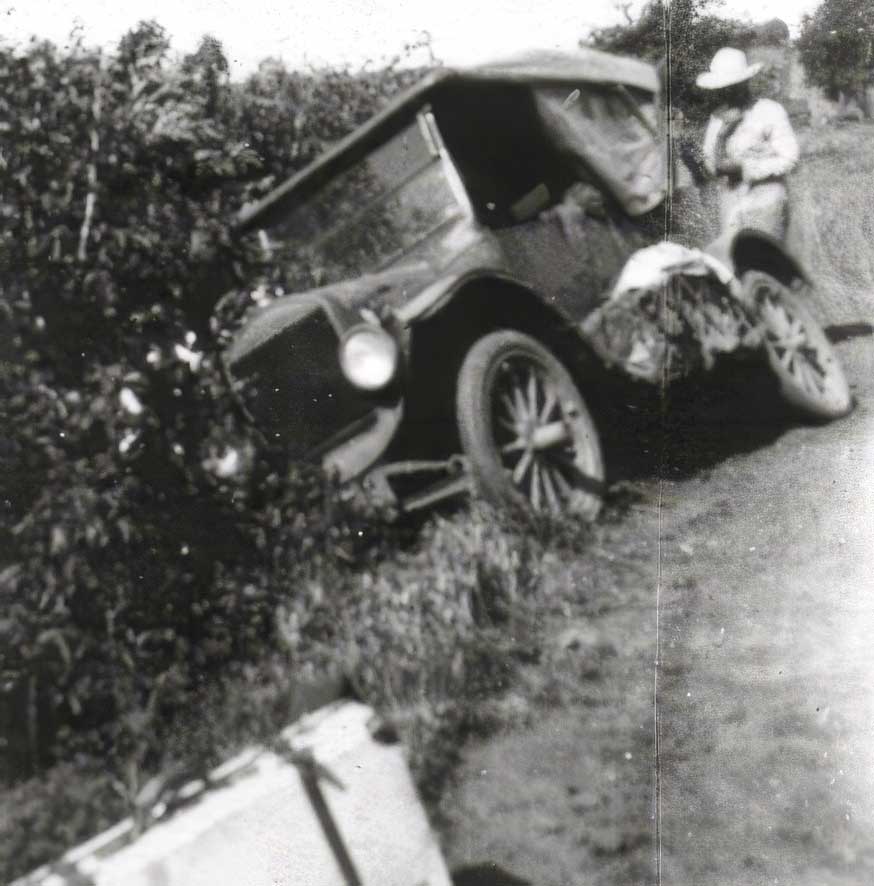
Muddy roads made driving hazardous in the 1920s.
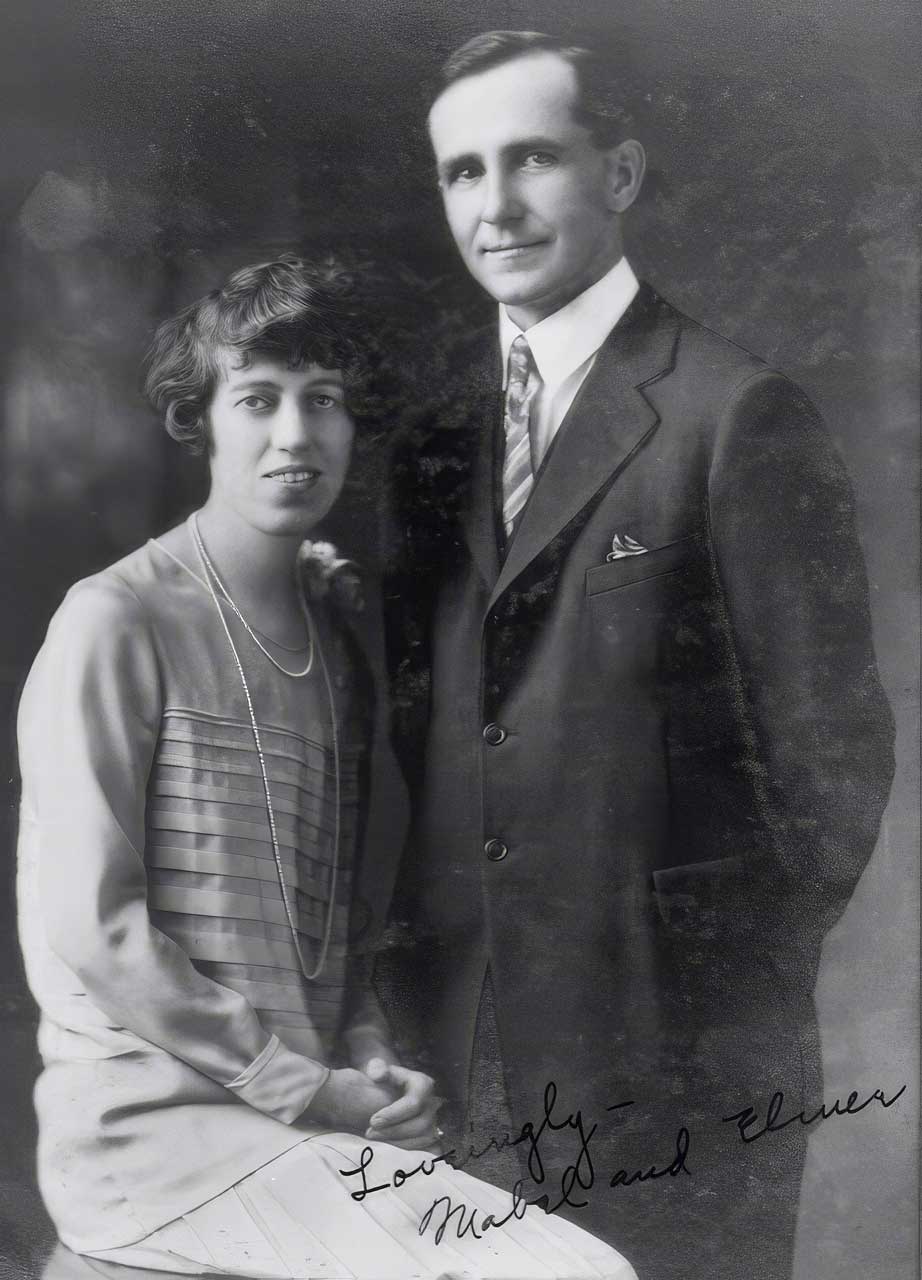
Wedding photo of Mabel and Elmer, taken in Keokuk on Jan. 2, 1928. (Images courtesy of the author)
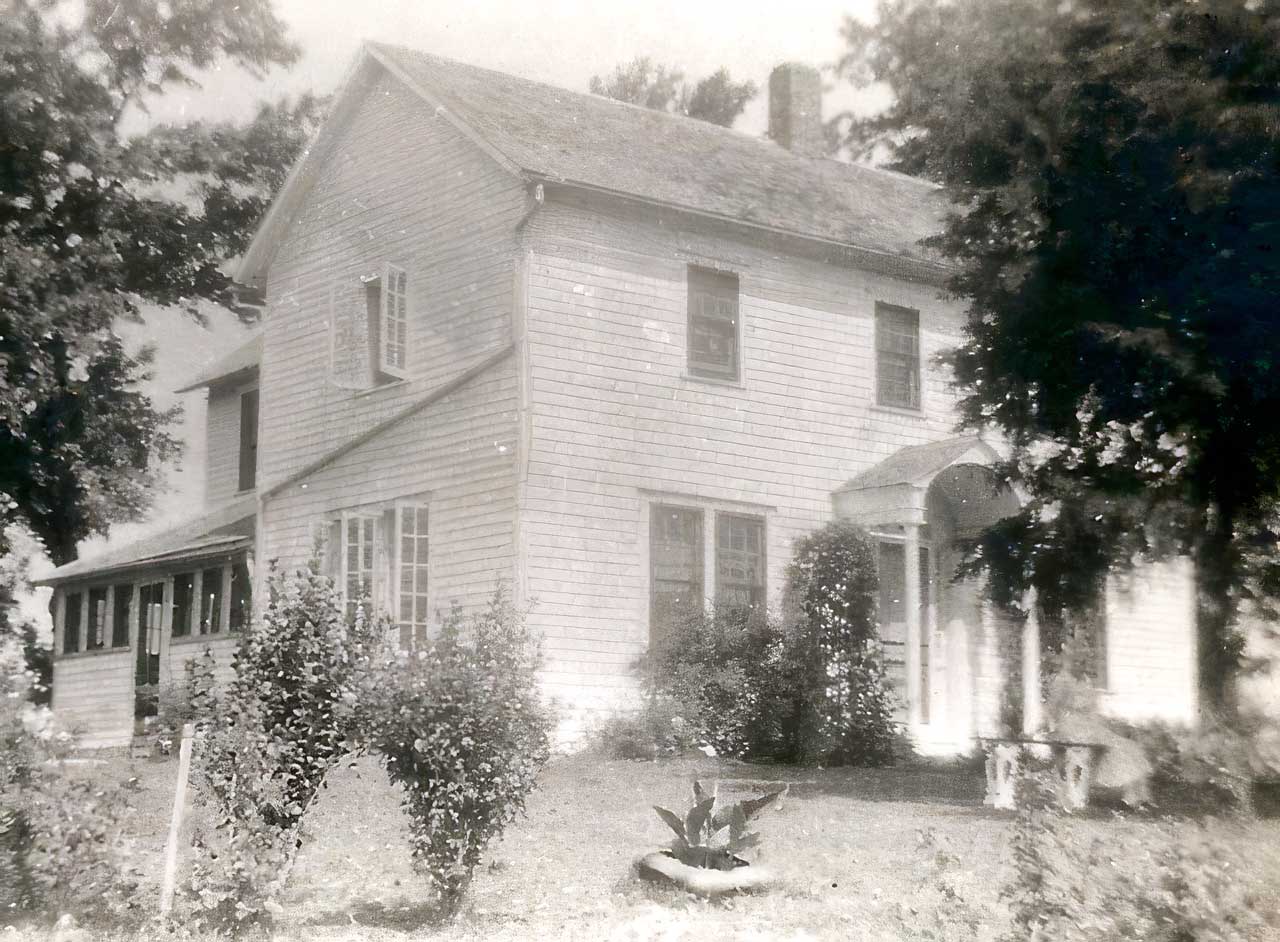
The farmhouse at Hillcrest Farm in the early 1930s.
Lucky for me, my parents persevered, and a wedding was planned for New Years Day, 1928, in Jacksonville, Illinois, where my mother had graduated from Illinois College and served on their faculty. The timing roughly coincided with their original blind date a year before in Kahoka. Friends and favorite teachers from her college days had been invited.
A day before the wedding, the couple and her mother (who by this time had evidently become reconciled about her musician-daughter marrying a farmer) braved a late-December storm to board the Keokuk & Western Railroad train in Kahoka for Keokuk, Iowa, where they planned to catch another train to Jacksonville (My grandfather wasn’t in the party – he may have been unable to leave his duties as a rural mail carrier, but there was no explanation in my mother’s diary).
By the time the train reached Keokuk, the storm had worsened with the snow turning to ice, and the train to Jacksonville wasn’t running. Undaunted, the couple summoned a local minister, and the wedding took place at his residence in Keokuk. The next day the couple got their wedding picture made and did some necessary shopping before returning to the farm to start their married life.
With help from other farm women, my mother soon learned to cook for threshing crews, grow and preserve garden vegetables, and raise chickens. Her musical career included several years of giving piano lessons in a music room in the farmhouse, and playing for church services, weddings and funerals. She also directed a centennial celebration for our county that included musical acts. One of the groups she brought in was a popular male quartet, the “Songfellows,” who were regulars on WHO-Radio in Des Moines and performed on the Iowa Barn Dance Frolic.
Ken Weyand is the original owner/publisher of Discover Vintage America, founded in July 1973 under the name of Discover North.
Ken Weyand can be contacted at kweyand1@kc.rr.com Ken is self-publishing a series of non-fiction E-books. Go to www.smashwords.com and enter Ken Weyand in the search box.
Recalling the days when a new radio was a ‘must have’ for U.S. households
October 2026 Vintage Discoveries Recalling the days when a new radio was a ‘must have’ for U.S. households by Ken Weyand A year after my parents’ wedding on New Years’ Day, 1928, my mother saved an issue of the Clark County Courier, the weekly newspaper that served…
His friends called him Charley – My grandfather lived a simple life, but he was a true gentleman
September 2026 Vintage Discoveries His friends called him Charley – My grandfather lived a simple life, but he was a true gentleman by Ken Weyand Charles Day Forrester, my mother’s father, was born November 13, 1865 in Palmyra, the county seat of Macoupin County,…
State Fair memories last a lifetime
August 2026 Vintage Discoveries State Fair memories last a lifetime by Ken Weyand Growing up in northeast Missouri, I recall that our farm family visited both the Missouri and Iowa state fairs. Unlike neighboring dairy farmers, whose work kept them at home, we were…
Arkansas traveling: retracing a 1921 road trip
May 2026 Vintage Discoveries Arkansas traveling: retracing a 1921 road trip by Ken Weyand My Aunt Florence was unique in her day. The oldest of eight orphans, she became a social worker and later a state employee in Arkansas, where she lived most of her life. One of…
Pennants helped students show school spirit in 1914
April 2026 Vintage Discoveries Pennants helped students show school spirit in 1914 by Ken Weyand My “cedar chest of family history” produced another couple of items: a pair of college pennants, well over 100 years old. They were among the few things my dad, Elmer…
Making a telephone call was challenging in the 1940s
March 2026 Vintage Discoveries Making a telephone call was challenging in the 1940s by Ken Weyand Growing up in the 1940s on a Missouri farm had its challenges, especially coping with the nearly four miles of dirt roads that separated our family from the nearest…
Old-time winter adventures remembered
February 2026 Vintage Discoveries Old-time winter adventures remembered by Ken Weyand Rural Missouri in the 1940s offered challenges for a youngster. Our farm was separated from the nearest village (and paved highway) by four miles of dirt roads. Winter snows – and…
Papier maché Santa dates from 1930s
December 2025 Vintage Discoveries Papier maché Santa dates from 1930s by Ken Weyand Somewhere in my collection of “old stuff,” there’s a faded Kodak print showing the living room of our farm house at Christmas, sometime in the 1930s. A decorated cedar tree dominates…
Remembering Thanksgivings with Lucy
November 2025 Vintage Discoveries Remembering Thanksgivings with Lucy by Ken Weyand My earliest memories of Thanksgiving go back to the 1940s, when my parents and I often spent the day with my step-grandmother Lucy and my Aunt Ruth at their home in Hamilton, IL,…
Tiny jail includes strange tale of early-day witches
October 2025 Vintage Discoveries Tiny jail includes strange tale of early-day witches by Ken Weyand A recent visit to the Parkville Nature Sanctuary north of the downtown area in Parkville, Missouri revealed a tiny jail near the north edge of the parking lot. The…
Old childrens’ books show how times have changed
June 2025 Vintage Discoveries Old childrens’ books show how times have changed by Ken Weyand Recently I found four old childrens’ books my mother had stashed away – curiosities of her early life after she moved with her parents to Kahoka, MO, where my grandfather…
Kansas City’s early-day airports helped make flying history
May 2025 Vintage Discoveries Kansas City’s early-day airports helped make flying history by Ken Weyand Operating in an era when airplanes were a novelty, pilots navigated using “dead reckoning, and a good landing was “any landing you could walk away from,” Kansas…