
September 2026
Vintage Discoveries
His friends called him Charley -
My grandfather lived a simple life, but he was a true gentleman
by Ken Weyand
Charles Day Forrester, my mother’s father, was born November 13, 1865 in Palmyra, the county seat of Macoupin County, Illinois. It was a momentous year, packed with important and traumatic events in the spring and summer: General Lee’s surrender, the abolition of slavery, and the assassination of President Lincoln. For those in the small town of Palmyra, my grandfather’s birth must have seemed a welcome sign that life goes on.
His father, Robert Forrester, was born in Kentucky, and grew up in Cumberland, Tennessee. Robert moved to the Palmyra area shortly before the Civil War broke out. On September 12, 1861, he married Ellen Elizabeth Crum, the daughter of Joseph (Hoosier Joe) Crum, one of the area’s early settlers, whose family had come from Indiana.
Charles was one of their five children, the third of two brothers, Andrew and William. Another brother, Joseph, was born in 1867, and a sister, Mary, completed the family in 1869. Charles attended Palmyra public schools, and later enrolled at Valparaiso University in Valparaiso, Indiana. After graduating, he worked as a clerk for Macoupin County, and served as County Assessor for two terms. Along with his assessment duties, he worked on his father’s farm on the outskirts of Palmyra.
My grandfather was well-read, and a writer, as well. He also enjoyed scrapbooking, a popular hobby of the era. An ancient scrapbook, thought to date to 1886 and made from an old business ledger, contains hand-written poems and short articles he had written, as well as ads for patent medicines, several pages of newspaper clippings featuring short stories and poems, personal “calling cards,” and more than a dozen colorful advertising cards collected from packages of “McLaughlins Coffee.” There were also two colorful “Award of Merit” cards given to Charley by one of his teachers, H. D. Folz.
In a larger scrapbook filled with newspaper clippings of family reunions and obituaries, there is an article from the Clark County Courier in 1923. My mother had written of a Chautauqua tour she had taken as a member if the troupe “J.C. Lockhart and His Scottish Lassies.” This larger scrapbook continues into the 1940s, with notes in my mother’s handwriting, indicating she continued her father’s scrapbook for several years after his death in 1937.
A woman entered Charley Forrester’s life in the early 1890s, while he was working in Palmyra. Carrie was petite and short, a notable contrast to Charley, who at six-feet-plus, towered above her in family photographs. It isn’t known how Charley and Carrie met, but for much of the following year the couple exchanged many letters, mostly on a daily basis. The letters often contained references to church events, activities then at the heart of Charley’s interests, and the center of much of the couple’s social life. Unfortunately, only Charley’s letters were saved. It’s interesting that Carrie also received several letters from other potential suitors during this period, and these letters were saved, as well.
Charley’s work with the county involved “going out in the country and making assessments.” Each day, when his assessment work was finished, he worked for his father on their farm at the edge of Palmyra. In February, 1892, Charley’s life was shattered with the death of his mother.
In 1893, about two months before their wedding, Carrie had moved to Carthage, and it wasn’t clear where their marriage would take place, although Jacksonville seemed to be Carrie’s first choice. Charley once wrote that his long hours between making assessments and working on the farm had left him “nearly dead, but he was feeling some better this evening.”
In his letter, he asked Carrie how she liked Carthage, and “how big a town is it?” This query was immediately followed by another: “Do you still love me?” He concluded his letter by fretting, “It seems like a long time before I get to see my sweetheart again. Be a good girl, Carrie, and don’t forget your boy.”
Charley and Carrie were married July 4, 1893 in Jacksonville, Illinois, and lived in Palmyra for the first two years of their marriage. Not long after the birth of their daughter, Mabel June, on June 5, 1895, the family moved to Kahoka, Missouri, where Charley had found work as a Rural Free Delivery (RFD) mail carrier with the Postal Service. It is thought that Carrie was largely responsible for the move to Missouri. Her father, William Van Horn, and her older sister, Elethea, lived in nearby Revere, and Carrie had lived in the area at one time. Several Van Horn relatives are buried in the nearby Peaksville Cemetery.
Charley would work for the Post Office for 35 years. Like other carriers, he drove a horse-drawn “postal buggy” on a rural (RFD) route south of Kahoka. A “sorting box” in the front of the buggy allowed Charley to sort the mail while making his deliveries. True to his calling, he braved all kinds of weather and road conditions to perform his duties. He approached his work with a sense of humor, reporting interesting anecdotes to the local weekly newspaper, the Clark County Courier. The editor dutifully printed all the details, and occasionally added some remarks of his own. One notable anecdote was a family favorite:
Carrier C. D. Forrester related that as he returned from his trip Wednesday, he found Honey Creek higher and angrier than ever before in his long experience. Determined to see his wife before drowning, the courageous Charley plunged in and crossed without incident, other than the wetting by the overflow of his rubber boots and the place where he sat.
Although they lived well into the "motor age," Charley and Carrie never owned a car, but relied on the train and steamboat connections of the day. My grandfather made several trips to Palmyra to attend family reunions and visit his old friends and relatives in Illinois—all by train. In 1910, to attend the annual mail carriers’ convention in St. Louis, he took the Keokuk & Western train from Kahoka to Keokuk, where he booked passage on a packet boat down the Mississippi River to St. Louis. In later years, when visiting my parents at Hillcrest Farm in northeast Missouri, he would take the Keokuk & Western railroad from Kahoka to Granger, where my dad would meet him at the station and drive him the four miles of country road out to the farm.
My mother, Mabel, was their only child, and Charley and Carrie gave her every opportunity they could from Charley’s modest earnings. Mabel showed an early interest in music, and was giving vocal, piano and violin recitals in Kahoka by the time she graduated from high school in 1912. She enrolled in Illinois College in Jacksonville, and earned much of her board and room giving music lessons in the Jacksonville area.
At one time, Mabel became engaged to Earl Pond, a fellow music student and vocalist. She would accompany him on the piano, and in their off-hours the two would enjoy long walks, and a mutual interest in poetry and classical literature. Earl even surprised her with a late-summer visit at her parents’ house in Kahoka, where he stayed for three days. Returning to Jacksonville, the pair continued their relationship, and her diary included many events they were attending. But after about a year, the engagement was broken. When she informed her parents, Charley was furious, and wrote a strong letter to Earl. Already coping with her emotions about the broken relationship, my mother had to act as an intermediary to calm her father down.
When she became a Chautauqua performer a few years later on tours that included parts of Canada and much of the U.S., my mother exchanged many letters with her parents, describing the towns where she performed, and the upcoming concert dates. Charley seemed especially interested in her career. However, on one occasion their exchange of letters became a problem when Charley sent a long description of her visit to the National Cathedral in Washington, DC, to the local newspaper, where it was published. Mabel resented having her correspondence publicized without her knowledge, and she reprimanded Charley in a strongly-worded letter. The exchange was recorded in her diary. It was the only time I ever saw a schism in their relationship.
Later, when Mabel was a teacher at Des Moines University, she met my dad, Elmer, at a New Year’s “watch party” in Kahoka while on a “winter break.” The “blind-date” had been arranged by my dad’s cousin, Lola Miller, who lived on a nearby farm. A day or so earlier, Mabel had “sung a couple of Christmas songs” at a church service Elmer attended in Kahoka. After the New Year’s party, their relationship instantly ignited, and they became “informally engaged” within a week. The sudden turn of events had an interesting effect on her parents.
Carrie, hearing the news, reacted with horror, fearing that my mother’s decision to become a “farm wife” was a serious mistake. After several comments about her daughter “having been raised to be a musician,” Carrie concluded she was “heartsick about the whole affair.” Charley, on the other hand, was more understanding, but still surprised at the sudden engagement. He responded with a letter:
"We were a little surprised to know that you and Elmer were engaged," he wrote. "I suspicioned you would be but did not know he was such a fast courter. I guess he is like the old darky I read about. His wife sickened and died. Mrs. Brown saw him a few days after the funeral and was expressing her sympathy for him and in doing so remarked that she did not know who she could get to do her washing now. The darky answered 'You jes' wait a few days, Mrs. Brown. I'se cotin' agin and I “cotes” rapid.' So, I guess Elmer must 'cote' rapid.”
Satisfied he had made his point with the “minstrel joke,” he continued, “Seems funny you are engaged to a man neither of us has ever seen. I wish you would send us one of his pictures he has taken lately so we can see how he looks."
Charley concluded his letter with this fatherly advice: "I hope you are getting a good man, and being a farmer is no disgrace. It takes more brains to be a successful farmer than it does in most any other calling. You both are certainly old enough to know your own minds, so here's wishing you and yours the best luck in the world."
Ironically, when my parents set their wedding for January 1, 1928 in Jacksonville, Illinois, only Carrie (apparently recovered from her devastation about her daughter’s choice of husbands) accompanied them on the train from Kahoka. Charley, probably bound to his schedule as a mail carrier, remained in Kahoka -- there was no reason given for his absence in any of my mother’s diary entries. A sudden ice storm forced the wedding party to get no farther than Keokuk, Iowa, where they employed the services of a local minister, who performed the wedding in his home.
In the months that followed, Charley and Carrie were frequent visitors at Hillcrest Farm, my parents’ home. My dad told me that Charley would occasionally take long walks across one part of the farm where Native Americans were reported to have forged a trail, and on one occasion he found a couple of arrow points.
In 1933, Charley and Carrie took advantage of a “special round-trip rate” to take the Santa Fe train from Medill, Missouri to the Century of Progress Exhibition in Chicago with my parents. They also attended the fair the following year, this time with only Mabel, as my dad had farm business to take care of.
In 1935, my parents traded their coupe and bought a new Chevrolet sedan, their “first big car,” according to my mother. Carrie and Charley accompanied them on what they termed a “California trip,” a 6,603-mile, 24-day trek that would include 15 states and a bit of Mexico. Their eventual destination was the Pan-American Exposition, then in progress in San Diego.
Before the trip, Mother had sent for Conoco maps. In the package there was a small book for keeping travel records, and she filled it with every important detail of the trip, itemizing every penny of expense. Staying in "tourist cabins" for as little as $2 a night, and with relatives, they kept overnight costs to a minimum.
Their main destination was the California Pacific International Exposition at Balboa Park in San Diego. They were among the more than seven million visitors to the Expo during the 377 days it was open. Admission to the Expo cost the four of them $2. Other expenses my mother mentioned were "25 cents to see logrolling" and another 55 cents for lunch.
My mother failed to mention in her diary that one of the Expo's more controversial exhibits was the "Zoro Garden Nudist Colony," an exhibit deemed "tasteful" by some and "scandalous" by its critics, whose outcries caused the exhibit to be drastically changed by the Expo's second year. It is extremely doubtful that any of the foursome ogled the nudists.
On the trip, they visited two of Dad's sisters: Mary, in Billings, Montana and Grace, in Piedmont, California. Mother caught up with several high school and college classmates on the West Coast, and they visited Lelia Miller McCutcheon, one of Dad's cousins, in Tulsa.
In 1935, gas cost as little as 17 cents a gallon; they bought a total of $61.23 worth for the entire trip. Amazingly, they had no tire problems, and the Chevy burned no oil. Their total trip expenses came to only $165!
The next October, the foursome took another road trip, visiting Forrester cousins in Texas. They stopped at Little Rock, AR, to visit my dad’s sister, Florence, who accompanied them on a side-trip to Hot Springs. Most of their overnights were spent in rooming houses. But on the way back, they stopped in Branson, Missouri, and stayed at the Sammy Lane Resort, described by my mother as a “nice log cabin camp on Lake Taneycomo.”
They stopped at Old Matt’s Cabin in “Shepherd of the Hills country,” at that time the only attraction within miles. My grandfather had been familiar with the Shepherd of the Hills story, and the novel by Harold Bell Wright had been one of his favorites.
Their trip included Bagnell Dam, where they toured the power-house, then drove to Jefferson City, where they toured the Capitol Building. They drove home by way of Hannibal, arriving at Hillcrest Farm at 6:45 in the evening. In her diary Mother reported the trip had totaled 2,433 miles.
In April of the next year, I entered the world at Graham Hospital in Keokuk, via a Caesarean operation. For the next few months my parents reported I was “filling out and doing fine,” although I remained underweight and skinny for years. But my mother would soon have other things to worry about.
It was not unusual for Charley Forrester to make trips to Palmyra, Illinois, where he had many friends and relatives. Carrie seldom went with him, and had not traveled with him in the days before he retired, when he would be away from home for as long as two weeks on vacation trips to Illinois and to St. Louis for mail carrier conventions. The exception was a trip to Philadelphia they had taken together, and the trips to California and Texas with my parents.
In early August 1937, he seemed to be looking forward to another lone trip to Palmyra, for a family picnic and reunion that would cover several days. Because train schedules were beginning to change in the late 1930s and he had no automobile, he planned this trip by bus.
On Saturday, August 7, he had written the following letter:
Dear Folks—How are you all? All in good health, I hope. Well, the great Clark Co. Fair is a thing of the past. 3 good days and good crowds each day. I think Friday had the largest crowd. The weather was nearly perfect. Quite hot in the sun but a good breeze most of the time. I waited for Mabel Friday till after 1 p.m. and then started for the fair ground. It was all right for I did not intend to start any sooner anyway, as ½ day at a time was all the fair I wanted. Did not have to walk but very little in getting to and from the grounds. Saw lots of people I knew and many asked about my fine grandson.
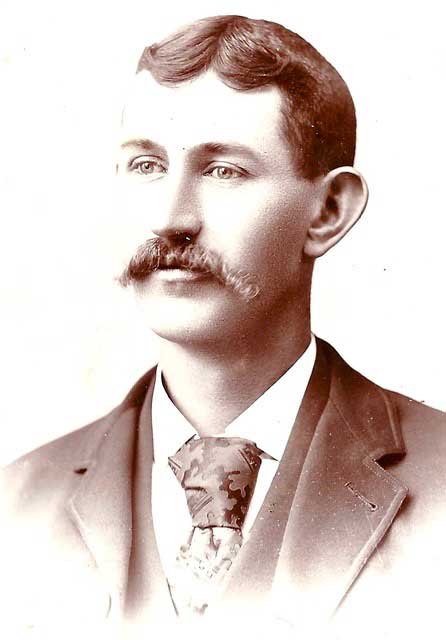
Charley Forrester, not long after his graduation from college.
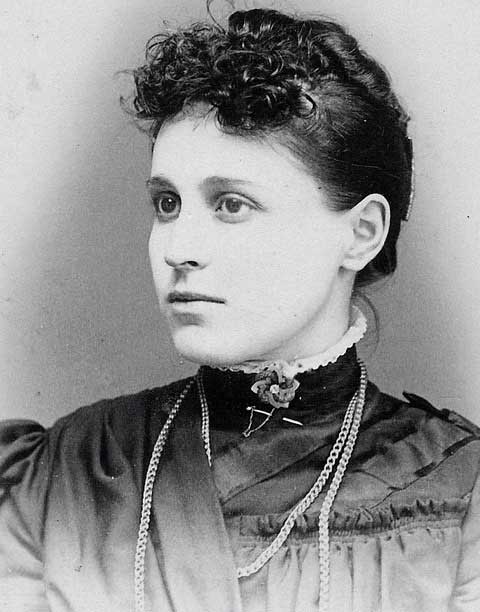
Carrie Van Horn, before her marriage
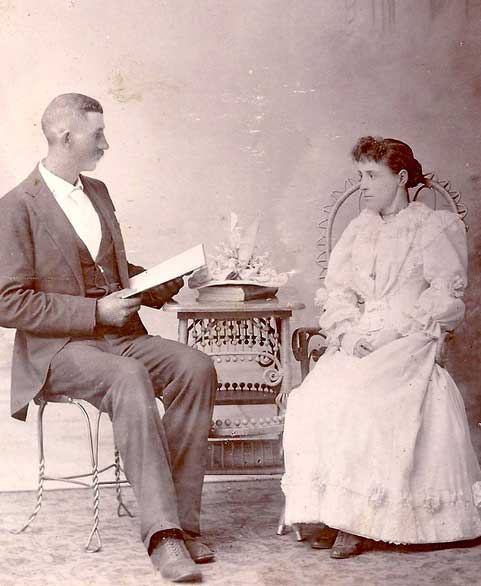
Wedding photo, 1893
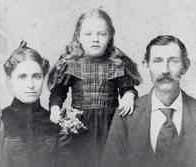
Charley and Carrie with their daughter, Mabel, about 1905
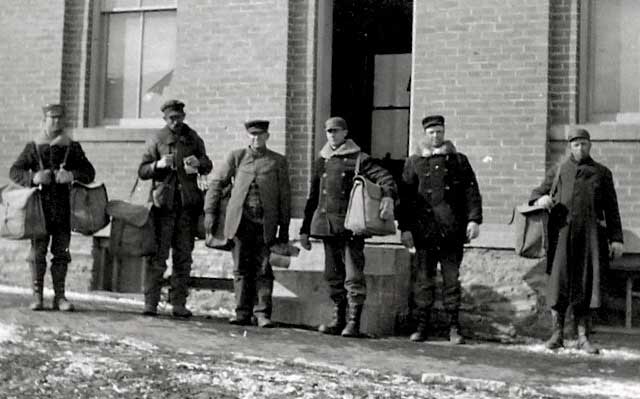
RFD mail carriers in Kahoka. (Charley is second from left.)
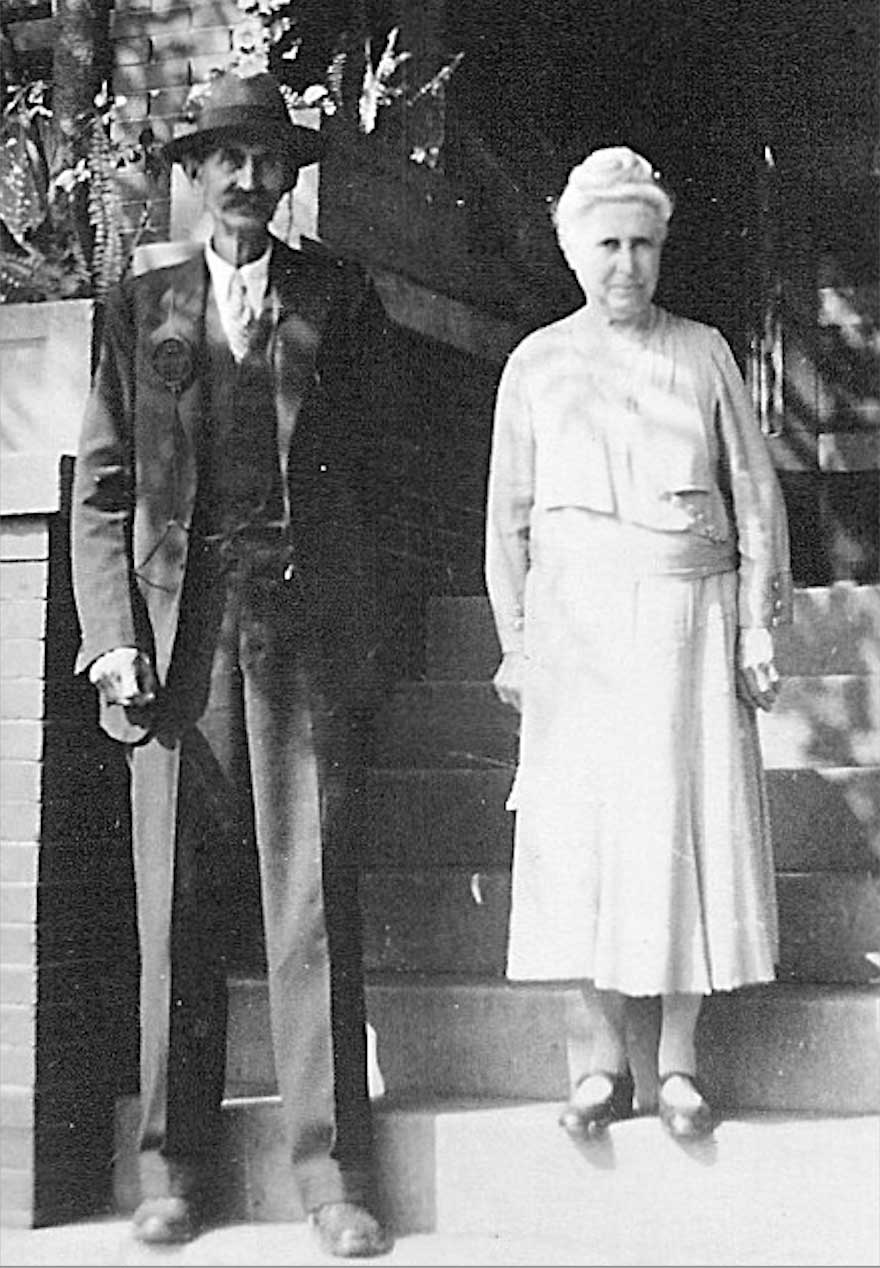
Charley and Carrie in early 1930s
Saw Chas. and Elsie Marsh. Elsie has not changed much since they were married 36 years ago but Chas. does not look like the same person, or as he looked 36 years ago.
I went to the Star Restaurant this morning and was there when the bus arrived. He still did not know when the bus left Keokuk for Jacksonville and Springfield. Said he would find out today and phone the Star Restaurant by 4 p.m. today. I think I will wait till Monday to start now anyway. I guess I can get to Palmyra in time for the first day of picnic and that will be soon enough.
You might drop me a card in care of Willie's folks and let me know how the grain turns out. Love to all and to my baby, Kenneth.
Chas. Forrester
On Tuesday, August 10, my mother noted in her diary, "Kenneth is 4 mos. old today. We threshed. Beulah helped with dinner. They are here again tomorrow. Nice cool time for such work."
The next day: "Threshing again today. Big rain storm at noon. But they finished up this p.m. Creva (the Forrester's neighbor across the street in Kahoka) called this eve. Said Dad was sick there at house. E and I went down this eve. He has summer flu."
Thursday, August 12: "E and I went to Kahoka early this p.m. and took Dad to Graham Hospital. Got there about 3:30. Dad is pretty sick. Has 103.4 fever. Dr. Dorsey says yellow jaundice."
Friday, August 13: "I went to Keokuk to see Dad this p.m. He is some better. Said he felt fairly well most of day. Has some gas pain. I left at 5:10. Didn't get to see the Dr."
Saturday, August 14: "We started canning corn. 5 qts. this a.m. 11 more quarts ready. Mrs. Peterson of Graham (Hospital) called at 1:45. Said Dad was worse, for us to come. He took pneumonia at 1. Passed away at 6."
This seemed like a good time for Mother to express the shock of losing her dad in a long letter. But the diary offered only enough room for cryptic notes.
On Sunday, August 15, she wrote, "We can't quite realize it. Otis (their neighbor and the local undertaker, Otis Gutting, whose wife, Creva, had made the first call) brought Dad's body to Kahoka. We went to Kahoka at 10 and stayed all afternoon. Daddy surely looks lovely."
The funeral took place at 2:30 p.m. at the Christian Church in Kahoka, where Charley and Carrie had been faithful members for many years. Charley was buried in the Kahoka Cemetery, where he would be joined by Carrie when she passed away in 1944.
Charley had always been interested in puzzles and games, and introduced the card game of Casino (said to have been brought back to the U.S. by World War I troops) to my folks. Winning the game meant acquiring the most “cards and spades,” and the “face cards” were part of the numbering system. My dad used to remark that after a hard day of work, Charley would approach him in the evening and ask, “how about a game of Casino?”
After Charley’s passing, I was taught the game as a child, and often played Casino with my parents. During my first week at our country school, I was asked if I knew my numbers. Beginning with ace and deuce, I continued through ten, and ended my recitation with “jack, queen, and king.” My first-grade teacher was surely puzzled.
My grandfather left his family little in the way of money, but there were a few items that I’ve always appreciated. A bookcase in the corner of our living room at Hillcrest Farm contained a large collection of National Geographic magazines that Charley had left for the family. As a child, I was fascinated by the stories of exotic islands and quaint villages in foreign lands. I also fancied exploring the twisty blue lines that designated streams and creeks that covered many areas of the wonderful maps.
I know the old maps influenced my thinking when as a 14-year-old I took a long hike one summer with two of my friends. Equipped with sleeping bags but no tents, we hiked down the nearly-dry Wyaconda River to Canton, Missouri, crossed the ferry to Ursa, Illinois, and walked north on a gravel road to Hamilton, and stayed overnight at my aunt’s house. The next day we crossed the bridge to Keokuk, Iowa, and followed the (then abandoned) Keokuk & Western railroad track west to our Missouri farm. The hike covered parts of three states and covered approximately 120 miles. A wanderlust inspired by the National Geographic maps had definitely been satisfied!
Years later, paddling a lightweight kayak, I would spend a month each year for several years exploring creeks and rivers in Florida with names like Weeki-Wachi, Withlacoochee, and Chassahowitzka. Different time, different place -- but still inspired by the old maps my intellectual grandfather left in our farm-house in the 1930s.
Ken Weyand is the original owner/publisher of Discover Vintage America, founded in July 1973 under the name of Discover North.
Ken Weyand can be contacted at kweyand1@kc.rr.com Ken is self-publishing a series of non-fiction E-books. Go to www.smashwords.com and enter Ken Weyand in the search box.