
May 2026
Vintage Discoveries
Arkansas traveling: retracing a 1921 road trip
by Ken Weyand
My Aunt Florence was unique in her day. The oldest of eight orphans, she became a social worker and later a state employee in Arkansas, where she lived most of her life. One of the few women to become a certified Red Cross lifeguard, she enjoyed summertime swimming and outings with her friends. It was a road trip in 1921 that caught this writer’s eye.
That summer she accepted an invitation from friends (a husband and wife and two other ladies) to join them on a road trip in the couple’s new Essex. Their route was from Little Rock to Memphis, TN, where they dropped off two of the women, then up to the Missouri border at Mammoth Springs, and back. Arkansas roads at that time were nearly non-existent, especially in the hill country, and the Essex suffered several breakdowns, but it got them back safely.
I learned about the trip from an old photo album, little larger than pocket-size, with pages of black paper. Along with a few photos, Florence had written an account of the trip in white ink, in a “doggerel” style, which Webster defines as “poorly written, and not to be taken seriously.” On the first page, she wrote:
“This doggerel’s a tale of a party of five, who went on a trip and got back alive. Allow me, I pray, to present our good Essie, thru no fault of hers, her appearance is messy. But in spite of all that, she goes like a whiz, like the most worthy car that our good Essie is”
Although never published, my aunt’s album offered insights into the early days of motoring, when tire changing and breakdowns were common, gay meant something light-hearted, and a radio concert was something to write home about. My aunt wrote that the group “enjoyed swimming in the Spring River.”
The car was a brand-new Essex. Built by Hudson Motors, it was designed to compete with Henry Ford’s Model T, but a bit pricier. Like the T, it was well-built, with semi-elliptical springs and an 18-hp engine. Its 32-inch tires gave it enough ground clearance to handle most roads in 1921. But the rocky hills of the Ozarks were a challenge. During their trip the Essex suffered two broken springs, a couple of flat tires, and a cracked radiator.
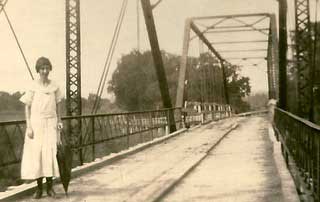
Florence, near the end of the trip
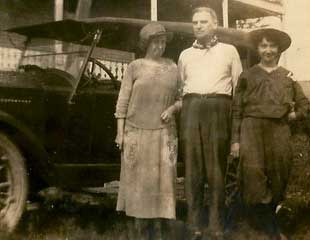
Florence (right) with her friends, the Snodgrasses, and their new Essex
By the time the group returned to Little Rock, the clutch went out.
Apparently, my aunt was undaunted by the strenuous trip. Back in Little Rock she added a final bit of doggerel to the album: “But with all her ailments, Essie pulled us thru. Brought us back to safety, as good cars ought to do.”
Recently, I drove to Arkansas and followed my aunt’s route from Little Rock that included Lonoke, Carlisle, Brinkley, Marked Tree, Ravenden, Imboden, Hardy, and Mammoth Springs. In Lonoke, I visited the Lonoke County Museum, where the director, Sherryl Miller, showed me some photos from the ‘20s, and described how the roads would have been in those days. The first leg of my aunt’s trip is now Hwy. 70, a two-lane road that parallels I-40 toward Memphis. The stream the travelers forded that caused the radiator to leak was either the Bayou Meto west of Lonoke or Two Prairie Creek, near Carlisle. Both have bridges now, but the style is similar to many built in the 1930s.
I followed Hwy. 70 and turned north on Hwy. 149, eventually leaving the flatlands and driving into the Ozarks, through Marked Tree, Imboden, Hardy, and finally Mammoth Springs. The towns are small, picturesque, and still feature a similar mix of small businesses and churches, typical of those in 1921. But now the highways are paved and well-marked. And travelers can now find overnight accommodations without resorting to staying in boarding houses, like my aunt and her companions did. The rickety bridges are gone, replaced by modern concrete. Roadside signs eliminate the need to ask directions from locals.
And with Sirius XM classic jazz playing on the car radio, I didn’t have to stop and attend a “radio concert.”
Ken Weyand is the original owner/publisher of Discover Vintage America, founded in July 1973 under the name of Discover North.
Ken Weyand can be contacted at kweyand1@kc.rr.com Ken is self-publishing a series of non-fiction E-books. Go to www.smashwords.com and enter Ken Weyand in the search box.