
Recalling the days when a new radio was a ‘must have’ for U.S. households
October 2026
Vintage Discoveries
Recalling the days when a new radio was a ‘must have’ for U.S. households
by Ken Weyand
A year after my parents’ wedding on New Years’ Day, 1928, my mother saved an issue of the Clark County Courier, the weekly newspaper that served her hometown, Kahoka, in northeast Missouri. For months she had been driving about 20 miles from their farm to give piano lessons to several Kahoka residents, and the front page included a notice of a recital to be held the following Sunday at a local church.
In the paper, there were several auction ads placed by farm families who had given up as the October financial crash loomed. Benteco Store, a grocery, offered “fruit granulated sugar” in 10-pound cloth bags for 63 cents, and Kellogg’s Rice Krispies for 10 cents. A large ad by Martin Bros, a Chevrolet dealer, touted the new Chevrolet Six Sedan, offered at $595. Other models, a Roadster, and a Phaeton, were priced at $525.
What caught my eye, however, were ads for radios. Limited by the fact that few stations were available, the radio had nevertheless caught everyone’s attention as “the latest thing.” Unlike the practical forms they later took, early radios were pieces of furniture.
A large ad by the Kahoka Jewelry and Music House featured the latest Crosley radios. The Model 32, touted as the “lowest cost of all,” was a cabinet model, resting on graceful legs, designed to “harmonize with any scheme of interior decoration.” Offered at the “lowest cost of all,” it was priced at $99.50, “without tubes.” The total cost of getting the radio up and running was not revealed in the ad.
Another advertiser, Martin Elec. & Supply Co., featured the “Majestic Electric Radio,” that had been chosen to entertain “Graff Zepp” passengers on their return trip to Germany. The store chose not to disclose the price, but urged readers to “let us give you a free home demonstration.” (The era of Graff Zeppelins ended with the crash of the Hindenburg, May 6, 1937 at Lakehurst, NJ.)
In 1921, when radio was even more of a novelty, my aunt had written of a “road trip” she had taken with friends in northeast Arkansas. She reported they stopped at one town for the evening an attended a “radio concert,” but didn’t mention any details.
In 1926, on a Chautauqua tour in Ohio, my mother reported attending a “demonstration of a new radio outfit,” and heard a violin and voice broadcast originating from Pittsburgh. “Towards the end of the concert,” she wrote, “the air conditions became ‘static’ as they express it in ‘radio language,’ and we had a little trouble getting everything, but on the whole, everything was as plain as could be. How wonderful to be able to hear through the air like that.”
In A 1929 letter, my mother congratulated my dad’s sister and her husband on getting their new radio. “In the absence of one of our own,” she wrote, “we have been enjoying several Sunday evening programs at a neighbor’s. I’m interested in the Chicago Symphony Orchestra programs sponsored by Standard Oil.”
My parents would later acquire a battery-powered Atwater-Kent radio, a few years before their farmhouse was wired for electricity in the early 1940s. My mother would eventually get her “classical music fix” by listening to Public Radio on WOI-FM from Iowa City, Iowa.
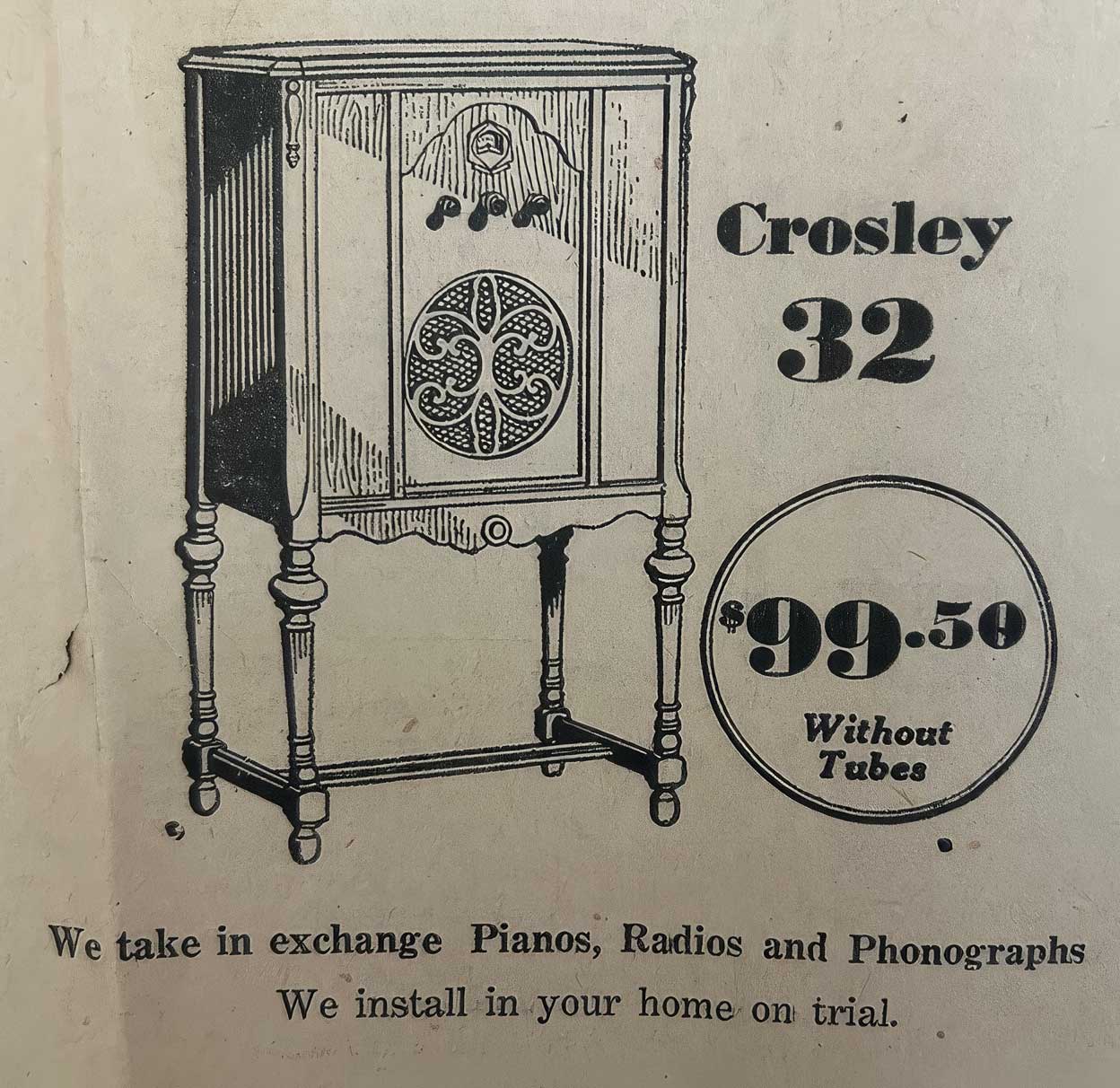
Advertisement for radio
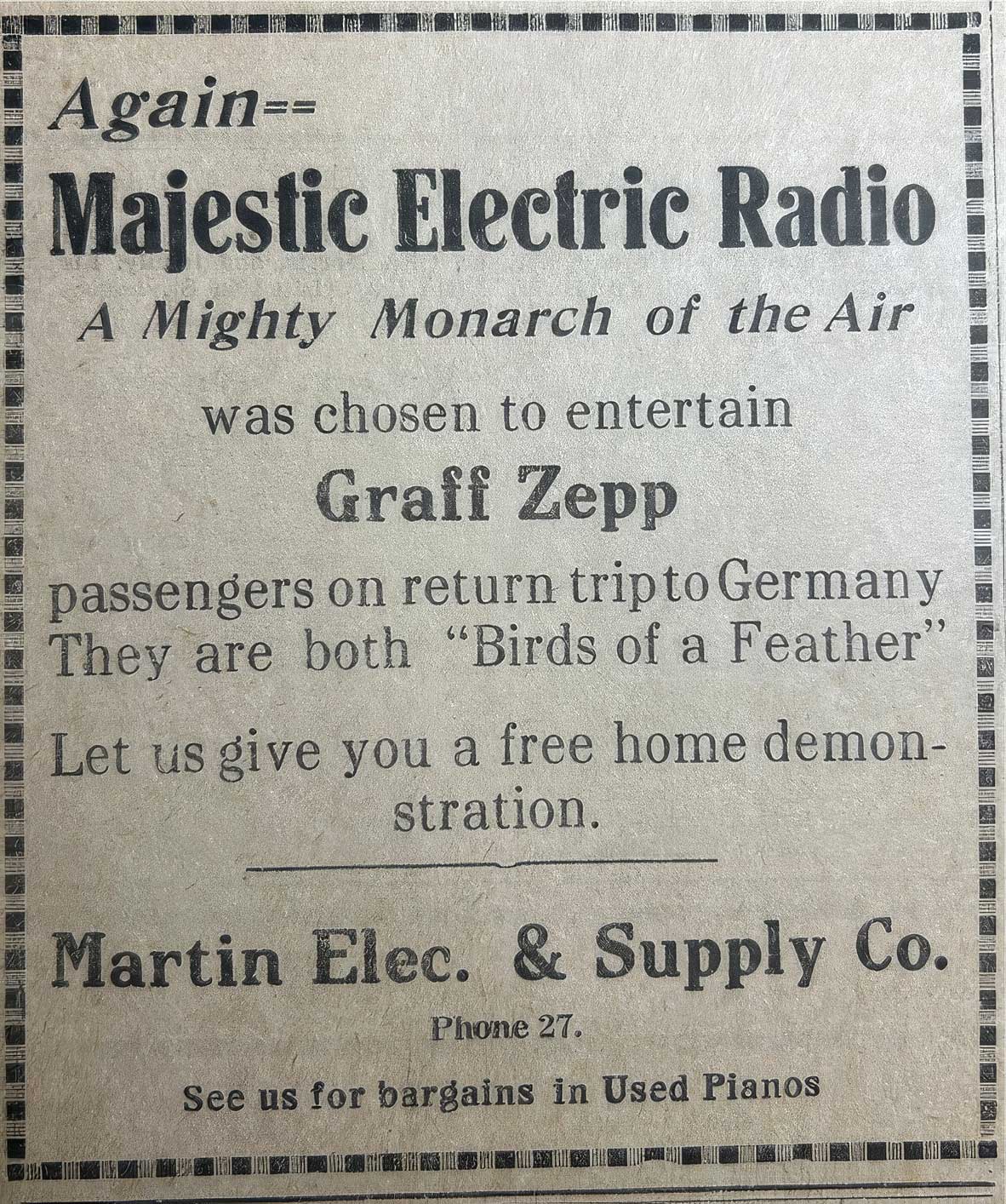
Advertisement for radio home demonstration
Ken Weyand is the original owner/publisher of Discover Vintage America, founded in July 1973 under the name of Discover North.
Ken Weyand can be contacted at kweyand1@kc.rr.com Ken is self-publishing a series of non-fiction E-books. Go to www.smashwords.com and enter Ken Weyand in the search box.
Keokuk, IA, celebrates 10-year restoration of 1891 Union Depot
December 2024 Vintage Discoveries Keokuk, IA, celebrates 10-year restoration of 1891 Union Depot by Ken Weyand Back in its day, the massive and ornate Victorian-style depot building built in 1891 was a centerpiece of Keokuk, IA. Then a bustling transportation center,…
Poster recalls Ozark Air Lines, TWA, and an exciting cross-country flight
November 2024 Vintage Discoveries Poster recalls Ozark Air Lines, TWA, and an exciting cross-country flight by Ken Weyand Recently, I found an old aviation poster, rolled up in a corner. It’s a reminder of the days I had a love affair with aviation, writing about its…
‘Forgotten airport’ found in Kansas City Area
October 2024 Vintage Discoveries ‘Forgotten airport’ found in Kansas City Area by Ken Weyand When I was putting together the 1970 book, “Aviation History in Greater Kansas City,” a few of the old-time pilots I interviewed mentioned the old “Police Airport” in North…
World’s Fair souvenir book reveals styles of the ‘thirties
September 2024 Vintage Discoveries World’s Fair souvenir book reveals styles of the ‘thirties by Ken Weyand Six years ago in my column, I recalled a trip my mother and her parents made in 1934 to the Century of Progress Exposition in Chicago. Recently, I discovered a…
Old ‘Wonder Tower’ in Colorado offered views of 6 states
August 2024 Vintage Discoveries Old ‘Wonder Tower’ in Colorado offered views of 6 states by Ken Weyand Back in the mid-1920s, a favorite ‘”tourist attraction” in eastern Colorado was a crude 65-foot tower built on what was reported to be the highest point between New…
Old brochure touts Ford’s automotive progress – in 1935
July 2024 Vintage Discoveries Old brochure touts Ford’s automotive progress – in 1935 by Ken Weyand A few years ago, I chronicled the story of a long “road trip” my parents and grandparents took to California in 1935, a couple of years before I was born. My parents…
Old ‘slate-board’ from the 1800s made learning a bit easier
May 2024 Vintage Discoveries Old ‘slate-board’ from the 1800s made learning a bit easier by Ken Weyand While today’s parents and teachers fret about how youngsters are too dependent on smart phones, I was tickled to find an “education tool” from another age in the…
Old magazine brought back memories of the 1950s
April 2024 Vintage Discoveries Old magazine brought back memories of the 1950s by Ken Weyand Like many 15-year-old boys in early 1950s rural America, I was caught up in the popular culture of the times. In those heady days before the Internet killed off or reshaped…
Old geography textbook taught my ancestor the ‘basics’
March 2024 Vintage Discoveries Old geography textbook taught my ancestor the ‘basics’ by Ken Weyand A small and very old textbook turned up recently in the back of a bookcase. I thought it might have been something I had acquired from an antique shop, but it turned…
Mother Goose book finds a new home
February 2024 Vintage Discoveries Mother Goose book finds a new home by Ken Weyand One of the “finds” in my collection of “old stuff” is a well-preserved “Mother Goose” book from my childhood. It isn’t guesswork on my part: the book has my name written discretely in…
Old Bible witnessed two decades of family history
December 2023 Vintage Discoveries Old Bible witnessed two decades of family history by Ken Weyand When my grandfather, a struggling grocer in Keokuk, IA, married a young milliner from neighboring Warsaw, IL, in 1880, their lives changed considerably. No longer would…
1926 souvenir book marked America’s first 150 years
October 2023 Vintage Discoveries 1926 souvenir book marked America’s first 150 years by Ken Weyand At the bottom of a cedar chest with other family memorabilia, I found a souvenir book of the 1926 Sesqui-Centennial Exposition, held in Philadelphia. It featured…