One wild ride – Ferris Wheel Antiques in Topeka celebrates 20 years

July 2023

Feature Article

One wild ride - Ferris Wheel Antiques in Topeka celebrates 20 years

By Corbin Crable


Move over, Beanie Babies. Hit the road, Hot Wheels. You won’t find either at Ferris Wheel Antiques, a place that owner Michelle Ferris calls one of the only “true antique stores in Topeka.”

It’s a strategy that has worked well for Ferris and her husband Ronnie, who are celebrating their 20th year of operating Ferris Wheel in 2023. The Topeka store, which was built from scratch in 2003, wasn’t exactly some-thing the couple planned, Ferris says. Like so many wonderful life events, “it just happened.”

“It wasn’t something we planned on,” Ferris explains, adding that Ronnie is a buyer and seller of petroliana. “When his buyers didn’t buy as much, we decided we had enough to open a store… We just jumped in with both feet to see what would happen, and it worked.”

The couple decided they wanted to deal exclusively in antiques, opting to stay away from the junk one might find in other stores.
Also joining Ferris and Ronnie as fixtures in the store were their young daughters, ages 5 and 1.

“Somehow I ran a store with a 1-year-old. I don’t know how,” Ferris says, laughing. “Our girls basically grew up in the store, and our clients have seen them. Our girls would drive wagons and pedal cars around the store. It was like Romper Room.”

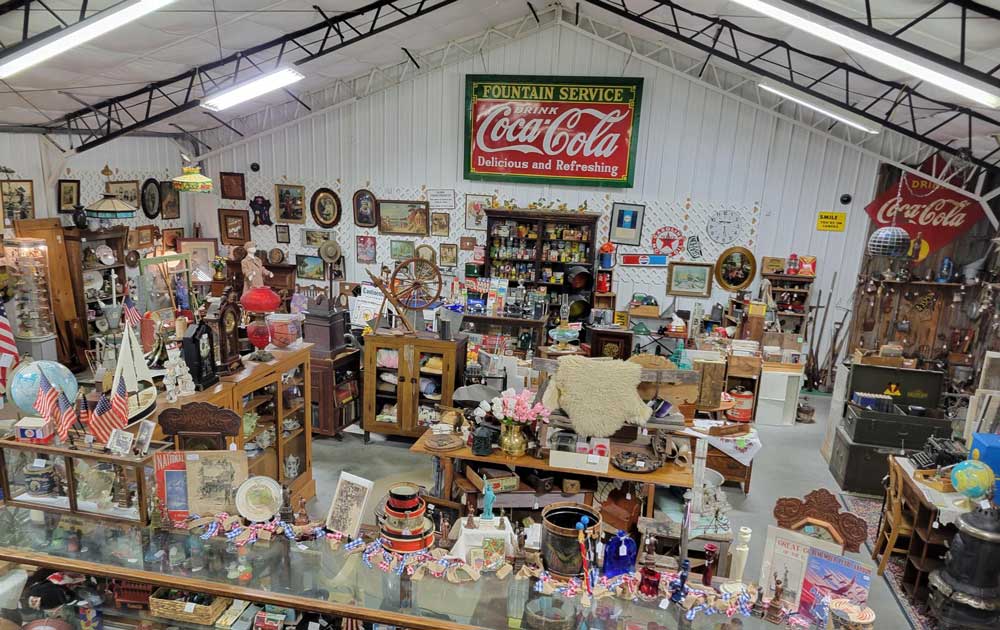
As their girls grew, so did the store’s physical space (Ferris Wheel began with just one building with 3,200 square feet of space and later would expand to its square footage of more than 6,000). Word-of-mouth promotion of the antique store in town that had lots of petrol-related collectibles spread as well. Visitors would discover a steady inventory of prim-itives, early Americana, and antique books, too.

Ferris says you won’t find any items more recent than the 1960s throughout the store’s shelves.
Over the past two decades, Ferris says she and Ronnie have amassed a following of customers who have become like family. And since they don’t have any hired staff to speak of – the Ferrises are at the cash register six days each week – they’ll be the ones you meet when you come in.

“We’re the fun place to shop,” Ferris says, “and we are the faces of the store. We could not have done any of that without customers, friends, and colleagues. We try to make our store feel like home. These customers we have are extended family. We’ve made friendships that will last a lifetime. My customers know that.”

Those customers, Ferris says, likely would describe her store using the three words “family,” “friends” and “fun,” while Ronnie adds that he believes they would use the words “traditional,” “quality” and “unique.”
Throughout the years, trends in buying antiques have come and gone, and Ferris says one of the biggest keys to her store’s success is that she always tries to follow them closely.

“We’ve seen cycles go up and down, trends come and go,” she notes, adding that younger buyers are increas-ingly repurposing antiques. “The younger generation now isn’t really into investing a lot of money in antiques, but the ones who come in now may have creative ways to use antiques and repurpose them, much more so now than 20 years ago.”
 

Gingerbread cookies

There is such a variety of merchandise to hunt through. The Coca-Cola sign on the back wall was the first thing to be displayed in the store and has been a fixture there for 20 years.
Gingerbread cookies

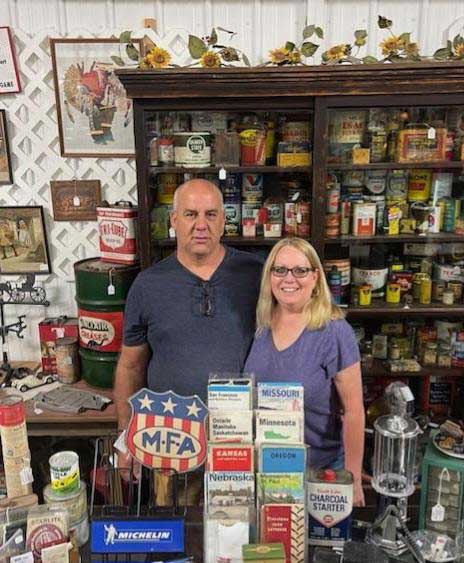
Surrounded by some of the widely varied merchandise at the store are proprietors Michelle and Ronnie Ferris. (All images courtesy of Michelle Ferris)

The advent of social media in Ferris Wheel’s early years has helped the business grow immensely, too.

“When we first started, social media was not a thing. Our advertising was a lot differ-ent then than it is now,” Ferris observes. “Pinterest is a big one; you have women coming in and looking for the same thing (due to a trend) on Pinterest that you have might have missed. There’s nothing bad about that; anything to pique some-body’s interest. I appreciate all of that.”

Though she says she has no plans to retire yet, Ferris says she doesn’t know how much longer she and Ronnie will be the faces of the store. That’s OK, though; she’s already training the next generation of antique sellers, she says – her infant grandson spends plenty of time at the shop, greeting customers who become adoring fans.

Ferris says she welcomes all to Ferris Wheel Antiques and hunt for that special treasure.
“We love what we do,” she says, “and I’d love for new customers to come in and find out what we’re all about.”

For more information, call Ferris Wheel Antiques at 785-862-8850 or visit their Facebook page or website: ferriswheelantiques.com.

 

Gingerbread cookies

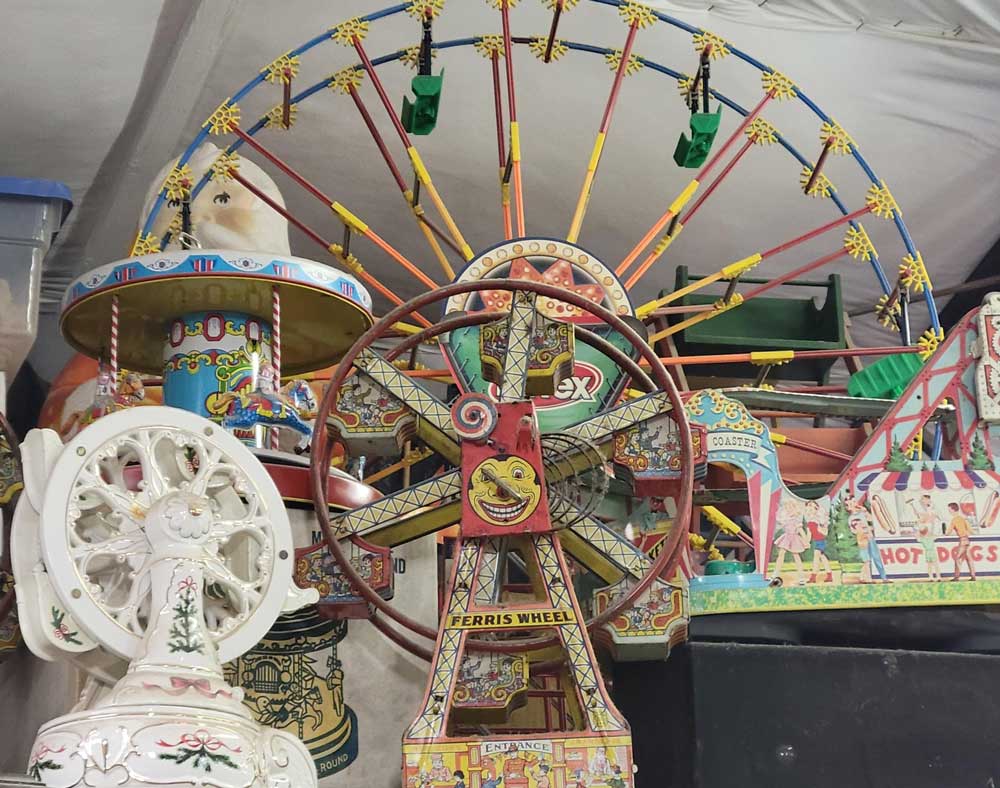
A small portion of their signature collection of Ferris Wheels (NFS).

Contact Corbin Crable at editor@discovervintage.com.


A brief history of Flag Day in the United States

June 2023

Feature Article

A brief history of Flag Day in the United States

By Corbin Crable


You might have pledged allegiance to the American flag every morning in elementary school, but do you know the story behind the holiday that bears its name?

Flag Day falls on June 14 of every year, just three weeks shy of Independence Day. In 1777, the Continental Congress of the United States adopted a resolution stating that the flag of the United States “should be of 13 stripes of alternate red and white, with a union of 13 stars of white in a blue field, representing the new constellation.” The 13 stars and stripes, of course, represented the 13 original colonies.

According to the U.S. Veterans Administration, the flag “was first carried into battle on Sept. 11, 1777, in the battle of the Brandywine,” but the claim of organizing the first official observance of Flag Day has been made by many institutions and on many dates. The first, the VA states, was during a celebration in Hartford, Conn., in 1861.

“In the late 1800s, schools all over the United States held Flag Day programs to contribute to the Americanization of immigrant children, and the observance caught on with individual committees,” the VA website states.

Generally, the first official Flag Day is recognized as having originated in New York in 1889, when a teacher of a free kindergarten sponsored ceremonies to observe the congressional resolution’s anniversary. Only a few years later, in 1897, New York’s governor “ordered the displaying of flags over all public buildings in the state,” the website reads. Other claims to the first Flag Day observance come from Pennsylvania and Wisconsin.

“Presidents Woodrow Wilson and Calvin Coolidge issued proclamations asking for June 14 to be observed as National Flag Day,” according to the VA website, “but it wasn’t until Aug. 3, 1949, that Congress approved the national observance and President Harry Truman signed it into law.”

Gingerbread cookies

Stars and Stripes forever

The History Channel’s website clarifies these and other facts about Flag Day, and even dispels myths surrounding the flag itself. Among them, “It is widely believed that Betsy Ross, who assisted the Revolutionary War effort by repairing uniforms and sewing tents, made the first American flag. However, there is no historical evidence that she contributed to Old Glory’s creation. It was not until her grandson William Canby held an 1870 press conference to recount the story that the American public learned of her possible role. It has since been confirmed that Francis Hopkinson, a delegate from New Jersey who signed the Declaration of Independence, designed the American flag.”

In addition, according to The History Channel, less than a decade after the observance of Flag Day was signed into law, a 17-year-old high school student in Ohio, Bob Heft, when it became clear that Alaska and Hawaii would be granted statehood, stitched 50 stars onto his family’s American flag that had 48 stars displayed across its blue field. He altered the flag for a class project – for which he received a grade of B-.

“Heft also sent the flag to his congressman, Walter Moeller, who presented it to President Eisenhower after both new states joined the Union. Eisenhower selected Heft’s design,” The History Channel’s website reads, “and on July 4, 1960, the president and the high school student stood together as the 50-star flag was raised for the first time. Heft’s teacher promptly changed his grade from a B- to an A.”

Today, the federal government has designated June 11-17 as National Flag Week, during which time the American flag should be displayed on all government buildings.
For more information on Flag Day, its history, and customs and etiquette surrounding the American flag, visit www.va.gov and www.history.com.


Contact Corbin Crable at editor@discovervintage.com.


School Releases Top Selling Antique & Vintage Trends from Past Year

March 2023

Feature Article

School Releases Top Selling Antique & Vintage Trends from Past Year

Submitted by Charles Green


Press Release

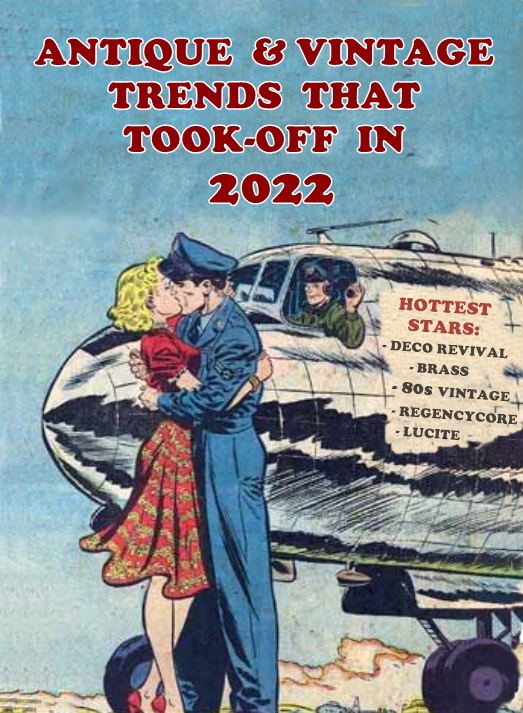
New York - For industry insiders, the wait is finally over. Now in its 14 year, the Asheford Institute’s annual survey of top decorative arts buying trends from the past 12 months has just made its way onto both digital and paper newsstands across the country.
The international survey/poll of past students and graduates from the Institute has become a staple to many in the antique and vintage industry for its unique ability to look into the current state of today’s decorative arts marketplace, as it relates to overall sales trends for dealers working within the collecting community.

Anthony Harper, the school’s lead researcher, says the key to getting meaningful survey results that businesses and people can actually use to help plan their inventory buying strategies for the upcoming year is based on receiving actual sales data, alongside item-specific requests from buyers, which can then be used to indicate interest within a particular collecting genre.

As with virtually all business this past year, Harper says ongoing supply-chain issues continued to have an effect on almost every segment of the economy - including certain genres within the decorative arts field. “In 2021 we were all still recovering from Covid, but this past year, buyers, dealers, and collectors were out en masse, in-person, and were literally snapping up everything in sight.” Harper says that by the end of summer many dealers were complaining about a lack of available and affordable inventory. “It wasn’t just one category of collectible,” says Harper, “it was virtually anything, from folk art to baseball cards.” Similar tales have surfaced in previous years, but Harper says those scenarios were not even close to the severe shortage of available stock that many antique and vintage dealers faced in 2022. Harper believes that some collecting categories in this years poll may have risen or fallen not necessarily because of a lack of popularity, but because of a lack of stable inventory.

However, he does acknowledge one upside to all the market uncertainty - for most dealers, sale prices rose sharply.
For Amber Shole, who’s been compiling survey statistics for over 11 years now, the most striking change in poll results this year was also related to price. “Item listing values skyrocketed in virtually every area,” she said, “and dealers took advantage by holding firm on prices.” Fan favorites like Art Deco and Textiles continued to boom says Shole, while other perennial favorites such as Mid-century modern began to show signs of weakening. “There’s definitely a shift,” she says, “it’s just a matter of being able to pick up on those markers before they become full-fledge trends.”

In other areas of the survey there were also some pleasant surprises, as once again an unexpected (but familiar) era of collecting shot back up the charts to a respectable placement for the first time in over 25 years. The cause? Well, according to Shole, it’s all about a younger generation that’s turned frugal-collector. “Young people are looking for inexpensive eco-friendly choices and sustainability,” says Shole, “and the antique and vintage market is giving them that.” Shole believes that the creation of new trends in the decorative arts market is more of a symbiotic relationship than anything else. “Millennials and Gen-Zer’s need something, and we›re able to supply it to them,” she says, ”and it’s that practical aspect that›s driving the creation of some of these new trends.”


Gingerbread cookies

Trends that took off in 2022

For readers seeking the complete 2022 listing of all the best-selling antique and vintage genres and categories contained within the school’s yearly poll and survey, you can find the full results (including this year’s winner) by visiting the Institute’s website at: www.asheford.com/asheford-news-ticker-headlines/top-selling-antique-vintage-categories-of-2022-released.

To learn more about the antiques and appraisal study program being offered by the Institute, you can contact them directly at: 877-444-4508, info@asheford.com, or visit their website at: www.asheford.com.


News release provided by Charles Green of the Asheford Institute of Antiques.
Contact Charles at 877-444-4508 or email to: info@asheford.com

The sweet story of gingerbread men

December 2022

Feature Article

The sweet story of gingerbread men

by Corbin Crable


Run! Run!
As fast as you can.
You can’t catch me,
I’m the gingerbread man!

The late author Jamie Gilson’s famous rhyme about this cute confection has been recited in elementary schools since its publication in 1981, but Christmas revelers with a sweet tooth have been eating gingerbread men for centuries.

Gingerbread

Gingerbread started as small cakes with honey – they didn’t contain ginger and they weren’t considered a type of bread. Historians believe the honeycakes were invented by the ancient Greeks or Romans, according to a Dec. 22, 2018, article on Time.com. A recipe for “gingerbread” in a 15th-century English cookbook had a chewy consistency, not unlike toffee. The recipe read, in part: “Take a quart of honey and seethe it and skin it clean. Rake saffron and powdered pepper and throw them on the honey. Take grated bread and moisten it. Combine honey with spices. Add cinnamon and cloves and make them into squares. If you want it to be red, color it with red sandalwood.”

Cookies in little men's shapes

The cookies have been shaped like little men since the reign of Britain’s Queen Elizabeth I in the 1500s. The queen had in her employ a royal gingerbread maker, who baked the cookies meant to represent members of Queen Elizabeth’s court. He then served the cookies at Her Majesty’s elaborate royal dinners. By the end of the century, bakers began using sugar in gingerbread instead of honey.
According to the Time article, around the same time, some who practiced folk medicine gave out cookies to young ladies in their village.
“If they could get the man of their choice to eat the gingerbread man that had been made for them, the idea was the man would then fall in love with the young woman,” Carole Levin, a historian with the University of Nebraska-Lincoln, says in the article.

According to another historian, Michael Krondl, gingerbread began to be associated with the Christmas season because of the belief that the cookie’s spices heat you up throughout the winter months.

By the 1700s, bakers began to add butter and cream to gingerbread recipes, and thus, the cookie started to resemble the gingerbread we know and love today.


Gingerbread cookies

Gingerbread cookies

Gingerbread cookies are the quintessential Christmas treat, and they’ve existed in some form since the ancient world. (Image courtesy of Country Cupboard Cookies)

Gingerbread houses

And who can discuss gingerbread men without a mention of gingerbread houses? According to the queen of homemaking, Martha Stewart, they are likely inspired by the tale of Hansel and Gretel, written by the Brothers Grimm in the early 1800s and which included a wicked witch’s house made of candy and cookies.

Gingerbread houses became popular around the same time thanks to German immigrants in America, who decorated their Christmas trees with gingerbread.

Today, of course, you can buy gingerbread house kits from your local grocer or merchant, allowing you to customize your delectable creation with your own holiday spirit.

News release provided by Tom Snyder of the St. Louis Gateway Postcard Club.
Contact Tom at 618-531-4189 or the.snyders@charter.net​

Vintage cookie cutters won’t take a bite out of your Christmas gift budget

December 2022

Feature Article

Vintage cookie cutters won’t take a bite out of your Christmas gift budget

by Corbin Crable


The Christmas season

The Christmas season is a feast for the senses – watching the twinkle of colored light displays, the sound of tearing open wrapped gifts, and the smell and feel of a freshly decorated fir. And one affordable collectible helps bring the taste of Christmas to every kitchen – cookie cutters.

The tool found in every baker’s arsenal can be traced back roughly 700 years, to the 1400s, when they were invented in Italy and known as “imprint cutters.” Like many Christmas traditions, the imprint cutter evolved to become used widely in Germany and Holland, where housewives used them during the Christmas holiday to bake cookies in the shapes of doves, eagles, and human figures, according to Collectors Weekly. Those earliest cookie cutters were made of wood.

When they immigrated to the New World, those same German settlers who worked as tinsmiths crafted cutters made of cheap tin, and the shapes in which they were produced now included stars, spades, and hearts, as well as reindeer and clowns.

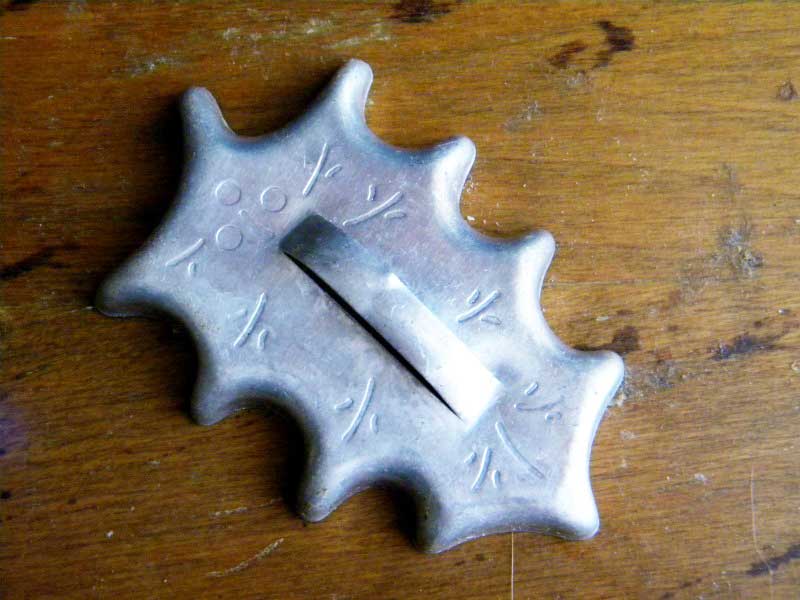
“Old tin can be identified from modern metals as it is relatively heavy and thick, usually darkened in color. These cutters make 3/4-inch to 1 1/8-inch-deep cuts,” according to Collectors Weekly. “The back of antique cutters are flat and may or may not have strap handles. Because tinsmiths tried to conserve every possible inch of metal they could, older backs are more or less cut to the shape of the cutting edge. These also have ‘air holes’ or ‘push holes,’ which helped detach the cookie dough from the cutter.”

Cookie cutters

Those cookie cutters made for the Christmas season were also made to be decorative, writes collector Kate Miller-Wilson for the antique blog Love to Know.

“As the idea of Christmas cookies spread throughout the Colonies, tinsmiths created Christmas-themed cutters that created cookies meant to be hung on Christmas trees. It wasn’t until the 1930s that the tradition of leaving cookies for Santa was established,” Miller-Wilson writes. ”Antique Christmas cookie cutters vary in value from a few dollars to over $100. In addition to the condition and age of the cookie cutter, size can also play a role in the value. For example, an extra-large, German-made Santa cookie cutter sold for about $80.”

Metal cookie cutters made in the 19th century can be found in antique stores and online – they were easily mass-produced, thanks to technological innovations made during the Industrial Revolution. These cookie cutters had handles made of metal or wood.
Aluminum cutters began to be produced around the turn of the century, with the most common coming from the 1930s.
“Metal cookie cutters with ‘bullet’ handles are especially sought after by collectors,” Collectors Weekly states. “In general, figurals like chickens and elephants tend to be more valuable than geometric shapes.”

These cutters weren’t just for cookies, however; in the early 20th century, they were made in the shapes of diamonds, hearts, spades, and diamonds – the four suites of playing cards – and made for sandwiches served at poker or bridge games.

holly leaf cookie cutter

Holly leaf cookie cutter

A vintage aluminum cookie cutter in the shape of a holly leaf. (Image courtesy of Love to Know)

Tin and plastic cookie cutters

Tin and plastic cookie cutters came in a variety of colors in the mid-20th century. British company Tala revolutionized the market by designing cookie cutters of different sizes that nested within one another. Major American companies that manufactured similar cookie cutters, meanwhile, included Midwestern Home Products, Ekco, and Kansas City-based Hallmark. Those cookie cutters sold by Hallmark in the late 1970s and early 1980s are especially collectible, Collectors Weekly reports.

“Recently, collectors have gravitated toward plastic cutters that advertise businesses,” the site states. “The vintage American cutters are marked ‘Made in the U.S.A.,’ while new ones are generally made in Hong Kong.”

Gift vintage cookie cutters

Still, according to Miller-Wilson, those wishing to gift vintage cookie cutters as stocking stuffers shouldn’t expect to pay too much for these culinary tools.

“These little treasures are easy to find in antique stores, and they’re affordable to collect,” she writes. “They often sell for only a few dollars.”

News release provided by Tom Snyder of the St. Louis Gateway Postcard Club.
Contact Tom at 618-531-4189 or the.snyders@charter.net​