Automotive factory overspray provides material for jewelry

May 2026

MEMORY LANE MUSINGS

Automotive factory overspray provides material for jewelry

by Sara Jordan-Heintz

Being a freelance journalist who writes about topics encompassing jewelry, antiques, nature, popular culture, and more, I’m always on the hunt for unique stories. A few years back, I came across Fordite, an eye-catching material that resembles agate and jasper, but is entirely manmade.

Fordite was created as a byproduct of paint overspray baked over time on the walls and assembly stands in manufacturing plants including Ford (where it gets its name) but also Chrysler, General Motors, Kenworth trucks, and Jeep. Sometimes you’ll see it labeled as Detroit agate and Motor City agate. The heyday of Fordite was the 1940s to 1970s — the decades before automated car painting was introduced in the mid-‘80s to curb waste.

As one car after another would be pulled through the bays for painting, the paint would accumulate, destined for disposal. Some factory workers were intrigued by the buildup, or slag, and would cut it out and keep it. In time, they discovered the vibrant-hued chunks could be fashioned into keychains, jewelry, and souvenirs.

Today, you’ll often find it sold by sellers based in Michigan, Ohio, Kentucky, and other places with a history of making cars. Hobbyists obtain the material from abandoned factories, some having been employed at the plants back in the day.

Fordite in its raw form is usually sold by the pound, but can also be sold by the gram. While regarded as an American “gemstone,” in actuality, Fordite can be harvested anywhere in the world where vehicles were painted the old-fashioned way. The swirling and banding of the stone reminds me of a human fingerprint.

What I love about Fordite is no two specimens are alike. Experts can even tell just by looking at a piece what car model(s) had been painted. Possessing a catalog of car paint codes from dealerships can help you with this task. You will encounter some Fordite in the shape of stalactites if the layers had formed from hardened drips of enamel paint. Lead-containing Fordite sometimes has visible layers of gray primer.

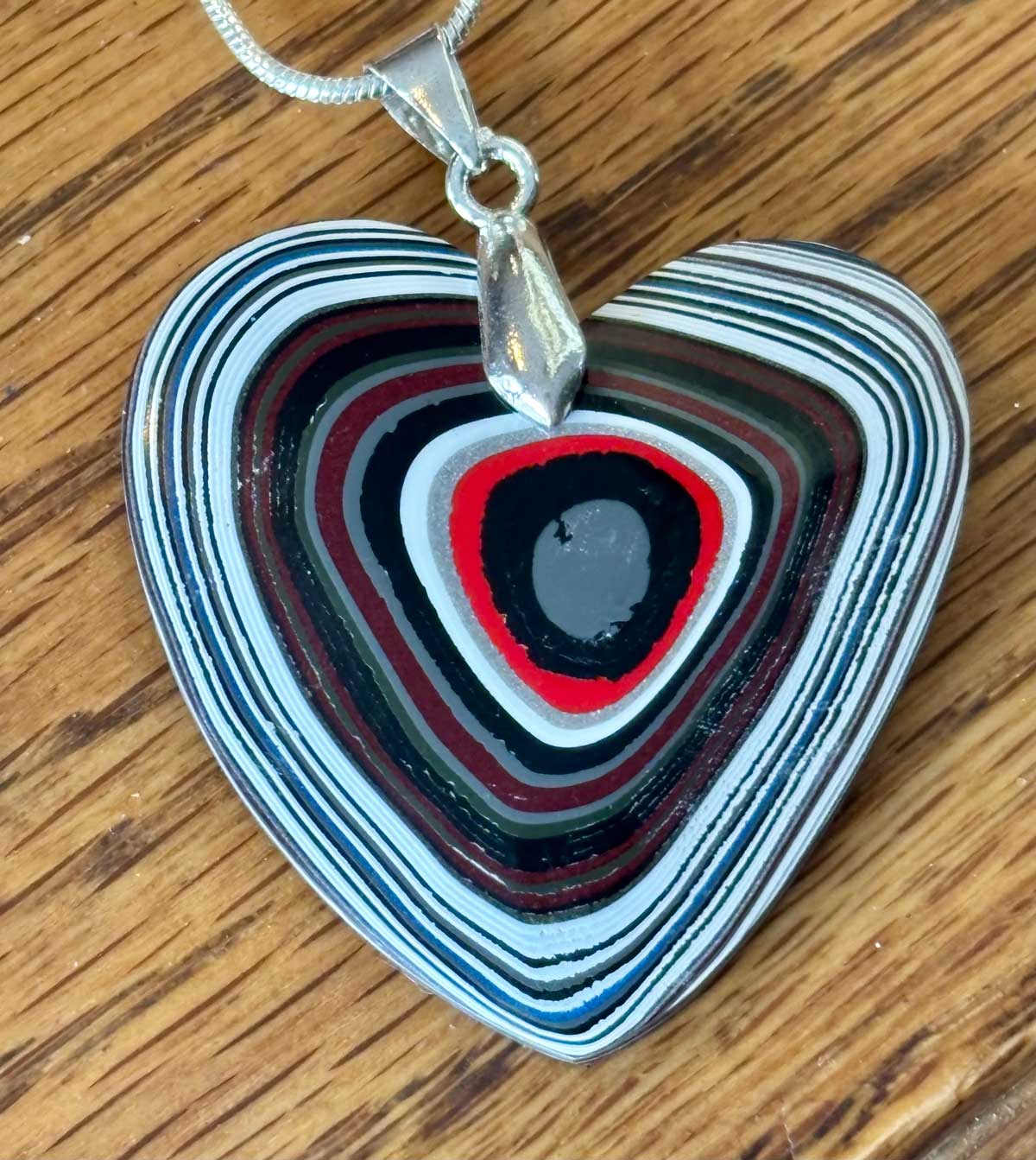
When you think back to the muscle car craze of the ‘60s and ‘70s, picture Mustangs. That variety of Fordite is immediately recognizable because of its bright metallic shades. The “bullseye” look comes from Fordite being collected in flat sheets. I’ve commonly seen this with the type from Jeeps, known as Jeepite.

Non-traditional Fordite is harvested outside of the plants. A roadside attraction and art installation called Cadillac Ranch in Amarillo, Texas, was established in 1974. People bring their own spray paint and decorate the discarded cars. The sun then hardens the paint (sort of), simulating the effect found in automotive factory painting. The color layers are thin and vibrant but can bleed into each other in a bit of a watercolor sort of way. Some artisans shy away from working with Cadillac Ranch because it can be brittle due to not being baked after each coating.


This piece of Fordite, known as Jeepite, has the bullseye look. It came from paint used on a Jeep Wrangler. Fordite: the upcycled ‘urban gem.’ (Image courtesy of the author)


After I purchased several pieces of Fordite, I was immediately struck by how lightweight the material is. In your hand, you’re expecting to feel a rock, but instead, it’s like a vinyl record, with its layers reminding me of grooves. Flipping the piece over, you could see entirely different patterns and pigments.

Proper care is important. In essence, Fordite comes in at a 4 or 5 on the Mohs scale of hardness. Fordite should not experience extreme heat or harsh chemicals. Jewelry makers I’ve spoken to say it’s common to seal a completed piece with resin or lacquer.

Is Fordite still being produced today (outside of art installations, that is)? The answer is yes and no. Vintage Fordite is confined to a place and time before the advent of paint automation. Modern car factories use electrostatic spray painting. But, mechanics that paint, say a door or other single part of a car for repair purposes, could paint it by hand. However, it would take a business years to accumulate enough layers of Fordite to “grow” it. But the well-connected enthusiast could obtain it that way.

Faux Fordite has wider paint layers and uses colors that were not used to paint automobiles. Connoisseurs know a fake when they see one.

Those interested in working with the material, particularly cutting it, should wear a mask and gloves to safeguard against inhaling any particles. Remember, car paint contained lead before 1978. However, polished pieces of Fordite are completely safe to wear.
Whether you have an interest in automotive history or love funky, colorful things, Fordite is a must-have for your collection.

Merchants National Bank ‘Jewel’ of Grinnell, IA

April 2026

MEMORY LANE MUSINGS

Merchants National Bank ‘Jewel’ of Grinnell, IA

by Sara Jordan-Heintz

Grinnell, IA, an artistic college town of 9,500 people situated along I-80 between Des Moines and Iowa City, may not be on your radar for a weekend road trip or romantic getaway, but it should be. Brimming with history (it was a stop on the Underground Railroad) and filled with buildings and residences on the National Register of Historic Places, it’s nicknamed the “Jewel of the Prairie” because its downtown is home to a Louis Sullivan “jewel box” bank.

Officially called the Merchants National Bank, 833 Fourth Ave., it was built in 1914 at a cost of $60,000. Sullivan, known as a mentor to Frank Lloyd Wright, is regarded as the “father of skyscrapers” and the “father of modernism.” He was the most influential architect of the Chicago School. He came to Grinnell in 1913 to sketch a design for the bank, which opened New Year’s Day 1915. It is one of eight “jewel-box” banks Sullivan designed in the Midwest during the last decade of his career.

My husband Andy and I toured the bank on Valentine’s Day while we were in town for the weekend.

The jewel box was designated a National Historic Landmark in 1976 and, after operating as a bank until 1999, houses the Grinnell Area Chamber of Commerce and Visitor Center. It is owned by Wells Fargo, which occupies the 12,000-square foot addition put on the building in the ‘70s.

Jessica Trivedi, a volunteer docent who hails from Chicago, where Sullivan’s work is legendary, said Iowa is fortunate to have examples of his work still standing.

B.J. Ricker was part owner of the local glove factory in town. Allegedly, his wife Mabel was in the same social circles as Frank Lloyd Wright’s first wife Catherine. Walter Burley Griffin and his wife Marion Mahony Griffin, colleagues of both Sullivan and Wright, designed the Rickers’ home at 1510 Broad St. in Grinnell, which is still standing. And, small world, Mabel Ricker attended high school in Oak Park with Walter Burley Griffin.

“Based on the history I’ve been shared, Mabel Ricker originally wanted Frank Lloyd Wright to build her new house, but he was unavailable,” Trivedi notes. “Since the Griffins worked in Wright’s office and managed certain commissions while he was in Europe, the Rickers developed a strong working relationship with them. When it came time to build the bank, B.J. Ricker recommended the Griffins to the board. However, they were in Australia at the time building the capital (Canberra) and recommended Louis Sullivan instead.”


Merchants National Bank was created with pink Tennessee marble floors, extensive ornamental terracotta, stained glass windows designed by Louis Millet, a hand-carved wooden check desk, and exterior Griffin statues, to impress its customers.

Merchants National Bank, also known as the Louis Sullivan Jewel Box Bank, 833 Fourth Ave. in Grinnell, Iowa. (Images courtesy of the author)

The Federal Reserve was established in late 1913 to provide the country with greater financial stability. Trivedi points out Merchants National Bank was created with pink Tennessee marble floors, extensive ornamental terracotta, stained glass windows designed by Louis Millet, a hand-carved wooden check desk, and exterior Griffin statues to impress its customers.

Upon entering the space, I was struck with how small and intimate the bank actually is (75 feet long, 43 feet wide, and 37 feet high). A blue stained glass sky light on the ceiling gives the viewer the illusion of floating beneath the surface of a pool. The terracotta headers are commanding, while the patterns in the glass complement the shapes in the exterior’s design.

Despite these elaborate touches (Grinnell was a small railroad town at the time) what the public seemed most impressed by, according to Trivedi, is the water fountain that originally sat at the end of the check desk.

In 1924, Merchants National Bank closed due to the agricultural depression of the time. Two years later, Citizens National Bank bought it. By 1930, it was called Poweshiek County National Bank, then Brenton National Bank by the mid-’80s. The Griffin statues (hybrid creatures featuring the body of a lion and the head, wings, and talons of an eagle) have faced vandalism and theft. Restoration efforts replaced the stolen Griffin and saw to repair work to prevent rainwater from getting into the building.

The care that has gone into preserving the bank (complete with framed documents and display cases) speaks not only of the town’s dedication to local history, but also an understanding and respect for what Louis Sullivan’s work means to the legacy of American architecture.

The Grinnell Chamber is open weekdays from 8 a.m. to noon and 1 p.m. to 4:30 p.m. Weekend and after hours tours can be set up by calling 641-236-6555.

Grinnell is truly a jewel, encompassing Grinnell College, small businesses, historic sites such as the Grinnellian Bed & Breakfast, and the Union Depot, used by the Chicago, Rock Island & Pacific Railroad, and today is El Cascabel Mexican restaurant. I know Andy and I will be back.


Sara Jordan-Heintz is a journalist, author, and editor based in Iowa. An “old soul” she is an avid collector of vintage jewelry, Russian stacking dolls, and autographs. In her free time she’s a voracious reader and lover of classic movies — “All About Eve” being her top pick. Her favorite fictional sleuths are Columbo and Jessica Fletcher. She holds a degree in American Studies from the University of Iowa. Connect with her at: sara.jordan909@gmail.com.
Bailey School Kids books offer reprieve from winter doldrums

March 2026

MEMORY LANE MUSINGS

Bailey School Kids books offer reprieve from winter doldrums

by Sara Jordan-Heintz

As a journalist, author, and editor, I read constantly. Whether it’s conducting research for an article or proofreading a manuscript, my mind sees words all day. Sometimes, it’s nice to unwind with some lighter reading. Scrolling through a ‘growing up in the 1990s’ nostalgia page on Facebook one night in 2024, I stumbled upon a post on “The Adventures of the Bailey School Kids” book series.

I was embarrassed to note I hadn’t recalled reading them as a child. The series debuted in 1990, the year I was born, with “Vampires Don’t Wear Polka Dots.” The books were co-authored by Marcia T. Jones and Debbie Dadey, with John Steven Gurney serving as original illustrator.

The first book I picked up turned out to be one of my favorites I’ve read to date: “Aliens Don’t Wear Braces.” I’ve been binge-reading them ever since.

These tomes make for the perfect escapist read after a long day of tending to adult responsibilities, or this time of year, battling the winter doldrums. Short, with large type and filled with kooky drawings, the books center on four third-graders with wildly active imaginations and a general distrust of grown ups. Howie is book smart and the most logical; Melody is competitive and brave; Liza is the most sensitive and often is written as “whimpering” when scared; and Eddie is the class clown with red hair and freckles, with a tad of false bravado.

The premise is that the kids frequently encounter an adult, be it at school, a place of business, library, bus, summer camp, on a field trip, etc., whom they feel, based on circumstantial evidence, is a supernatural or mythical being. Some characters recur throughout the books such as homeroom teacher Mrs. Jeepers (the kids think she’s a vampire), or one and done characters that conveniently are never heard from again (clearly having returned to the mother planet, swamp, mystical kingdom, etc. where they belong). Alleged creatures who find themselves wandering into Bailey City include: aliens, vampires, ghosts, phantoms, ghouls, gremlins, dragons, werewolves, mummies, bogeymen, wizards, and witches, to more innocuous souls such as Santa, suspected as being the new school janitor, or Cupid, spending Valentine’s Day baking love cookies at Bailey Elementary School. The youngsters also believe elves, angels, unicorns, robots, and leprechauns have walked among them. Once, the gang thought a wrestler was a Viking and their friendly neighborhood dentist was Hercules. And of course, it doesn’t assuage concerns that the new swim instructor at Camp Lone Wolf isn’t the Loch Ness Monster when she herself is named Nessie MacFarland.


Sara's collection of Bailey School Kids books.

The book covers always seemed a bit zany, with eye-catching illustrations. Image courtesy of the author


The books’ titles are always incorporated into the dialogue. One of the kids may try to dissuade the others from thinking a particular adult is not a mere mortal: “Maybe you’re right,” Melody said. “After all, Santa Claus doesn’t mop floors. And I’ve never seen Santa wearing shorts or green tennis shoes.”

At the end of every story, I have one of two thoughts: “Oh kids, how could you accuse that sweet old man of being a gargoyle? For shame...”
Or, the final few pages will have my pulse racing as they follow the suspected interloper back to their lair to search for further proof: “You were right all along, kids. Run. Run quite fast. Don’t let that woman beam you up in her spaceship!”

As the story comes to a close, it’s always ambiguous as to whether the person was a magical being. The kids just assume that whatever “potion” they made or trick they played, was successful in reducing or eliminating the powers or strange behaviors. The wonderful drawings peppered throughout are always good for a chuckle. Does the adult really possess those exaggerated facial features or flat skull (looking at you, “Frank”) or are they drawn as a way of representing the kids’ perceptions?

There are 51 books in the original series, followed by nine books in the Super Special Editions, nine Junior Chapter books, and nine Bailey City Monsters, plus five holiday specials. There is one book in the Bailey City Monsters Super Special series, and it’s called “The Hauntlys’ Hairy Surprise.”

With the recent publication of these stories in graphic novel form, a new generation of readers can appreciate these works. Some have also been converted to ebooks and audiobooks for more accessibility. If you know in your heart that wizards don’t need computers, mermaids don’t run track, and leprechauns don’t play basketball, this zany, nostalgic children’s book series is for you.


Sara Jordan-Heintz is a journalist, author, and editor based in Iowa. An “old soul” she is an avid collector of vintage jewelry, Russian stacking dolls, and autographs. In her free time she’s a voracious reader and lover of classic movies — “All About Eve” being her top pick. Her favorite fictional sleuths are Columbo and Jessica Fletcher. She holds a degree in American Studies from the University of Iowa. Connect with her at: sara.jordan909@gmail.com.
Hollywood Collection jewelry goes out of business after 29 years

February 2026

MEMORY LANE MUSINGS

Hollywood Collection jewelry goes out of business after 29 years

by Sara Jordan-Heintz

Despite having been born in 1990, my tastes in music, movies, and other forms of popular culture are decidedly old school. I was the teen showing up to class with a brooch pinned to my sweater and a heart for Greta Garbo movies. The tunes stuck in my head would more likely be known to my Baby Boomer teachers rather than to my classmates.

During this time I stumbled upon the Hollywood Collection, a Florida-based company specializing in costume jewelry replicas of high-end pieces worn by movie stars of Tinseltown’s heyday. This past December, the company announced it was going out of business, after 29 years of preserving and promoting this cinematic history.

At one point, Hollywood Collection distributed a full-color glossy catalog. I’d spend hours oohing and ahhing over the pink diamond ring Ingrid Bergman wore in “Casablanca” and what had to be a weighty blue rock on Lana Turner’s finger in “The Postman Always Rings Twice.”

While the company’s vast inventory was largely ladies’ rings, it also sold earrings, brooches/pins, bracelets, necklaces, pendants, and a smattering of timepieces. Movie stars represented include It Girl Clara Bow, Bette Davis, Barbara Stanwyck, Betty Grable, Jean Harlow, Ginger Rogers, Greer Garson, Marlene Dietrich, and younger actresses such as Eva Marie Saint and Natalie Wood. The male stars that were given a piece or two in the collection include Clark Gable, Humphrey Bogart, and Rudolph Valentino.


These starburst CZ earrings set in gold are replicas of ones worn by Bette Davis in “All About Eve”; this cognac hued bauble comes from the 1940 film “Escape” and was worn by Norma Shearer; a giant rectangular clear cocktail ring inspired by the one Marilyn Monroe wore in “Gentlemen Prefer Blondes”; my all-time favorite ring encrusted with simulated diamonds, as worn by Vivien Leigh; a hard to find Hollywood Collection ring, I believe a takeoff on an orange-red one worn by Carole Lombard. (Image courtesy of the author)

Here is a smattering of Hollywood Collection jewelry I own, open to a page from “Hollywood Jewels.” (Image courtesy of the author)


The charm (and likely the marketing technique) was the inclusion of a small romance card that told the jewelry’s backstory, including which celebrity had worn the original and in what movie or promotional still. Stones, primarily cubic zirconia, faux pearls, and other man-made gems, were offered in a rainbow of hues, from ruby red and dusky emerald to champagne, cognac, and canary, plus cabochons in blues, pinks, and blacks, set in sterling silver or alloy, plated with either rhodium or 14k gold. On each piece is the signature stamp: HC. Sometimes I’d purchase an item solely based on it having been inspired by a certain celebrity I fancied. But more often than not, I selected based on design and sparkle factor.

For my 14th birthday, my Aunt Lisa bought me what has become one of my all-time favorite rings in my jewelry box — Vivien Leigh’s from the 1955 film “The Deep Blue Sea.” I like everything about it, from the profile and shape to cut of the stones set in snow white metal. But I think it was the description of the center oval stone being surrounded by “encrusted” diamonds that sealed the deal.

Jewelry styles presented by HC include Art Deco, the White Period of the early 1930s, colorful cocktail rings of the ‘40s, and rhinestones in the ‘50s and beyond. Geo-politics also influenced designs. During World War II, the U.S. government declared platinum a strategic metal and banned all non-military usage, leading jewelers to consider white and yellow gold as alternatives.

If you’re as smitten by these baubles as I am, I highly recommend the 1992 book “Hollywood Jewels: Movies, Jewelry, Stars” by Penny Proddow, Debra Healy and Marion Fasel with photography by David Behl. It’s a photographic journey through the Silent Era, Golden Age and extending into the early ‘90s. The authors — experienced jewelry curators — combed through hundreds of films, reviewed auction records, and interviewed jewelers, filmmakers, and actors, to compile the details housed in the book. The Hollywood Collection reproduced some of the pieces highlighted within its pages.

As I look back on more than 20 years wearing and collecting Hollywood Collection jewelry, I can’t help but lament. How many special occasions have I slipped one of its rings on my finger, or clasped the chain on a necklace, eager to adorn myself with just a glimmer, just a taste, of a bygone era — a portal to the past — a kind of train that transports you from the mundane to the extraordinary. Hop aboard. I’ll save you a seat.

Sara Jordan-Heintz is a journalist, author, and editor based in Iowa. An “old soul” she is an avid collector of vintage jewelry, Russian stacking dolls, and autographs. In her free time she’s a voracious reader and lover of classic movies — “All About Eve” being her top pick. Her favorite fictional sleuths are Columbo and Jessica Fletcher. She holds a degree in American Studies from the University of Iowa. Connect with her at: sara.jordan909@gmail.com.
Coming Soon

January 2026

MEMORY LANE MUSINGS

Coming this January 

by Sara Jordan-Heintz

Coming Soon 

Some exciting memories are on there way!

watch this space

Sara Jordan-Heintz is a journalist, author, and editor based in Iowa. An “old soul” she is an avid collector of vintage jewelry, Russian stacking dolls, and autographs. In her free time she’s a voracious reader and lover of classic movies — “All About Eve” being her top pick. Her favorite fictional sleuths are Columbo and Jessica Fletcher. She holds a degree in American Studies from the University of Iowa. Connect with her at: sara.jordan909@gmail.com.