
The risks of buying antiques online
October 2026
Good Eye
The risks of buying antiques online
by Peggy Whiteneck
With nearly universal expansion of Internet access, a lot of antiquing today happens online rather than on the ground. Despite that trend, I prefer live shopping, in spite of the closure of so many of my favorite live shops.
Most of my collecting interests lie in glass, porcelain, and other ceramics, and I buy these now almost exclusively in live venues unless I’m very familiar with the seller and know they know what they’re selling and how to ship it safely. Sure, restricting online shopping restricts my access to potential additions to my collections, but it also avoids the risks of buying online – some of which I previously experienced and which led to my marked preference for live shopping. This column deals with some of those risks, for sellers as well as buyers.
Customer who buys but doesn’t remit
This happens occasionally in online auctions. It can occur when a potential buyer gets carried away by a hot bidding war and then discovers not really wanting the item that much when it comes time to pay. If you posted the winning bid, you bought the item. If you don’t know how to control your own bidding, online auctions are probably not for you.
The obverse to this is a seller who has every desire to take your money and no impulse to send the merchandise. Over the years, there have been some well-publicized cases involving sellers who have specialized in this kind of scam.
Merchandise misrepresentation
This may be the most frequent and glaring risk of buying antiques and collectibles online. It never ceases to amaze me how often sundry pieces of no-name glass are represented by a seller as a desirable glassmaker’s work when the only thing the item has in common with the work of the alleged manufacturer is that they’re both made of glass.
But it isn’t only manufacturer misidentification that can be a problem online. Sellers can be blind to defects such as chips and cracks in porcelain and glass. I’m willing to cut sellers a bit of slack on this point since I witnessed an especially surprising dealer blind spot while I was working in an upscale antique store. A regular dealer proudly showed an item the dealer was so proud of because of its allegedly immaculate condition despite its age. The shop’s owner happened to be there at the time, and he and I shared a quick glance at each other because it was immediately obvious to us that there were a few chips and defects in the piece. It was just as clear, though, that even this professional, experienced dealer was so overwhelmed by the allure of the piece itself as to just not see its defects.
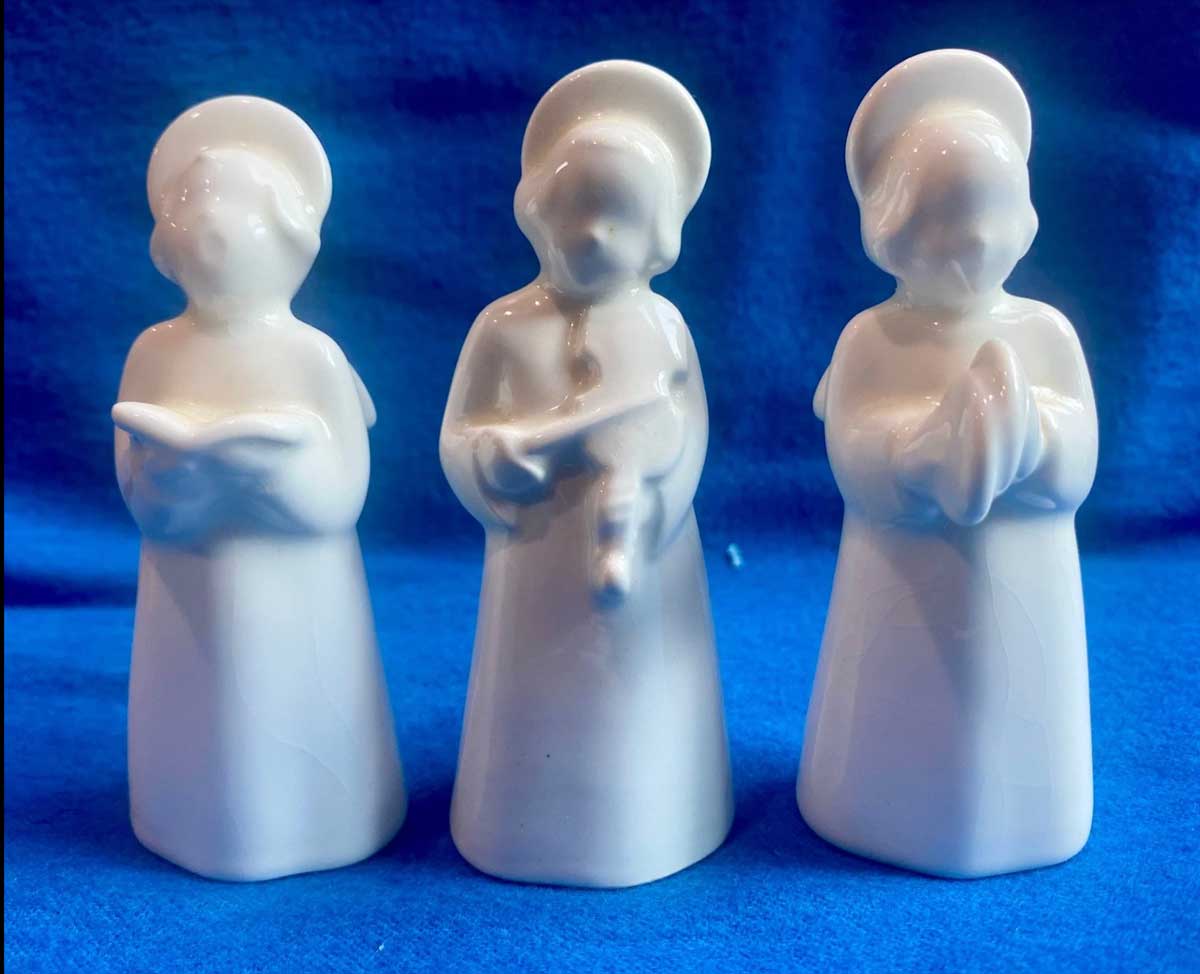
This group of angels was offered as Royal Copenhagen in a recent eBay listing. The clues that they are not Royal Copenhagen were several: a very large “blowhole” in the base (which would be not much larger than a pinhole on an authentic RC), the inept modeling of the figures themselves, and a poorly done counterfeit mark on the base. (Image courtesy of eBay)
Sellers who don’t ship safely
There are lots of collector message boards on Facebook, and I’m struck by the number of people who post photos of broken glass from very poorly packaged merchandise they’ve received from an online seller. It takes special effort and care to package porcelain and glass for mailing (an expertise I must admit, with red-faced chagrin, that I myself lack since I sent a slightly damaged porcelain figurine to a restorer that arrived even more damaged because of my inept packaging). The one or two folks I will buy from online are past-masters at packaging glass and porcelain safely. Otherwise, the time and expense of getting a damaged item returned and the sale price reimbursed can take more time and effort, especially from a resistant seller, than the item would ever have been worth had it arrived in pristine condition.
Yes, online posts give collectors increased access to desirable items. But for novice collectors, I would recommend using online sources first for extensive research and education until such time as the collector knows enough to have good buyer instincts and to pay attention when “it just doesn’t look right.”
Peggy Whiteneck is a writer, collector, and dealer living in East Randolph, VT. If you would like to suggest a subject that she can address in her column, email her at allwritealready2000@gmail.com.
Quilt art by the piece
May 2025 Good Eye Quilt art by the piece by Peggy Whiteneck Most of us are familiar with quilted bed coverings, which have a history going back centuries. We’re also familiar with the prices the best of antique quilts can command today. Quilts can be found in many…
Laying down a Tile
September 2025 Good Eye Laying down a Tile by Peggy Whiteneck Wall tiles aren’t just an antique decorative accent but a treat for modern collectors. They have a long history: Ancient tiles were being used for paving various surfaces as early as centuries before…
Hold that door! Doorstops have been around as long as doors
March 2025 Good Eye Hold that door! Doorstops have been around as long as doors by Peggy Whiteneck These days, what with open-concept home layouts and modern-style sliding and other doors, we don’t have much use for doorstops anymore – except of course – as a…
Some ‘almost’ antique kitchen and dinnerware
February 2025 Good Eye Some ‘almost’ antique kitchen and dinnerware by Peggy Whiteneck When I began collecting mid-century American-made kitchen and dinnerware sets, I quickly learned that even items made by entirely different manufacturers could be pleasingly matched…
Little lights for winter celebrations
December 2024 Good Eye Little lights for winter celebrations by Peggy Whiteneck Candlelit fairy lights (AKA fairy lamps) were popular in the 19th century before access to gas and electrical lighting. George Miller Clarke invented fairy lights in England in 1844, just…
Gobble up these collectibles for Thanksgiving
November 2024 Good Eye Gobble up these collectibles for Thanksgiving by Peggy Whiteneck Pilgrim forms made of cloth, straw, or ceramics are useful as decorations for Thanksgiving but not so much for the rest of the year. Broadening our focus, there are many…