
July 2026
MEMORY LANE MUSINGS
American Gothic House stands as tribute to
masterpiece painting
by Sara Jordan-Heintz
The “Mona Lisa” by Leonardo da Vinci may be the most recognized painting in the world, but one could argue that “American Gothic” by Grant Wood is the most parodied. Countless variations of the work have permeated popular culture since its creation in 1930: the stoic man holding a hayfork while a pensive woman looks off into the distance, standing before a house designed in the Carpenter Gothic style. The real home, known as the Dibble House but universally called the American Gothic House, is situated in the small town of Eldon, Iowa. The original part of the house that harbors the two Gothic windows (one on the front of the house, one on the back) was constructed in 1881-82 by Catherine and Charles Dibble. It’s a fun stop to make while celebrating the 250th anniversary of American independence.
My first visit to the house took place in September 2013 when my now-husband Andy and I made the short drive there from nearby Ottumwa, Iowa, where we were residing at the time. We felt as though we’d stepped back in time and into an iconic moment when we donned the borrowed costumes (they just go over your head) and smiled for a photo we’ve had on display ever since.
I recently sat down with Cari Nicely, administrator of the American Gothic House Center, who shared insights into what the house and center offer to visitors. She noted the exterior of the house is open dawn to dusk with the inside available to tour on select dates or for pre-arranged groups. Only the ground floor is safe for tourists to traverse.
The exhibits, gift shop, media room and costume closet are next door at the visitors’ center, which opened in 2007 and is approximately 2,500 square feet in size. Tourists from all over the world visit each year, viewing a collection of original Grant Wood artwork and pieces of Americana interest.
“When I first became the administrator almost five years ago, there was nothing here for children. So one of the first things that I did is, I put in six children’s exhibits that are specifically for them with hands-on activities. They discover patterns by playing with Legos. With flexible straws they can make a gothic window — where they can draw connections between playing and the painting itself,” she notes.
And if you’re one of those people who aren’t really all that into history or art and get “dragged” to places like the American Gothic House (you know who you are), take heart.
On the property is the Chippewa Creek 18-hole disc golf course, which draws folks from near and far. Nature lovers can enjoy the lavish prairie gardens and trail.
But honestly, how can you come out to the house and not be even a little intrigued by the backstory?
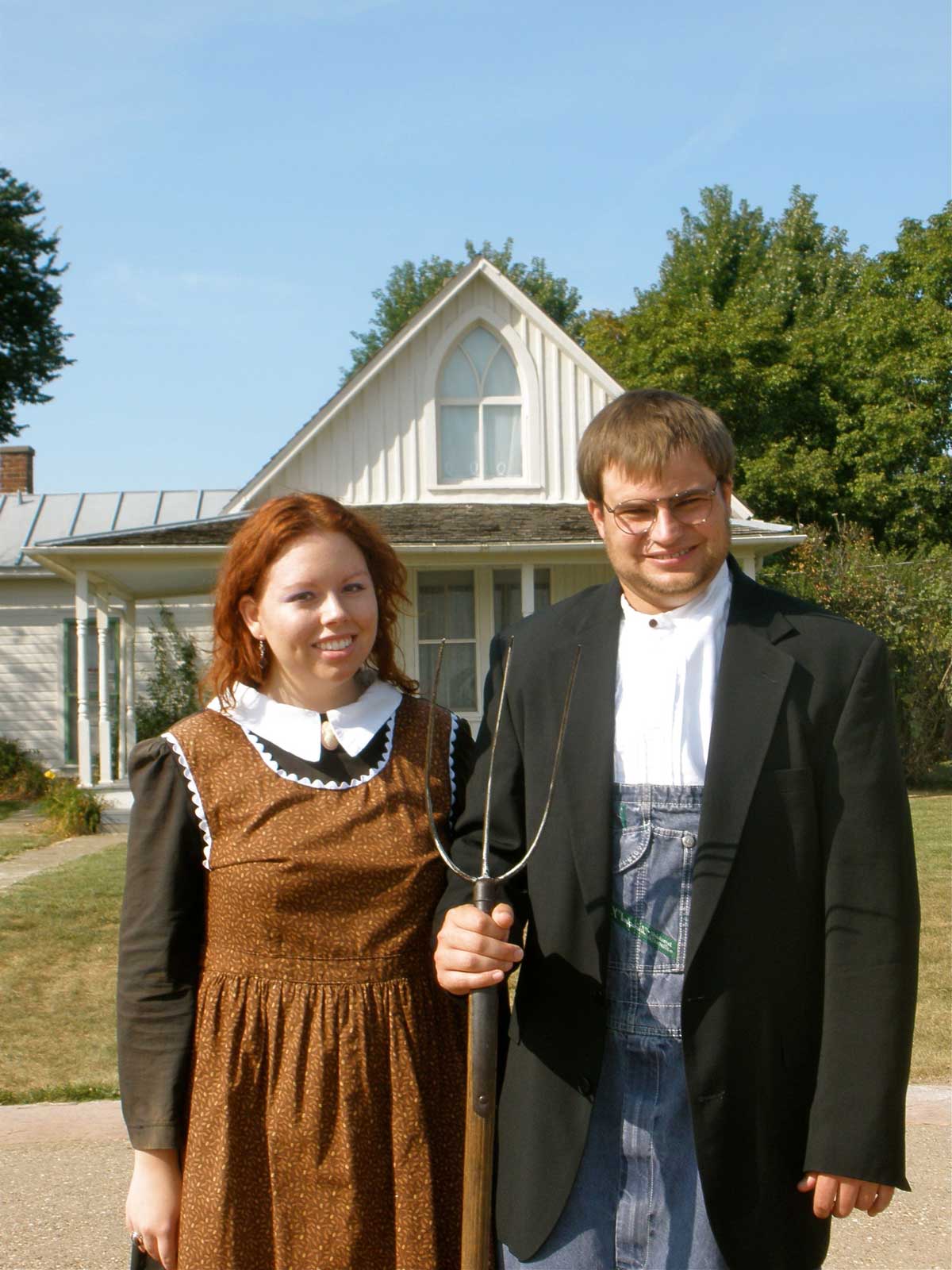
The American Gothic House in Eldon, Iowa, was the inspiration for Grant Wood’s painting “American Gothic.” Here I pose with my husband Andy when we came out to the house in 2013 when we were first dating. They let you borrow props and costumes, which are available in several sizes. (Image courtesy of the author)
My favorite aspect? The fact that Grant Wood (1891–1942) never stepped foot inside the house. Nor did his models pose there in real life. The inspiration for the pair in the painting is his sister Nan Wood Graham and the family dentist, Dr. Byron McKeeby.
It all began in summer 1930, when Wood was in Eldon attending an art exhibition at Eldon Art Center organized by Edward Rowan, then director of the Cedar Rapids Little Art Gallery. The objective was to bring art to rural areas.
“John Sharp, who knew Wood through Rowan’s art gallery, took Wood on a drive one afternoon where Wood spotted the house with the unique window. Upon sight, he asked Sharp to pull over so he could make a sketch. In later interviews, when asked why the house caught his eye, Wood said he found the window amusing and called it ‘pretentious’ for such a small house. As he did with most paintings, he sketched his idea on site but returned to his studio in Cedar Rapids to complete the work,” according to the American Gothic House’s website.
The house has changed hands several times since then and has been listed on the National Register of Historic Places since 1974. In 1991, then-owner Carl E. Smith donated the house to the State Historical Society of Iowa.
Admission is $5 for those ages 13-59 and $4 for people 60 and over. Children age 12 and under and Wapello County, Iowa residents (proof required) get in free. The center is open Wednesday through Saturday 10 a.m. to 4 p.m., Sundays 1 p.m. to 4 p.m. Last admission is 3:50 p.m. Closed on Mondays and Tuesdays.
The painting itself hangs in the Art Institute of Chicago.
To learn more, visit americangothichouse.org
Sara Jordan-Heintz is a journalist, author, and editor based in Iowa. An “old soul” she is an avid collector of vintage jewelry, Russian stacking dolls, and autographs. In her free time she’s a voracious reader and lover of classic movies — “All About Eve” being her top pick. Her favorite fictional sleuths are Columbo and Jessica Fletcher. She holds a degree in American Studies from the University of Iowa. Connect with her at: sara.jordan909@gmail.com.