
December 2025
Vintage Discoveries
Papier maché Santa dates from 1930s
by Ken Weyand
Somewhere in my collection of “old stuff,” there’s a faded Kodak print showing the living room of our farm house at Christmas, sometime in the 1930s. A decorated cedar tree dominates the scene, with a nearby armchair featuring my mother’s favorite cat, Tux, taking a midday nap. Next to the chair is a small table with a Santa figure, brought out to celebrate the occasion.
The papier maché Santa, purchased by my mother from a dime store in her hometown of Kahoka, Missouri, was a seasonal guest in our house by the time I was born. It was one of the few “luxury items” my parents could afford when they married in 1928. Times got worse soon after that, with the stock market crash and resulting Great Depression — still in effect when my photo was taken.
Along with the photo, the original Santa found its way to a shelf in the back of a small closet in my house. For several years it has taken up space, protected from any strong lighting that would fade its red-painted suit. I recall that it was occasionally an object of interest to my family at Christmas-time.
Online research turned up little about the origins of my Santa. Papier maché was developed in China in the 1800s. By the 1920s it was widely used in toy manufacturing. Lightweight and easy to mold, it was ideal for toys and decorative items that would be shipped worldwide.
Like most paper maché Santa figures, mine has no maker’s name, so its origin is unknown. An internet search yielded similar figures, with prices running in the $30 to $40 range.
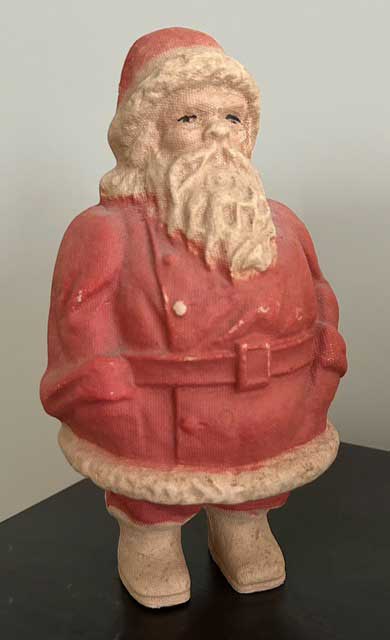
Paper mache’ Santa Claus figure, circa 1930. (Image courtesy of the author)
Ken Weyand is the original owner/publisher of Discover Vintage America, founded in July 1973 under the name of Discover North.
Ken Weyand can be contacted at kweyand1@kc.rr.com Ken is self-publishing a series of non-fiction E-books. Go to www.smashwords.com and enter Ken Weyand in the search box.