
March 2026
Vintage Discoveries
Making a telephone call was challenging in the 1940s
by Ken Weyand
Growing up in the 1940s on a Missouri farm had its challenges, especially coping with the nearly four miles of dirt roads that separated our family from the nearest highway. But looking back, one of the biggest challenges was our phone system – a long way from the pocket-sized cell phones we take for granted today. Although our primitive telephone lacked the wonders of today’s smart phone, it gave us an important lifeline to the outside world.
Our house had only a single phone — a candlestick type, about 15 inches tall, with a mouthpiece atop a vertical column, both with a black finish. On the side of the column was a metallic cradle supporting the receiver. Lifting the receiver opened the connection, which closed when the receiver was returned to its cradle. The phone rested on a wooden box containing a battery and a bell, which rang loudly when a call came in. On the side of the box, a handle could be cranked to activate the ringer and make a call.
We were on a party line, shared by seven other farm families. Two long rings meant the call was for us. Other families would be summoned by combinations of “longs” and “shorts.” But everyone on the line would hear all the rings, and could listen in to any of the calls – which frequently happened.
The system had its obvious disadvantages in its lack of privacy. And several neighbors sharing a phone call would reduce the volume and could make hearing difficult. I can remember my mother asking neighbors to get off the line so she could hear better. But there were times when she needed help with a recipe and used the party line to get advice from others. And any emergency, such as a fire or accident, was instantly shared throughout the community, with neighbors always quick to respond. In this way, a long tradition of mutual support in rural communities continued.
Other farm families had similar phones, but most were a bit newer than ours. Instead of the candlestick type, their phones were built into a vertical box, which contained the basic parts – mouthpiece, receiver, ringer and batteries. However, like us, they had to ring a series of “longs” and “shorts” whenever they made a call.
A telephone office, located in Granger, a small village about four miles away, connected us with long-distance callers and the outside world beyond our community. A single operator, who lived in a house attached to the office, worked at an old-fashioned switchboard. A large collection of connections, made by plugging in various lines to their receiving terminals, made it all happen.
Our telephone, and those of our neighbors, was manufactured by Western Electric, a company that dates back to 1869. The firm diversified into several areas, making products that ranged from teletypewriters to telephone switching systems and telephone booths. The company eventually became a subsidiary of AT&T.
In the days before many farm families had electricity, cranking a battery-powered phone was an important lifeline with the outside world. Although our farm got electricity in the early 1940s thanks to President Roosevelt’s Rural Electri-fication Administration (REA), World War II and the demands it made on major industries kept us cranking our telephone the old-fashioned way for several years.
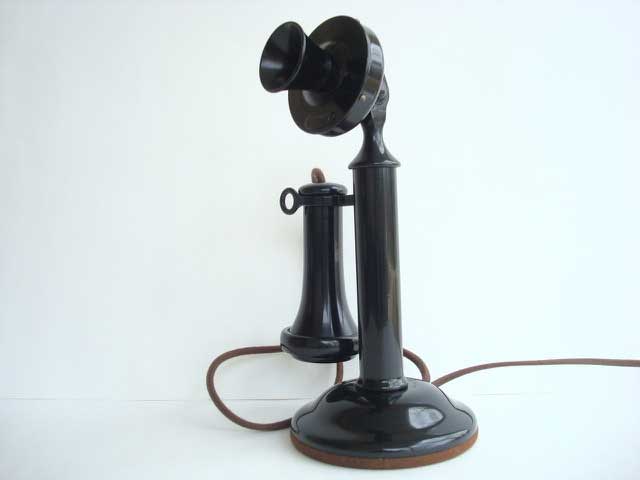
Old-fashioned "candle" style telephone. (Ken Weyand collection)
How primitive our system was compared to phones used by city folks became apparent to me when I was about 12. After completing five years at a one-room country school, I left the farm in the late 1940s to become a member of a boys’ choir then headquartered in Dallas.
When I arrived by train and there was no one to pick me up at the station, a “Travelers Aid” staffer offered to help me call the choir director. I remember being handed the phone and fumbling to hold it properly so that I was talking into the receiver and not the earpiece. As a farm boy, it was one of the first encounters (of many) I would have with urban life.
In the late 1950s, a new system was installed in our rural area, with new equipment, including a small plastic desk phone that replaced the ancient wooden box and candlestick. The telephone office in Granger was phased out, and the original phone lines gave way to an electric system, eliminating the old glass insulators that soon became sought-after finds at collector shows. The party line continued for a time, but eventually it gave way to private connections.
Today, a few land lines are still in use, but cell phones have become the norm. For me, my world can be instantly accessed (and photographed) by a handful of technology in my pocket, and I waste uncounted hours watching unsolicited news reports, opinion sites, and occasional cat videos. But I fondly recall the good old days in our farmhouse when “two longs” meant there was an incoming call.
Ken Weyand is the original owner/publisher of Discover Vintage America, founded in July 1973 under the name of Discover North.
Ken Weyand can be contacted at kweyand1@kc.rr.com Ken is self-publishing a series of non-fiction E-books. Go to www.smashwords.com and enter Ken Weyand in the search box.