November 2026
Good Eye
The fire under Native American pottery
by Peggy Whiteneck
Native American pottery of various authenticity can be found in antique shops. Some of it is simply marked with the word “Dine” (the native term for Navajo, which may or may not indicate authenticity), with not much else to determine maker source. These items can be acquired for just a few bucks, with higher prices reserved to items signed with a known artist’s mark.
Recently, I acquired a very small pot marked in cursive “L. Kee Navajo” and distinguished by what my research discovered was embedded horse hair in the finish. In this Navajo technique, the hair itself combusts on contact with the heat of the furnace but leaves behind the wispy shadow image of the hair.
“Kee” is a common Navajo surname, and I was not able to identify a specific maker for this vase, a common problem in attributing Native pottery. I was surprised by the healthy prices found online for horsehair pottery in general, even with no-name provenance, but I would recommend this style as “buy it if you like it” rather than an “investment” before time has burnished its value.
Native American pottery has been made mostly by women when there have been few economic opportunities available to women. There are some Native American potters, however, who have achieved a national and international reputation.
Joy Navasie (1919-2012)
AKA Frogwoman, Joy Navasie is the second Hopi-Tewa potter to bear that artist name, the first being her mother, Paqua (1890-1955). Both signed their pots with the image of a frog, the signatures being distinguished from one another by Paqua’s frog having distinct straight-line toes while Joy’s have webbing between the toes. Joy and her mother perfected a line of white-slip pottery in a distinctive style and strictly adhering to traditional potting methods.
Joy stopped potting some years before her death. Consequently, there is a finite supply of her work and a strong collector demand for it. Meanwhile, Joy’s several daughters continue the family potting tradition.
Price ranges on Joy’s work run from several hundred dollars to $2,000-$3,000 for the larger pieces such as the one shown here, which measures 3 ½” diameter at the opening, 5.5” tall, and 20” in circumference at its widest point. Painted in black and shades of brown, this example has a painted band at the collar; Navasie often left her pot collars totally white.
This olla has sentimental value to my family because my parents acquired it on a trip to New Mexico that was an anniversary gift from their children. Dad told the tale of a dispute between himself and airline staff about my parents holding the large, cloth-wrapped olla on board the plane for the flight home rather than stowing it in an overhead bin. Dad won.
Joy Navasie’s work is in museum collections, including the Art Institute of Chicago, Crocker Art Museum, Natural History Museum of Utah, Museum of Northern Arizona, Heard Museum, and others.
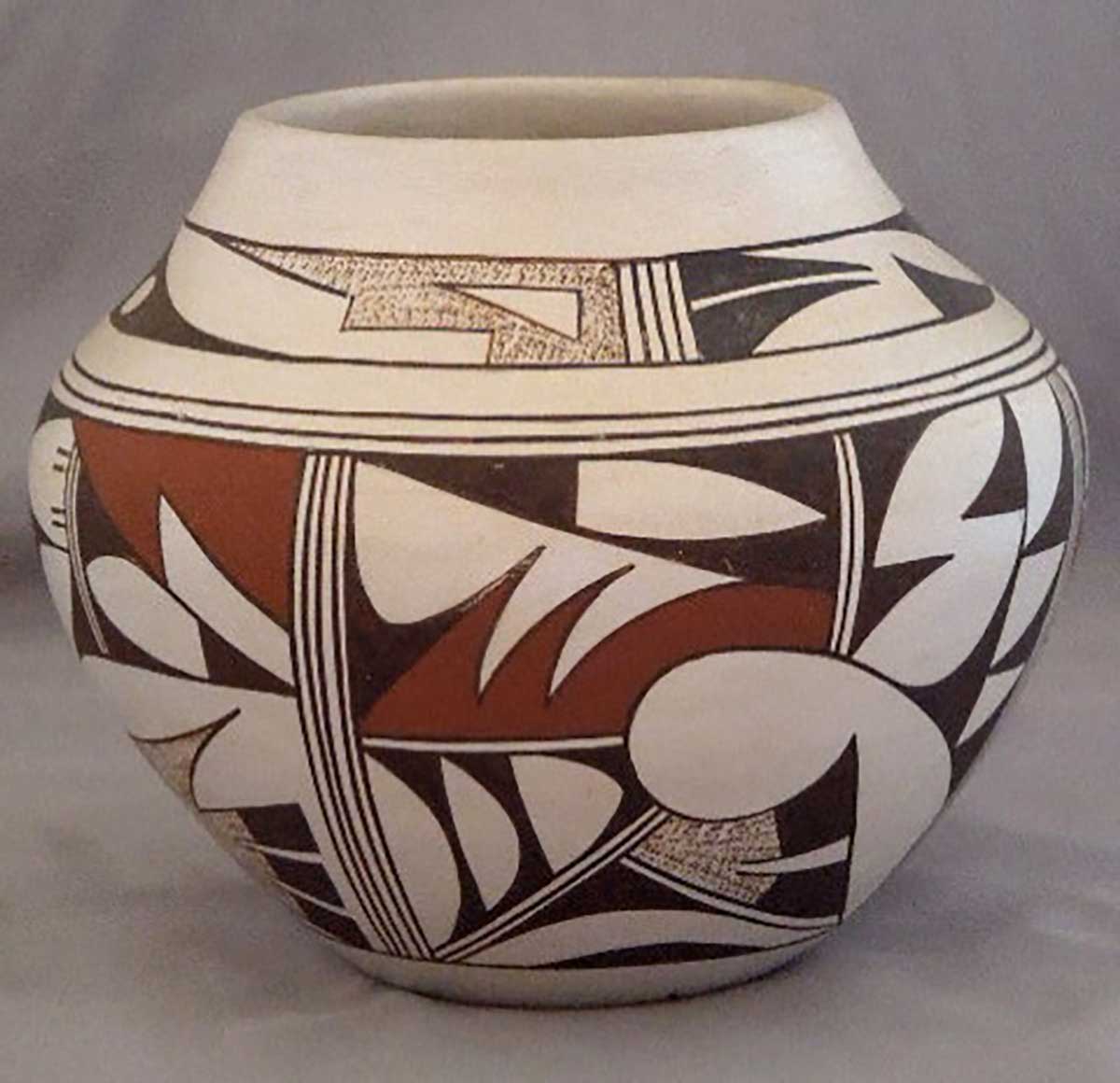
A Joy Navasie olla (pot) that I inherited from my parents. (Image courtesy of the author)
Maria Martinez (1887-1980)
A Pueblo artist known especially for her black ware pottery glazed with an etched design, she also did some works in earth-colored clay. Among primitive firing methods used throughout the 20th century, Martinez’s kiln consisted of old tin cans to support wire frames resting into an open fire. Given this method, and others like it used by Native American potters, breakage during firing was a not-uncommon natural disaster!
Serafina Tafoya (1863-1949)
This artist used the “coil method” for constructing pottery, in which coils were rolled, then wound and smoothed out to form the even surface of the pot. Her extensive pottery-making progeny consists of four generations! And like many of the best Naïve American potters, her work is featured in art museums, such as the Mount Holyoke College Art Museum and the Art Institute of Chicago, among others.
These are just a few of the native world’s finest potters, so research if you have pots signed with other names.
Peggy Whiteneck is a writer, collector, and dealer living in East Randolph, VT. If you would like to suggest a subject that she can address in her column, email her at allwritealready2000@gmail.com.