February 2026
Good Eye
Sometimes it pays to advertise
by Peggy Whiteneck
Many pottery and glass companies in the mid-20th century supplemented lines for which they were most famous with an occasional advertising item commissioned by another company. These items are especially valued by collectors with a personal affinity for the advertisement.
Advertising in kitchen ceramics
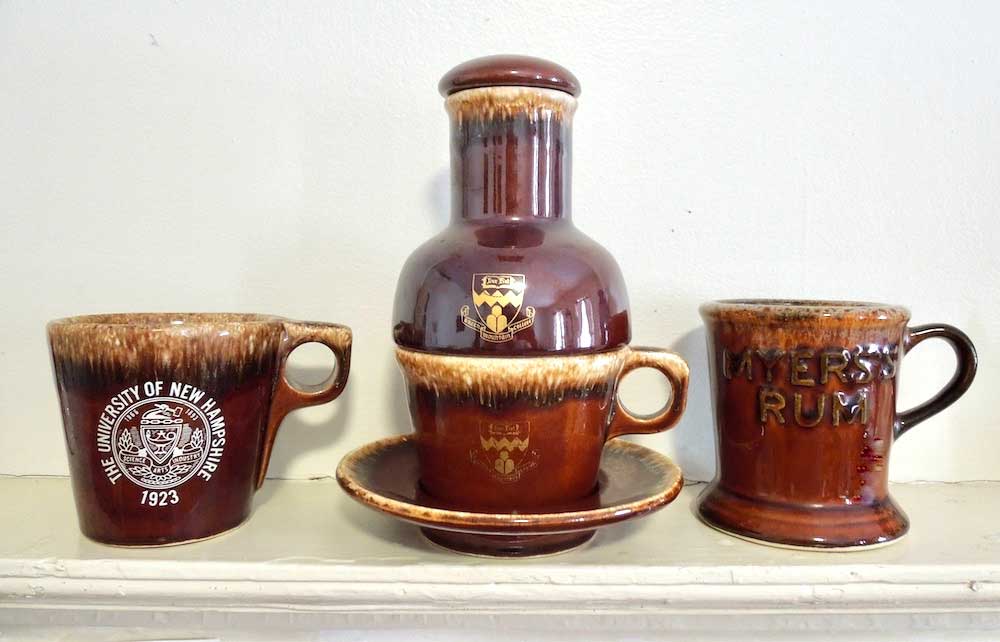
Those of you who have followed this column over the years would know that I have an extensive collection of Hull and McCoy Ivory Foam/Brown Drip pottery that I use in the kitchen, but I hadn’t previously noted the advertising items made in these sets. One of these is a complete Hull Brown Ivory Foam carafe set marked on the base as Crestone, a very slightly later version of Hull’s immensely popular line in this Brown Drip color that was made from the early 1960s through the 1980s. This version from the carafe and matching cup sports the crest for Green Mountain College (closed in 2019) in my state of Vermont. The complete unaffiliated version of the set can be seen in an advertising page reprinted on page 36 of the book Collector’s Guide to Hull Pottery; the Dinnerware Lines by Barbara Loveless Gick-Burke (Collector Books, 1993). The whole carafe set, especially as an advertising piece, can be considered rare.
Another advertising example is a mug with the advertiser’s name integrated into the clay. Although the item was not actually made by Myers, the bottom is marked “Imported and Bottled by Fred L. Myers and Son, Baltimore, MD, 80 proof.” The white clay rim on the base indicates the mug itself would have been made by an American company, probably either Hull or McCoy (Items made in Canada or Japan with a brown glaze have a red-brick-colored base rim).
I picked this up at an antique mall because rum is my own favorite (very occasional) celebratory beverage.
My third advertising item is a Hull coffee cup with the white crest logo for my undergrad alma mater, the University of New Hampshire (still going strong after 100 years). Its base is simply marked “hull [small h and name in block print], Oven Proof USA [in cursive].” (Hull Ivory Foam and McCoy Brown Drip items are mostly all marked oven proof; I bake Thanksgiving pies in Hull pie plates).
My mom’s favorite “advertising set” among ceramic kitchen collectibles featured the Pillsbury Dough Boy, whose form was made in everything from salt and pepper shakers to Cookie jars. The earliest versions were made in the 1980s in the classically chubby form that most of us think of when we think of this advertising character. Later versions were more stylized.
Mirror Brown/Brown Drip pottery
Examples of Mirror Brown/Brown Drip pottery with advertising logos. From left to right, a coffee cup with the logo of the University of New Hampshire, a rare full carafe set with the logo for the now-closed Green Mountain College, and a mug made for Myers Rum. That mug was made in two forms; the one believed to be produced a bit later was marked “Myers’s Rum and coffee” (the last two words rendered in script). Perhaps it was feared the original might encourage drinking an entire mugful of just rum! (Image courtesy of the author)
Advertising items in glass
Perhaps the most famous use of advertising in household glass items was made in Anchor Hocking’s brand, Fire King, the first of which was made in the early 1940s and was mostly discontinued in 1976. Retail foods were sometimes sold in Fire King bowls with advertising lids for products such as cottage cheese. Soup/chili bowls with a Heinz logo in black print on the side of the bowl are rare. Some Fire King items with advertising and souvenir logos were made in entire sets. Among the most popular is the Exxon tiger set, decorated with just the lion and no other identifying info.
More overt advertising mugs were made featuring the names and trademarks of everything from Bazooka Gum to A&W Root Beer and for both McDonald’s and Burger King franchises (See the book Fire King; An Information and Pricing Guide by Joe Keller and David Ross, Schiffer Publishing, 2002, pp. 103-104).
Advertising names on the surface of drinking glasses included Westinghouse and, perhaps most famously, Coca Cola. These glasses were not necessarily identified as to manufacturer.
Advertising collectibles remind us of brands from our childhood and youth, especially those that are no longer in business. This gleeful recognition and rediscovery are what pull us to collect pottery and glass items featuring brand advertising.
Peggy Whiteneck is a writer, collector, and dealer living in East Randolph, VT. If you would like to suggest a subject that she can address in her column, email her at allwritealready2000@gmail.com.