
March 2026
Good Eye
Shaker antiques: A gift to be simple
by Peggy Whiteneck
A religious sect called Shakers, founded by a woman with the modest name Anne Lee, came to New York from England in the late 18th century. The group’s official name used after emigrating to America was “United Society of Believers in the Second Coming of Christ.” The name became “Shaker” because of the group’s ecstatic form of worship that involved shaking the body. Before they split off into a separate group, the Shakers were part of the larger Quaker community. Early Quaker worship was also characterized by shaking and trembling – hence their name.
Within 10 years of their arrival in the United States, Shakers became established at two sites in New Hamp-shire, one in Canterbury and the other in Enfield. Event-ually, there were 19 Shaker communities, extending into Ohio and Kentucky as well as the Northeast.
Key characteristics of Shaker communities were communal living in which property was shared, celibacy, simplicity in dress and in what the community produced by way of architecture and furnishings, and rural living apart from what they regarded as the potentially corrupting influences of city life. Male and female members of the group called one another “brother” and “sister.”
Obviously, a community cannot long survive in celibacy without some other effort to ensure the future of the community. Shakers were able to preserve the faith’s practice and survival for more than 150 years by actively recruiting converts and adopting children. The latter, once they reached the age of 21, were given the choice of staying in the Shaker community or leaving it. Over the lifetime of their communities, the Shakers raised hundreds of orphaned children. Today, there are left just a handful of Shakers still living their traditional lives, as they are able given their advanced age.
Shaker Craftsmanship
Shaker craftsmanship in stone buildings and in furnishings and utilitarian items made from wood is highly esteemed today. Their buildings, which were communal and, therefore, large, are still standing. Austerity was not what Shakers were after in what they created by hand. Their emphasis in hand-creation was on beauty allied with simplicity and basic functionality, with a complete lack of excess ornamentation but not devoid of pride in the workmanship.
Today, genuine examples of Shaker wooden items made for inside the home can be quite hard to find and expensive to acquire. They can also be challenging to identify as genuinely Shaker since modern artisans have imitated their style and production techniques.
Shaker wooden buckets and boxes used primarily for kitchen storage were made from rounded bentwood. During production, the wood was kept pliable for rounding by steaming it or by hot water immersion with the ends brought together in swallowtail joints secured with copper tacks (Rounded boxes with modern non-copper tacks can be one clue to modern imitation).
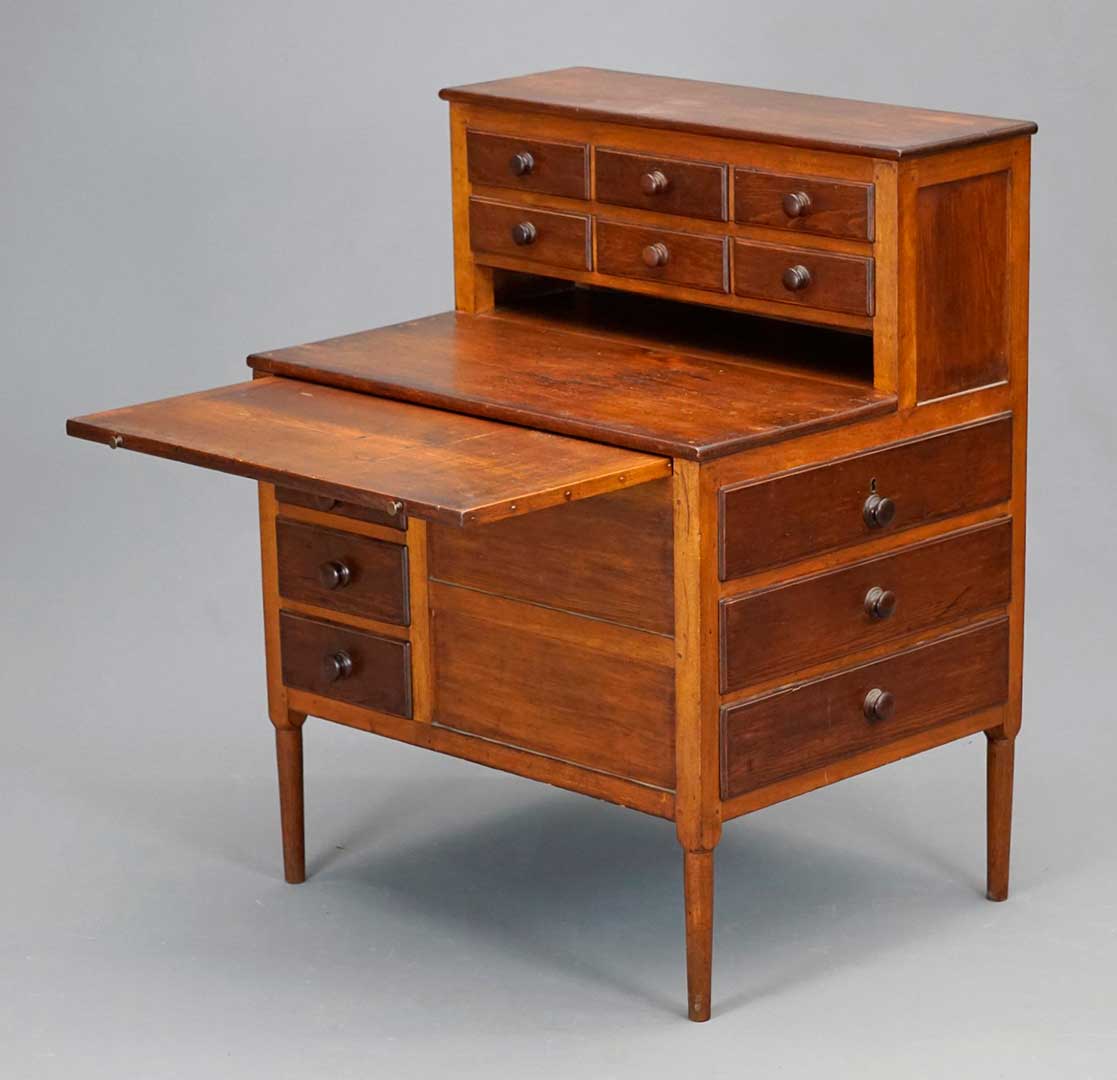
A 19th-century Shaker sewing desk
A 19th-century Shaker sewing desk, c. 1840-50, believed to be from Enfield, NH. Six drawers on stepped in top, a slide pull-out, three lower left drawers, three side drawers, all with original walnut pulls. Sold at a 2017 Copake Auction in Copake, NY, for $12,870 – above its auction estimate of $5,000-$10,000. (Image courtesy of Copake Auction)
Shaker furniture, such as small tables and stands, was made with legs tapered toward the bottom. Larger pieces, such as bureaus and chests, used dovetail joinery on the edges of drawers, in which the craftsmanship of Shaker furniture is seen in the tight joinery, with no spaces between the interlocking wood. These are not merely plain; they are starkly beautiful.
Nor did the Shakers neglect toys for the children. Toys that included wooden puzzles and cloth dolls were a way to make use of scraps from homemade clothing and woodworking. The toys were made with the same care and attention as items made for general use in the home. Still, most “Shaker” toys today would be modern imitations as original Shaker cloth dolls, for example, were made from then-recycled material that would not have been able to survive after 100 years.
While their physical survival as communities was not to be, what Shakers bequeathed to humanity was their example that happiness doesn’t need ornamentation and possession…just an eye for simple beauty.
Peggy Whiteneck is a writer, collector, and dealer living in East Randolph, VT. If you would like to suggest a subject that she can address in her column, email her at allwritealready2000@gmail.com.