
September 2026
Good Eye
A world of Wedgwood
by Peggy Whiteneck
Wedgwood is an English company that makes many patterns of dinnerware. Whole dinnerware sets, of course, are seldom collectible in multiples because of the space that would require. Wedgwood is probably most famous among collectors for its decorative jasper stoneware, featuring relief scenes against an unglazed colored background.
Wedgwood is a very old company; the founder, Josiah Wedgwood, began making jasperware in 1774 (Incidentally, Charles Darwin was Josiah Wedgwood’s grandson! And, Josiah’s granddaughter was Charles Darwin’s wife, making that couple first cousins).
Today, Wedgwood belongs to the Fiskars Group, which also owns other well-known brands such as Georg Jensen, Royal Doulton, Royal Copenhagen, Royal Albert, and Waterford (https://fiskarsgroup.com/). Jasperware is most noted for its raised white scenes against a light blue background, sometimes referred to as “Wedgwood Blue,” but there are several other background colors for Wedgwood jasper, including a dark blue, lilac, green, yellow, crimson, and basalt (black).
Crimson Jasperware is considered rare as it was made in a relatively short window from the late 19th century through its suspension in 1910. Other expensive jasperware uses unusual color combinations, such as the Portland vase of dark blue on pink, and even the current retail pieces on these examples can run up to three and four figures.
The Portland vase, still being made, is an iconic example of Wedgwood jasperware. It has been made in several base colors, including dark blue, light blue, and black. This vase was also made in the rare crimson color with white relief, a genuine antique for which four figure prices are the rule, even for damaged examples. The design was Josiah Wedgwood’s copy of the Barberini vase from Roman antiquity. The Wedgwood relief design continues even to the underside of the base. A large Portland vase, with both the classical relief and background in a color Wedgwood calls “flaxen,” retails at Wedgwood for $18,500!
Jasperware has been imitated, and wannabe items are usually entirely unmarked. Authentic Wedgwood will always be engraved as such on the bottom of its pieces. Be sure the mark’s spelling is correct; even when fake pieces are marked, the mark is often misspelled “Wedgewood” (with a second “e”). AI often also uses this misspelling, so take care in your research!
The themes of decorative reliefs on Wedgwood vary widely, from classic Greek and Roman motifs to leaf and flower decorations to ships and buildings. The variety of relief themes is, to my eyes, one of the most attractive aspects of Wedgwood forms that range from vases to dishes to Christmas ornaments and more. Relief work is applied by hand and shaped by craftsmen who serve an apprenticeship of up to 10 years before becoming master craftspeople.
Most Wedgwood found on the secondary market today will be relatively modern. Letters embossed in the surface of the base were introduced in 1860 as an aid to dating the pieces. The dates began with the letter O and proceeded alphabetically until 1906, repeating the alphabet for subsequent years after “Z.” Any marks after 1891 will have ‘England’ included. You can find a fairly complicated list of older and antique Wedgwood marks at https://fineart-restoration.co.uk/news/identifying-wedgwood-makers-marks-and-dates/. The most expensive secondary market pieces were made in the 19th century or earlier.
Since it is waterproof, jasperware vases can be used to display cut flowers (although I imagine the inside of a Jasperware item could be discolored by standing water if the water has a high mineral content).
“The key is thoughtful use. Avoid dishwashers, microwaves, and extreme temperature changes,” according to heirloomblog.com.
Secondary market prices, such as eBay on the most commonly seen light blue Wedgwood jasperware, can be very affordable as the market has been pretty much glutted. Collectors interested in value are advised to focus on other colors. Whatever its background color, when buying on the secondary market, carefully inspect the relief (as well as the overall form) for chips and nicks, which will affect value.
.
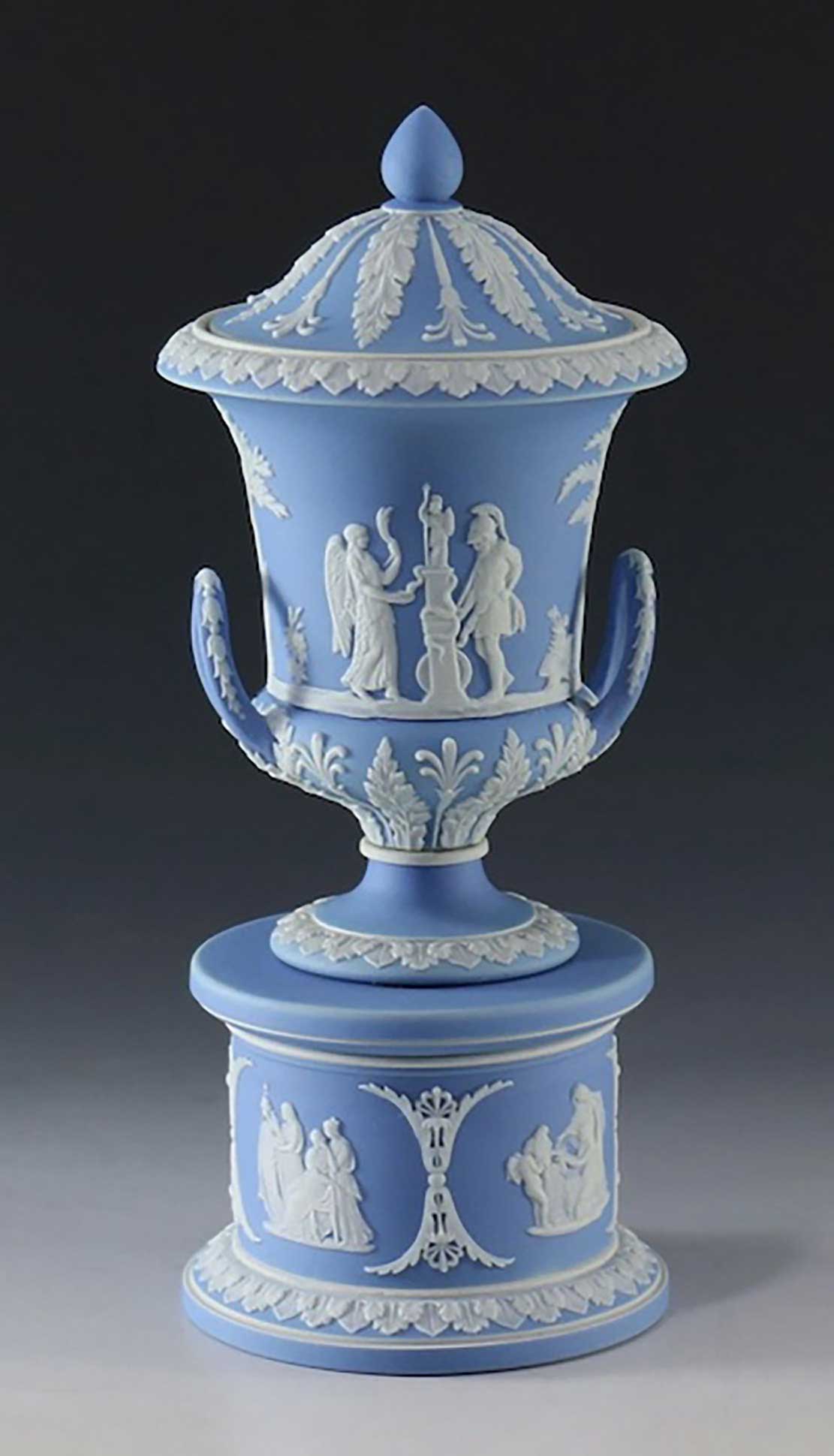
This 19th-century Wedgwood Campana vase in the classic Wedgwood colors of white on light blue sold on eBay in late April for $650. Later and smaller examples of this Wedgwood light blue are much more affordable, many for less than $25. (Image courtesy of the author)
Peggy Whiteneck is a writer, collector, and dealer living in East Randolph, VT. If you would like to suggest a subject that she can address in her column, email her at allwritealready2000@gmail.com.