
July 2026
SMACK DAB IN THE MIDDLE
Birds of a feather: Mexican Feathercraft
by Donald-Brian Johnson
“The hand-carved cedar frame you are now holding, and the artistic and beautiful feathercrafted bird within it, are the result of patient and skillful hand work, traditional from our ancestors. Together, they are a symbol of a million bird songs that anciently haunted our great forests, and still hold something of that mysterious beauty.” -- Feathercraft label--
In other words, that plaque you just picked up at a garage sale, featuring a bird pictorial made entirely of feathers, isn’t just any old souvenir. During the 1940s and ‘50s, these exquisitely detailed renderings of colorful exotic birds were prized keepsakes of a trip south of the border. Although the warblers depicted existed, for the most part, only in their creators’ imaginations, only a bird-brain would quibble. Realistic or not, feathercraft bird plaques were the 20th-century descendants of a time-honored tradition:
“The art of feathercraft is very ancient, originating years before the 1521 Spanish conquest of Mexico. Birds have a prominent place in Aztec mythology and Mexican history. The Tarascos, a noble race, used hummingbird feathers in the robes and crowns of their kings. And Cortés, the Spanish conqueror, speaks many a great thing of the feathered jewels of the Aztecs.”
Of course, the feathered jewels Cortés was talking about were quite a bit different from the framed bird plaques snapped up by travelers centuries later. “Plumaria,” the technical term for featherwork, was an Aztec craft used for both sacred and secular purposes. Among the many items adorned with feathers: cloaks, banners, shields, and headdresses.
Feathercraft of centuries past utilized the feathers from a resplendent aviary of tropical birds—the Central American quetzal, the hummingbird, macaw, toucan, and parrot (just for starters). Now you may be saying to yourself, “Wait a minute. I am not about to feather my nest with plaques made from the feathers of endangered birds, no matter how pretty they look!”
Fortunately for you, and most especially for the parrots and their fine feathered friends, the tradition of using feathers from rare birds for feathercraft died out long ago, thus saving the birds themselves from a similar fate. The winged wonders on feathercraft plaques of the 20th century are constructed entirely of chicken feathers.
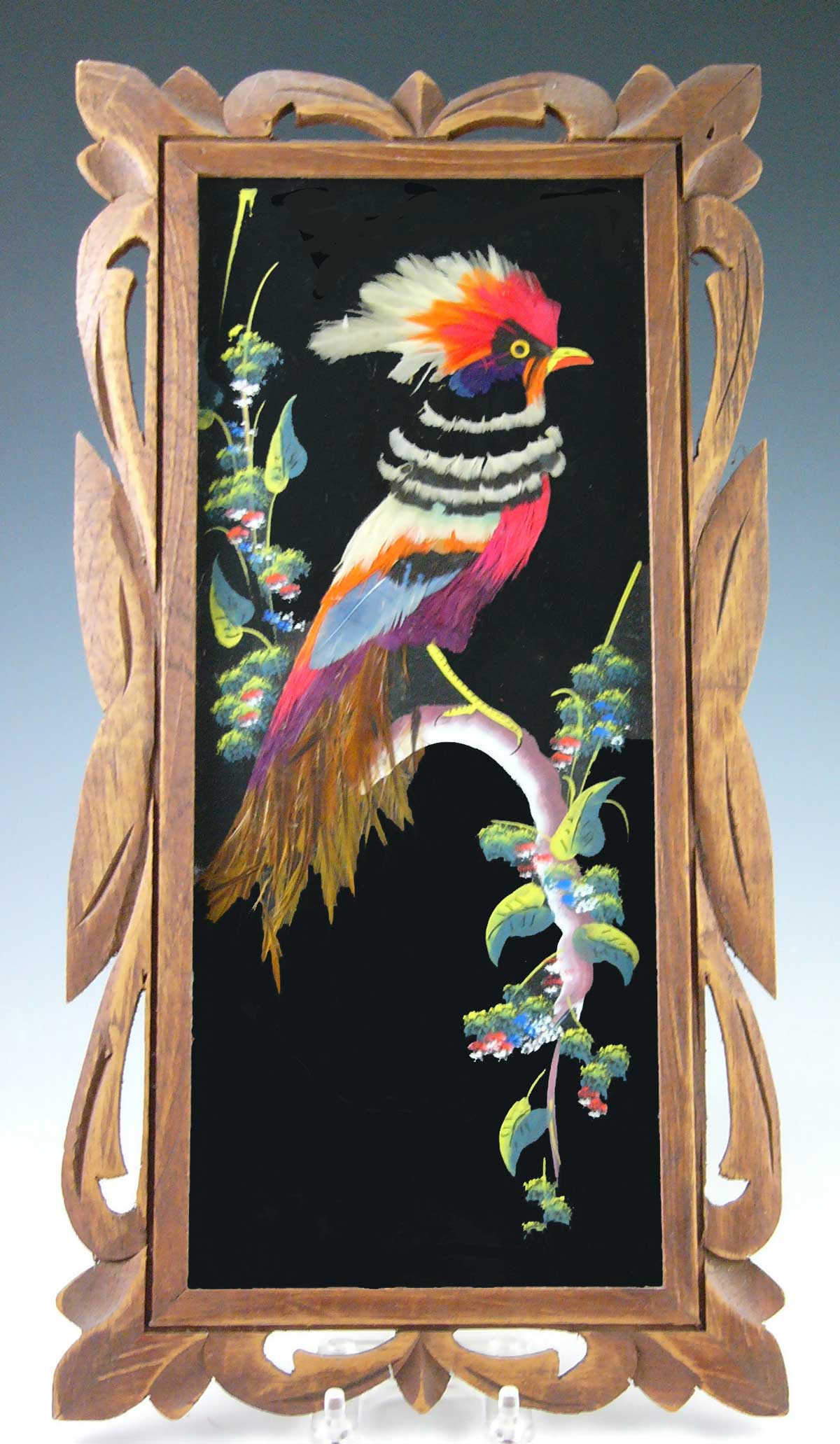
Regal ring-neck with brown tail. (Image courtesy of the author)
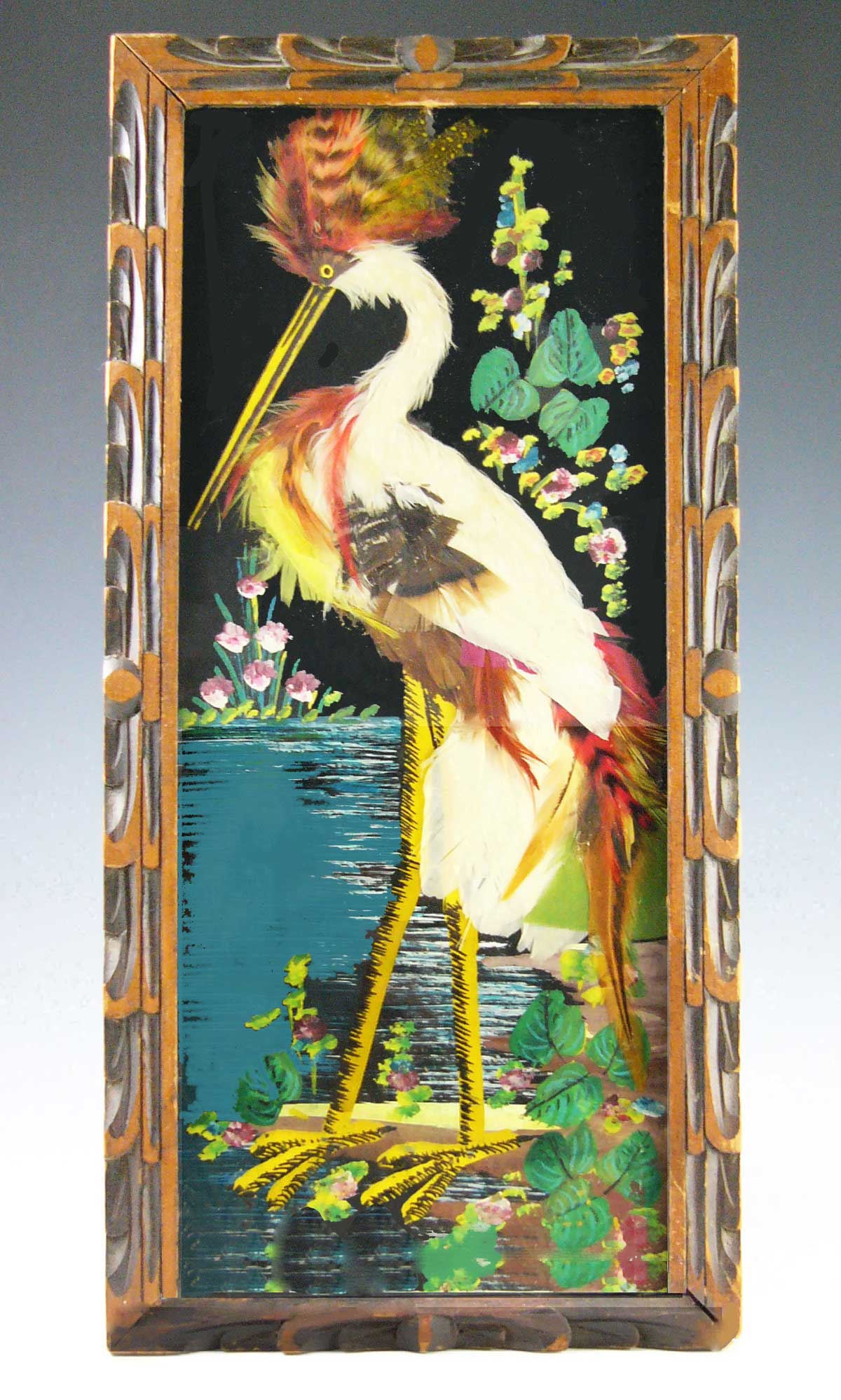
Fantasy stork in fantastic-yet-familiar surroundings. (Image courtesy of the author)
“Chicken feathers?” you may ask. “Then why aren’t those birds all white? Or all yellow?” The secret ingredient here is “dye.” Chicken feathers were dyed in a dazzling rainbow of colors, placed on a paper pattern, beginning with the smallest, then arranged in a lavish style which would have real birds shaking their topknots in disbelief. While there may be a passing resemblance in shape or pose to an actual bird, these are fantasy representations. Their heads are topped with windswept, lush plumes in bright tropical hues. Streamlined bodies lead to sweeping tails in variegated patterns and shades. They rest majestically on branches or rocks, bracketed by hand-painted, equally unusual trees and flowers. Completing the alien composition: almost all feathercraft birds are set against a black, velveteen-like background, their colors leaping out with even greater vibrancy.
Feathercraft creations run the gamut of sizes, from small 3-inch round plaques, to whopping 3-foot rectangular ones; most average 12-15 inches high. Inside their hand-carved cedar frames, almost all are glass-covered, protecting the designs from falling feathers and other deterioration. While the majority are wall pieces, originally marketed singly or in pairs, there’s also an attractive assortment of wicker baskets, the glassed-in bird forming the basket base interior.
Thanks to their popularity with mid-century tourists as take-home treasures, feathercraft items often show up at garage and estate sales. Several hundred high-flyers are also listed each day on eBay. Prices average well under $25, so assembling a collection will definitely be a feather in your cap. As one plaque label notes, “feather pictures speak with the voice of the past to the present—a language that is eternally announcing the presence of the soul of America’s original inhabitants.”
Donald-Brian Johnson is the co-author of numerous Schiffer books on design and collectibles, including “Postwar Pop,” a collection of his columns. Please address inquiries to: donaldbrian@msn.com