
For the Love of Feedsacks
August 2026
Covering Quilts
For the Love of Feedsacks
by Sandra Starley
By Georgia Starley, guest columnist
A note from Sandra Starley: This month I have turned my Covering Quilts column over to a special guest writer, my mother, Georgia Starley, who has a deep fondness for printed feed sacks from the late 1930s, 1940s, and 1950s.
I would like to tell you I have a profound love for fabric. Some might even call it an addiction. How long have I had this condition? I believe it started when I was big enough to lift the lid on an old tin trunk in my mother’s room; I could have been three or four. The shelf or drawer had buttons, lace, old cards, rickrack, bone crochet hooks, and tiny bundles of scraps of fabric, and of course, little balls of string. When I got big enough to lift the insert out of the trunk, I found two dolls, an old blue baby book, and the most incredible trim with blue glass beads on it. Well, you get the picture. But these finds just piqued my curiosity; they were not the cause of my addiction. It was the fabric, but not all the fabric. I hated to touch the taffeta; it gave me goose bumps. The fabric I liked was the colorful floral prints. I was hooked. It was years later that I found out they were flour or feed sacks. Did I wear feed sack clothing growing up? I don’t know. All our dishtowels were sacking. My treasures were carried in small sacks.
Twenty years ago, I found a whole group of people with my same addiction. I was bidding against them in auctions. They write books about bags and sell small scraps for big bucks. We meet together and admit our addictions. It was through these groups that I began to learn and understand the history of textile bags.
Up to the middle of the 1800s, products were carried in wooden barrels, kegs, boxes, or tins. Cotton production, the Westward trek, and the great expansion of American farmland gave birth to a new form of packaging and transporting goods. It is much easier to carry bags on the back of a horse than boxes. Early bag measurements were based on the size of a barrel. The weights were in pounds: 196, 48 or 49, 24, or 12. By the early 1900s, smaller size bag weights were common: 6, 4, and 1-pound bags. In 1943, the U.S. War Production Board ordered bags to be in standard sizes of 100, 50, 25, 10, 5, and 2 pounds. Checking bag weights can help you date or identify your bags.
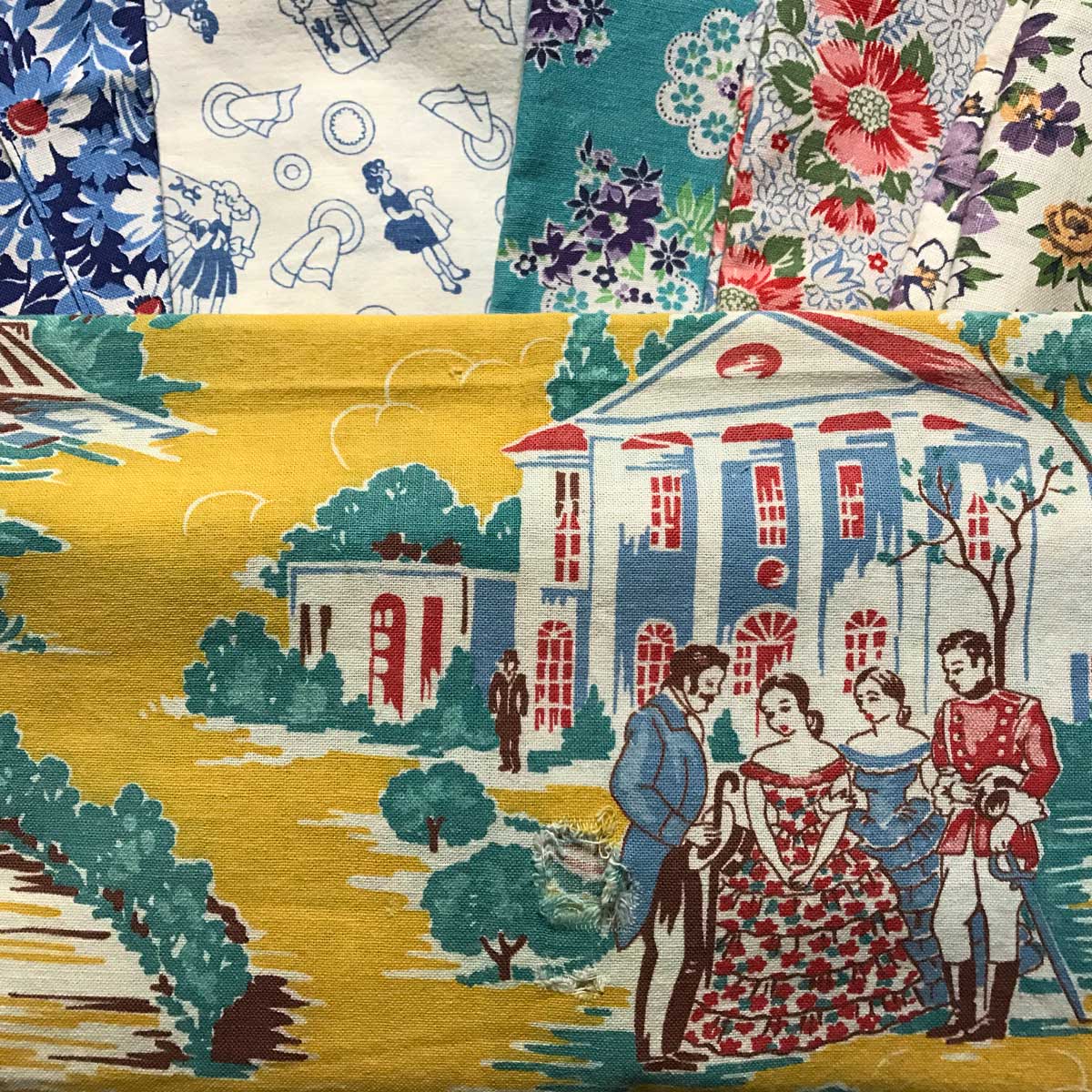
A variety of printed feed sacks, including the “Gone with the Wind” print. (Image courtesy of the author)
These early bags were white, brown, or a solid color with name brands and contents printed on the front, along with instructions for removing the print. A patent application filed in 1924 changed the textile bag industry and the way we shopped for food for our families and farm animals. The application states that the sack should be “of a size suitable of being remade into clothing” and “with a substantially indelible or permanent pattern.” These patterns are the root cause of my addiction! Our moms were now more concerned about the color and print of the sack than they were its contents. Sacks can be dated by their designs. The movie “Gone with the Wind” was made in 1939, and a bag showing movie scenes was printed shortly after that. Patterned sacks beyond gingham checks started in the late 1930s and bloomed in the 1940s.
* Collecting note: printed feed sacks can easily be found for sale online, from quilt dealers, and at antique shops. Look for the chain stitch holes or company names or logos to determine if you have a real feed sack.
Sandra Starley is nationally certified quilt appraiser, quilt historian, and avid antique quilt collector. She travels throughout the U.S. presenting talks on antique quilt history, fabric dating classes and trunk shows as well as quilting classes. Learn more at utahquiltappraiser.blogspot.com. Send your comments and quilt questions to SandraStarley@outlook.com
Divine inspiration: Bible stories depicted in quilts
November 2025 Covering Quilts Divine inspiration: Bible stories depicted in quilts by Sandra Starley For decades, the Bible has been an inspiration for quilters who depicted stories from its pages in cloth. Among them – the Song of Solomon’s Rose of Sharon,…
The Honey Bee quilt block
October 2025 Covering Quilts The Honey Bee quilt block by Sandra Starley Like many of today’s popular blocks, this pattern was first published during the 1930s Quilt Revival, a time when many antique quilt patterns were updated and named, or renamed several…
Colonial Quilters and Scrap Quilts – Some Treasured Myths of Early Quilting
September 2025 Covering Quilts Colonial Quilters and Scrap Quilts – Some Treasured Myths of Early Quilting by Sandra Starley What do you picture when I say, “Colonial Quilts”? Betsy Ross and Martha Washington sewing scrappy quilts by candlelight or quilting…
Top Tips for Antique Quilt Collecting, Part II
August 2025 Covering Quilts Top Tips for Antique Quilt Collecting, Part II by Sandra Starley Knowledge is power With all the online resources available today, it is easy to become an educated consumer. It just takes some determination and time to develop your…
Spool Pets – Meet Clara Cow
June 2025 Covering Quilts Spool Pets – Meet Clara Cow by Sandra Starley Quilters cannot sew without thread and other sewing notions, and most have collections of sewing supplies. You never know what you may find in that box of vintage lace, rickrack, and bias tape. I…
Flying Geese classic quilting block helps quilts take flight
May 2025 Covering Quilts Flying Geese classic quilting block helps quilts take flight by Sandra Starley Egyptian pyramids, Mayan Temples and myriad European churches feature this iconic triangle. This ancient shape was quickly adopted by very early quilt makers as a…