
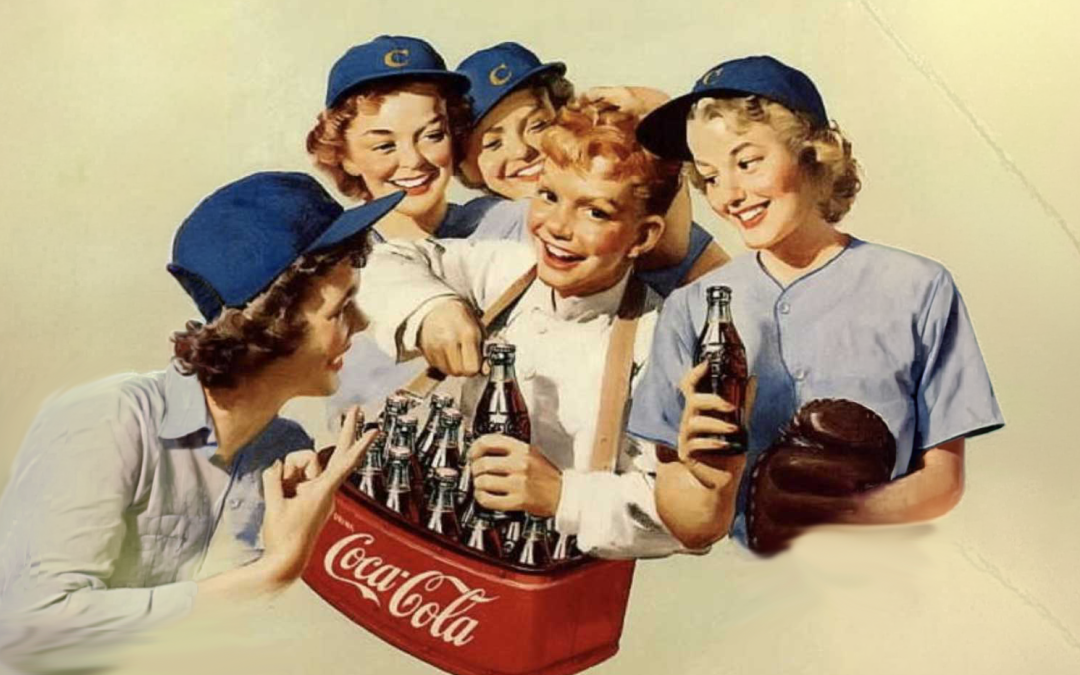
Retro advertising poster shows Coke hawker at girl’s ballgame. (Image courtesy of pinterest.com)
March 2026
Cover Story
Collecting Coca-Cola
Coke antiques chronicle company’s history
by Corbin Crable
When it comes to collectibles, nobody beats Coca-Cola.
The fizzy beverage that has been a household name for nearly 150 years is much, much more than a product that helps quench your thirst. Its brand recognition has garnered generations of fans across the globe. It’s said that 94% of the world’s population can identify the brand’s red and white logo, and that the phrase “Coca-Cola” is the second most understood phrase in the world, right after ‘okay.’ Currently, Coca-Cola can be found in more than 200 countries. The brand hasn’t only influenced the food and beverage industry, but pop culture as well (no pun intended).
A refreshing brand
Coca-Cola has long also been a giant in the antiques industry. Coca-Cola collectibles of every type have spread the word about “the Pause That Refreshes” in the form of coolers, bottles, calendars, clothing, stuffed animals, serving trays, and more. Collectors clubs have brought collectors together around the world, too, with regular conventions allowing collectors to buy, sell, and trade every item imaginable. Regionally, the Mid-America Chapter serves Kansas, Missouri, Nebraska, and Iowa (its 50th anniversary show is coming up, from April 17-18 in Independence, MO); the city of St. Louis alone has its very own chapter, the Gateway to the West Chapter.
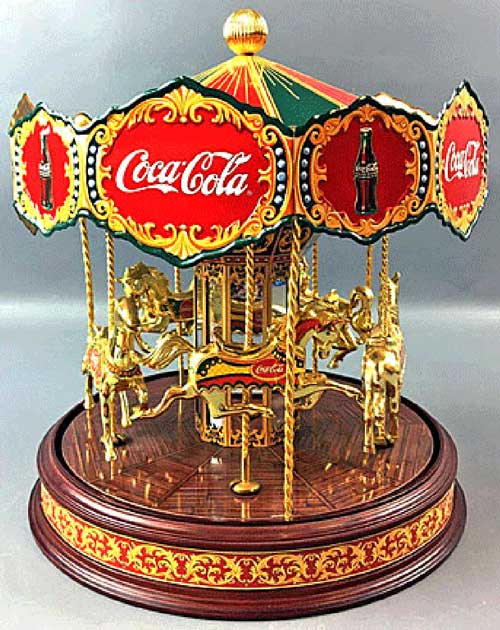
Coca-Cola logo on collectibles
The Coca-Cola logo can be found on collectibles at just about any price point, including this higher-end carousel toy. (Image courtesy of The Antiques Almanac)
According to one historian, Coca-Cola’s logo began to appear on regular, everyday items you might find around the house.
“The marketers were tremendously creative in producing things that you’d carry on your person, things like wallets, purses, cufflinks, pocket mirrors for the ladies, bookmarks, stamp holders, and notebooks. Let’s say your wallet has a Coca-Cola emblem on it,” Phil Mooney, former archivist for the Coca-Cola Co. told Collectors Weekly in 2009. “Well, every time you pull out that wallet to pay a bill, it was a reminder to try a Coca-Cola. Or say you had a lady’s pocket mirror. Every time you adjusted your make-up, you’d get that reminder as well. All of these items had a very utilitarian element—they were things that you used every day in the course of living your daily life. Yet each was an invitation for you to try a glass or a bottle of Coca-Cola.”
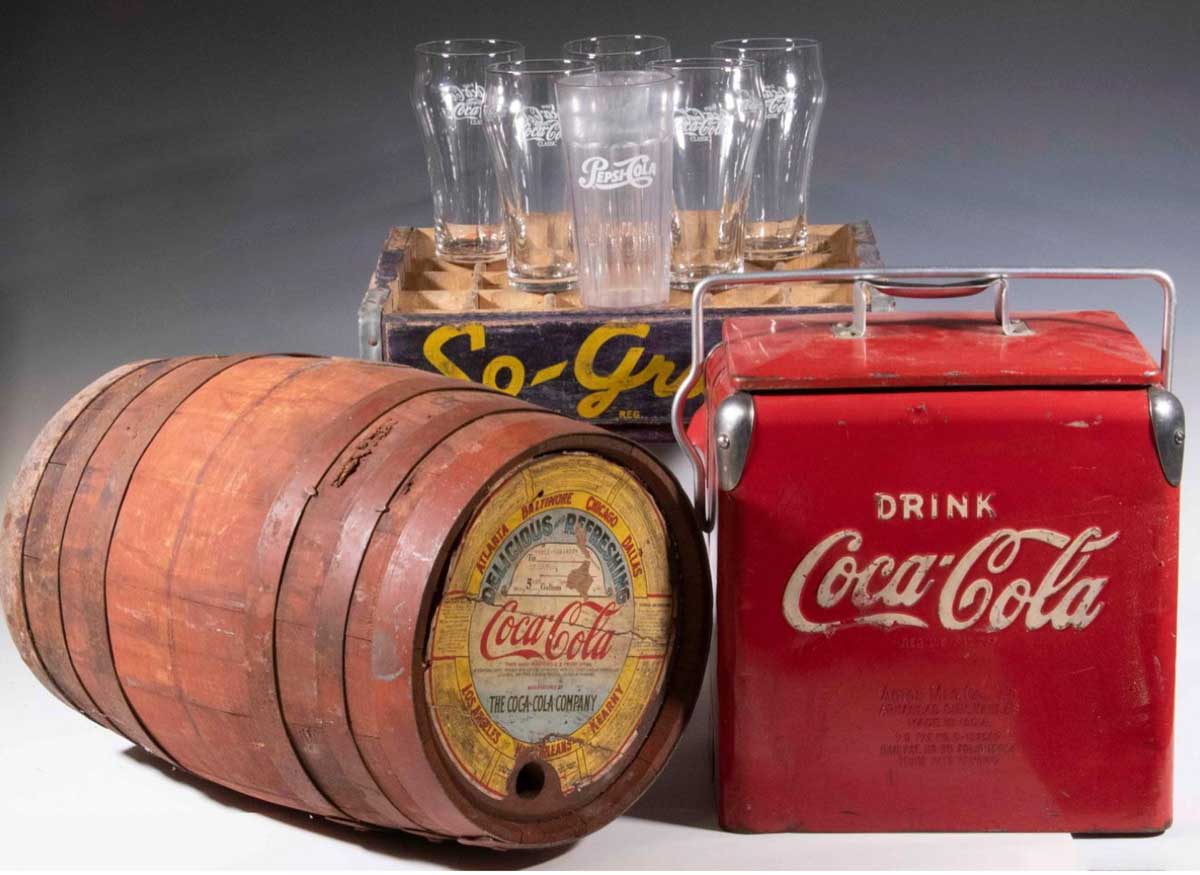
Vintage Coca-Cola collectibles
This lot of vintage Coca-Cola collectibles, which included a syrup barrel from the 1920s, a metal cooler from the 1950s, and crate with bottles. A note on the syrup barrel’s ingredient list notes “cocaine removed.” (Image courtesy of Thomaston Auction)
The soda with a place in history
Until its invention, Mooney explains, beverages were usually fruit flavored. Cola itself was a new product, and the company pulled out all the proverbial stops to get consumers to give it a try. That meant putting the logo on items such as clocks in drug stores and on scales at the pharmacist’s desk. It was a strategy that worked, and the advertising found its way to even more items as the 19th century ended and the 20th century began. Mooney said he especially enjoys Coca-Cola antiques made during two specific periods.
“I like the turn-of-the-century Coca-Cola antiques. They have that wonderful Victorian quality to them. The very ornate trays with those fashionably dressed women on them immediately take you back to that period in our history,” Mooney said. “I also like the advertising that we did in the 1920s. If you read history and literature, you probably already have a picture in your mind of what people looked like in the 1920s. … Well, advertisements for Coke in the 1920s capture all of that perfectly. If you want to know what a flapper looked like, just take a look at a Coca-Cola tray. Coca-Cola advertising from that period captured the lifestyle perfectly. It’s almost like a photographic record.”
According to Mooney, Coca-Cola’s brand recognition reached new levels in the post-World War II era, thanks to American soldiers being dispatched throughout the world and introducing local populations to the drink. For those GIs, Mooney said, “Coca-Cola was a strong reminder of home.”
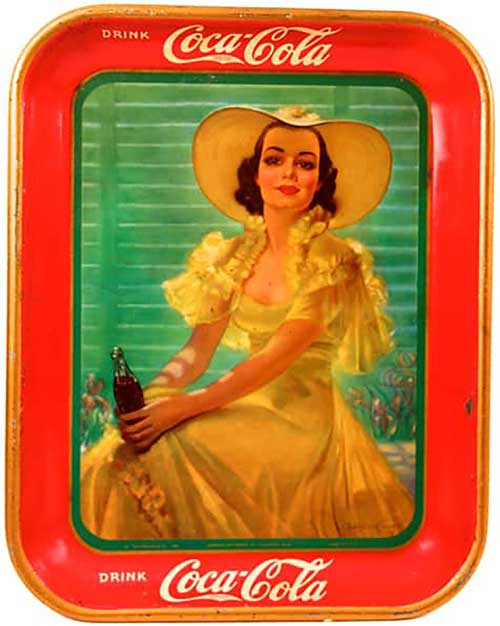
Coke’s original collectibles serving trays
Coke’s original collectibles included serving trays that prominently featured beautiful, stylish women enjoying a bottle of the beverage. (Image courtesy of Collectibles with Causes)
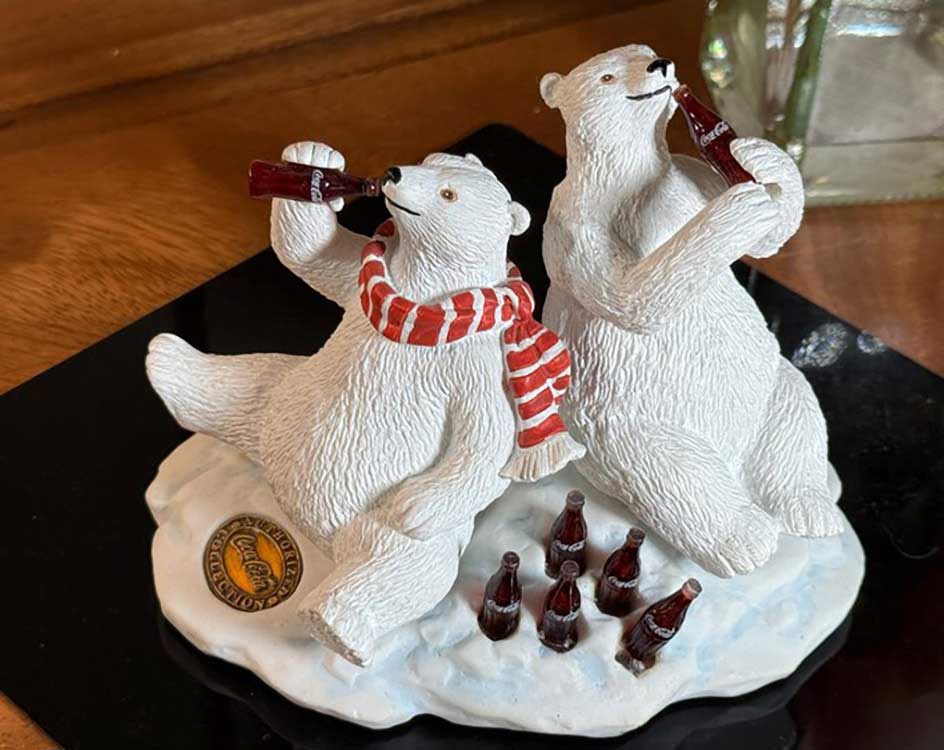
The Coca-Cola polar bears
The Coca-Cola polar bears proved to be a hit with customers and collectibles alike. Pictured: A polar bear figurine from 1994. (Image courtesy of Etsy)
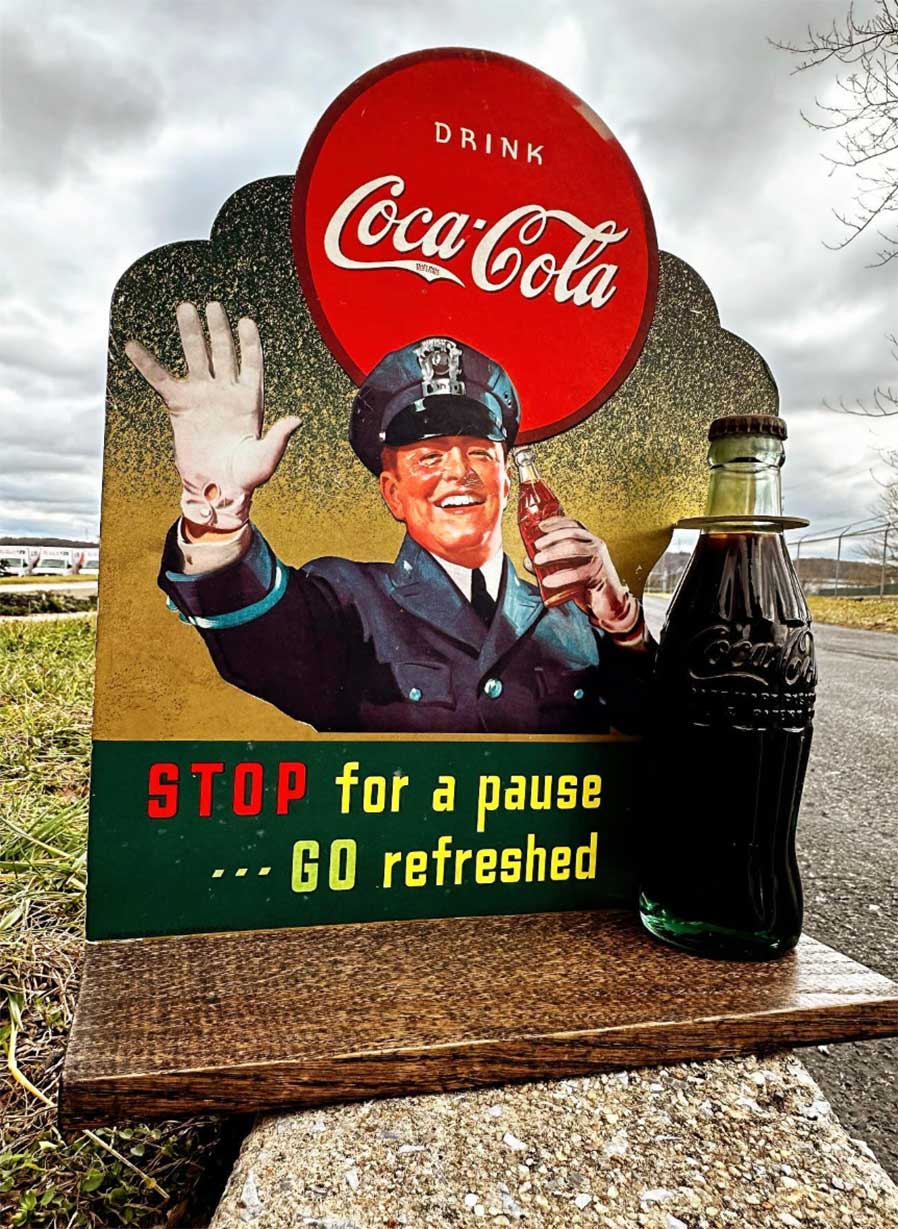
This vintage Coca-Cola display
This vintage Coca-Cola display is incredibly rare, having been produced in Canada in 1938. It is pictured with an original 1940s display bottle made in Arkansas. These bottles almost never contained any actual liquid, instead being painted on the inside to make them appear full of Coca-Cola. (Image courtesy of the Cedartown (GA) Coke Museum and Instagram)
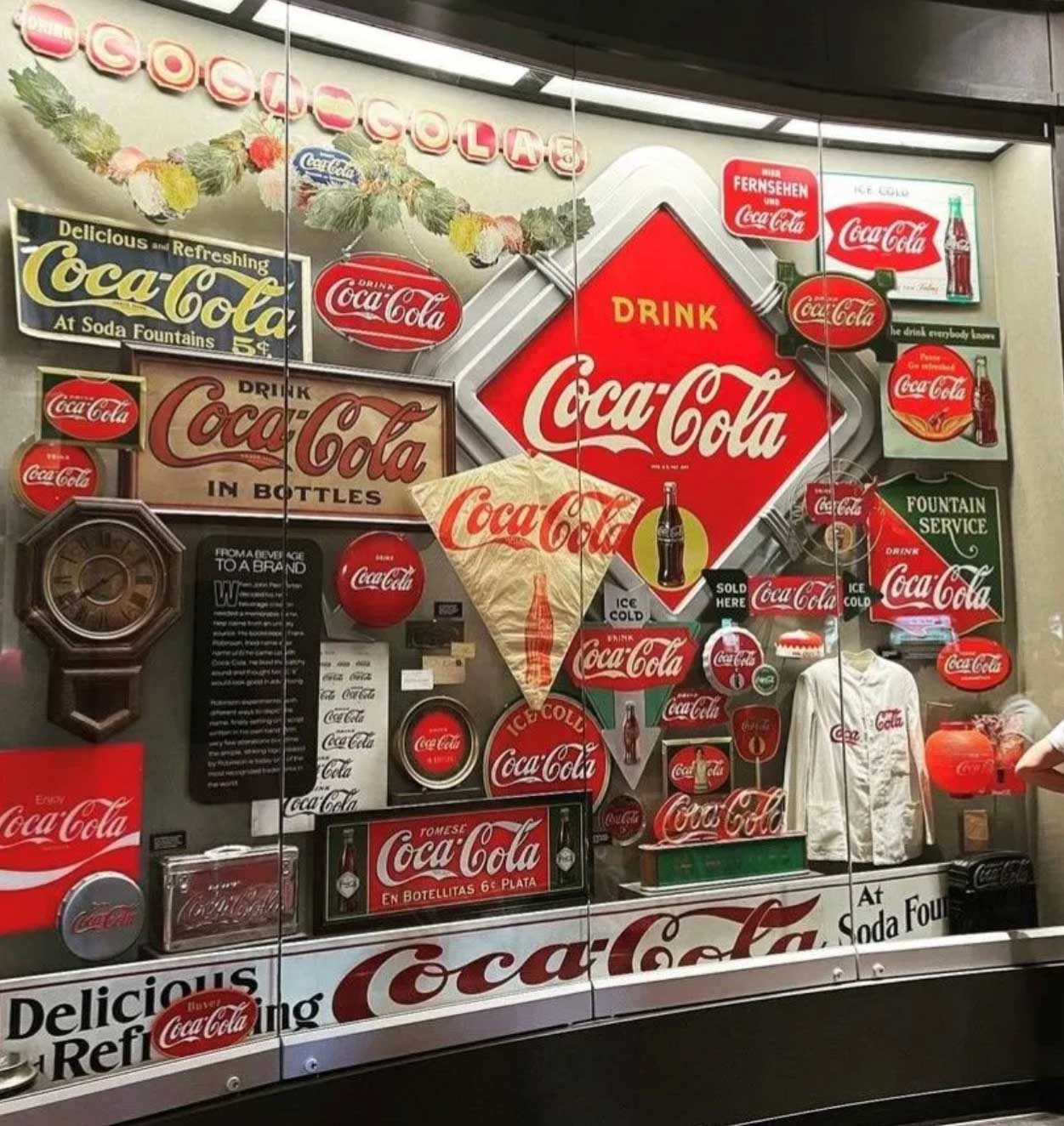
The largest collection of Coca-Cola items
The largest collection of Coca-Cola items belongs to a collector in Oregon, OH, with a staggering 5,237 items. (Image courtesy of worldrecordacademy.org)
That set the stage for a sort of renaissance for Coca-Cola collectibles, which enjoyed a surge of popularity in the 1960s and ‘70s (it was at this time that Coca-Cola collectors clubs began to pop up across the globe).
“There are two categories (of memorabilia): vintage Coca-Cola collectibles and more recent items. The vintage pieces are difficult for young collectors and new collectors on a budget because they tend to be pricey,” Mooney told Collectors Weekly. “It’s a lot easier to get into collecting bottles or cans or pins because they tend not to be expensive. You can develop a pretty nice collection without spending a lot of money. The vintage stuff is out there, but it’s not cheap.”
Jolly St. Nick dons the red and white
Another of Coca-Cola’s significant contribution to pop culture came in 1931, when an illustrator for the company, Haddon Sundblom, created the image of Santa Claus that has become our default imagining of the jolly old elf; in older depictions, Santa was portrayed as wearing green or blue. Sundblom’s Santa introduced the world to a Santa festooned in red and white (the colors associated with Coca-Cola, of course), and the image lives in our collective consciousness still. Mooney, meanwhile, wrote that Coca-Cola Santa Claus collectibles are among the company’s most popular items.
“We began creating Santa Claus imagery in 1931, and Sundblom did all of it through 1964,” Mooney wrote. “So for more than three decades, we had one artist working on creating an image of what Santa Claus ought to be. Today his Coca-Cola Santa Clauses are part of our collective DNA.”
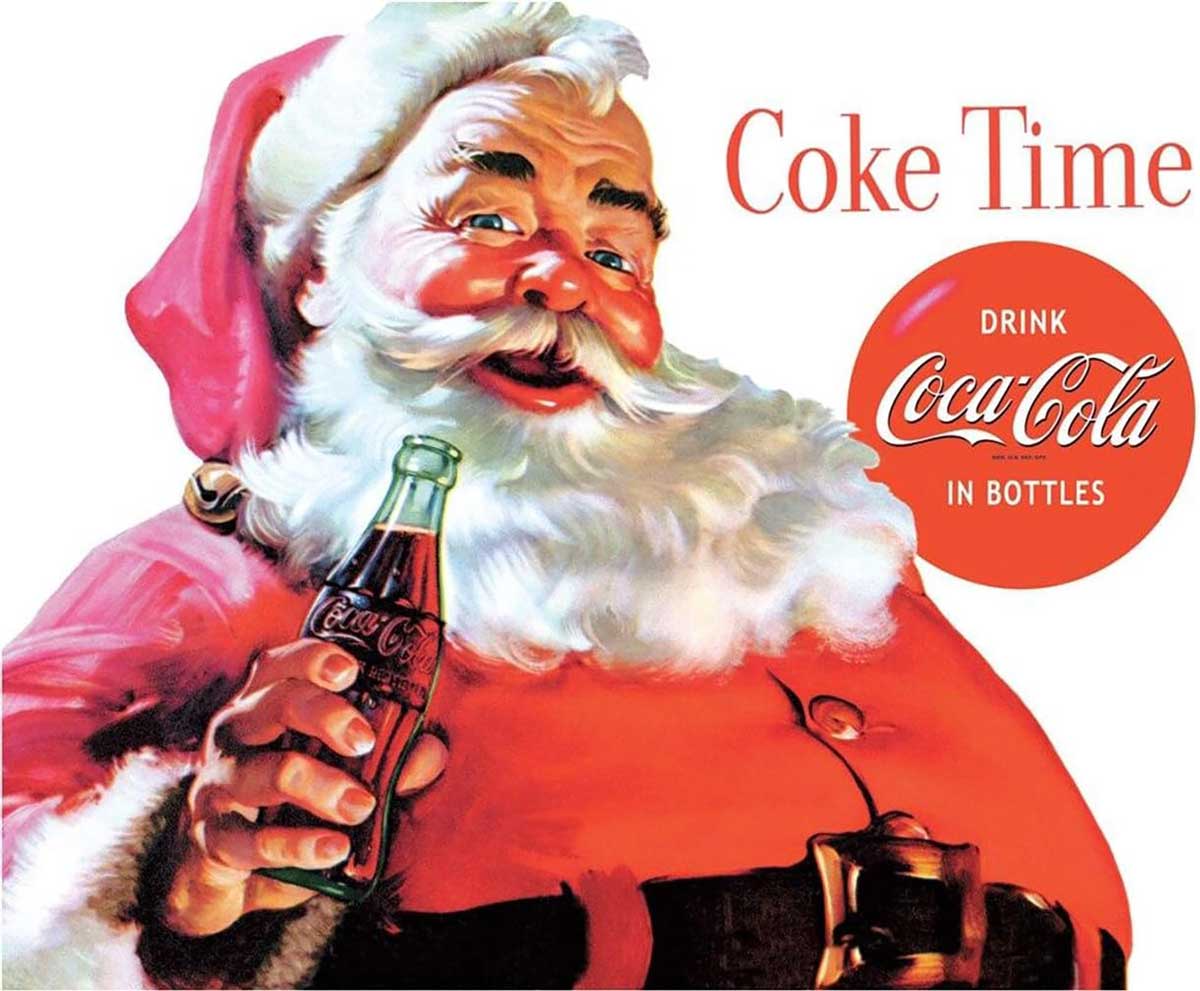
Santa and Coke
We have Coca-Cola to thank for our present-day imagining of Santa Claus. Do the colors of his suit look familiar together? (Image courtesy of Amazon)
Although the Coca-Cola name could be found on everyday household items since the product’s inception, Mooney said the logo could be found in the most unusual of places.
“At one point, somebody created a sandwich press that had a Coca-Cola logo on it. It was sort of like a Panini press today for sandwiches, but this one put a Coca-Cola logo on the bread. That was unusual. There were a couple of hatchets that were produced. They had logos on them. Why they did it, I have no idea, but somebody apparently decided that would be a cool idea to advertise on an axe or a hatchet,” Mooney said. “So I guess when somebody went to chop a tree down, if you got thirsty, you would go and buy a Coke. … They had little dishes that were created with our logo on them. There were things like flyswatters that had the logo. There were knives and forks and spoons that had the logo. Cufflinks and cow bells, wash gloves and thimbles, just about anything you can think of.”
It’s like an old friend
Unlike many antiques, Coca-Cola is finding a new life with younger collectors, Mooney added, even if those younger collectors aren’t snatching up the bigger, more expensive items and instead opting for smaller, more cost-effective options.
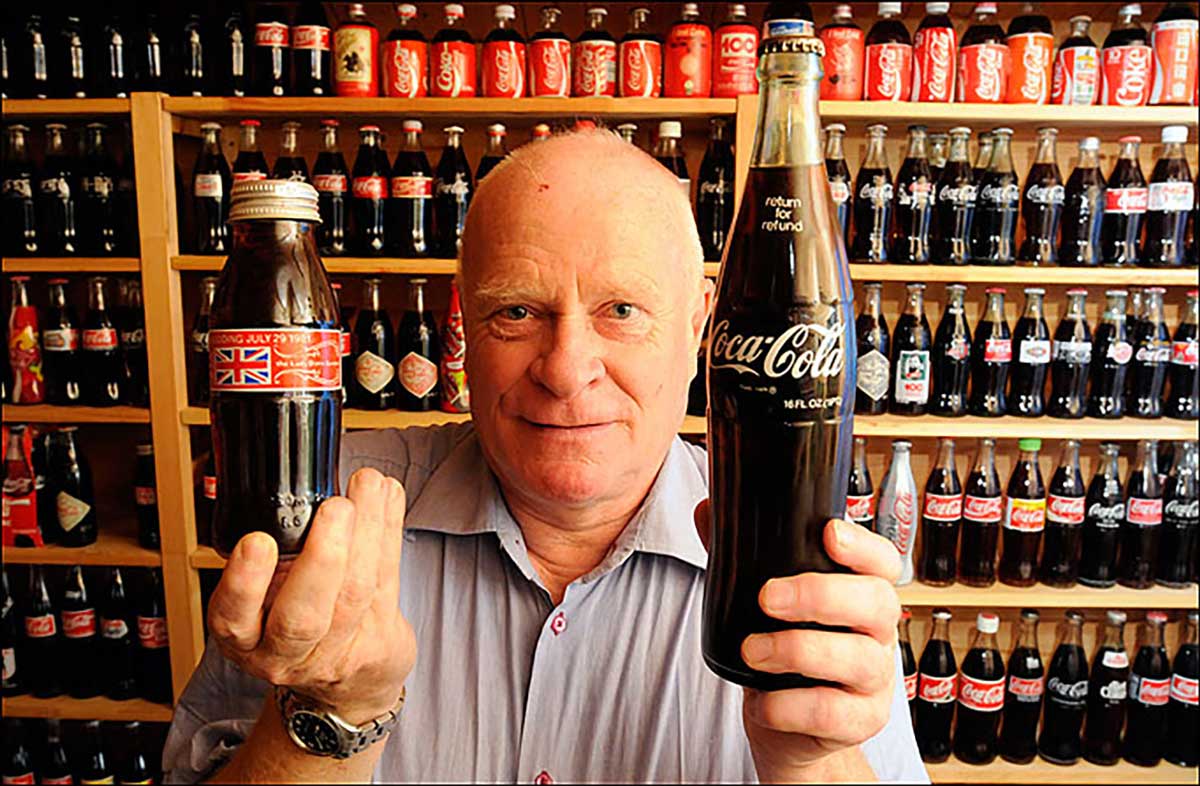
Unopened Coca-Cola cans and bottles
John Burley of the United Kingdom boasts the world’s largest collection of unopened Coca-Cola cans and bottles. More than 600 unopened Cokes sit on shelves in his house. (Image courtesy of worldrecordacademy.org)
“The biggest change that I’ve noticed is a movement on the part of young people away from vintage collectibles. They are just not that available, and if they are, the pieces are so expensive that they can’t afford to participate,” Mooney said. “The trend is toward what I call the secondary collectible categories, things like bottles, cans, pins, and small collectibles.”
Mooney said that though attending a collectors convention is a wonderful way to network with other collectors, receive appraisals, and hunt for coveted treasures, sites like eBay and Etsy “are fantastic places to gauge the market.” Still, he noted, there’s nothing like the feeling of finding that special item at a brick-and-mortar antique store or flea market.
Coca-Cola collectibles continue to rise in popularity due in large part to what the brand itself represents – something that is nostalgic, familiar and ever-present, both in small moments and big celebrations. No matter what happens in our lives, Coca-Cola is there.
“People are comfortable with Coca-Cola memorabilia. It brings back memories. It may remind them of a simpler time in our history. There are all-American girls on the trays and calendars, suggesting a more innocent age, if you will. That’s kind of the appeal of the product: Coke is a brand that people associate with happy times—a birthday, a football game, the prom, graduation. It’s a product that people have around when they are with friends and family,” Mooney said. “I think that that’s what makes Coke so comfortable for people. It’s like an old friend. So if you collect this stuff and you put it in your rec room or living room, every time you walk into that room, you probably smile a little bit because it seems like you’re rekindling something that you once had as a part of your life.”
Start or add to your own Coca-Cola collection at the 50th Anniversary Coca-Cola Collectors Show & Sale, APRIL 17-18 at the Hilton Garden Inn in Independence, MO. For more information, contact Joanie Shover at jshover50@aol.com or 816-229-8920, or visit www.mid-americatcccc.com. To book a room, call the hotel at 816-350-3000.