
December 2025
Feature Article
Father Time, Baby New Year have heralded passage of time over millennia
By Corbin Crable
It’s always a delight to read about the first baby of the new year born in your city, state or region – a practice that has been tradition with local news sources until recent years. A symbol of a new year – and with it, hope, health, and prosperity – you might see babies clad in a diaper, top hat, and sash representing a new year in media or antique collectibles, usually accompanied by an old man known as Father Time, who symbolizes the end of the previous year with the passage of time.
Depictions of Baby New Year and Father Time have existed since long before the antique collectibles on which they appear. Like many of our modern-day traditions, they began in the ancient world; back then, however, they weren’t yet linked to the beginning of a new year but to the changing of the seasons instead. In ancient Greece, the baby symbolized the end of winter, the start of the springtime harvest season, and the resurrection of Dionysus, Greek god of wine, vegetation, and fertility, according to a 2024 article by Elizabeth Yuko on readersdigest.com.
Out with the old, in with the new
Yuko writes that the elderly, white-bearded image of Father Time is most likely drawn from Chronos, the Greek god of time, or the Roman god Saturn. Like Father Time, each was often depicted carrying a scythe, like the Grim Reaper. But (Prof. Daniel Compora of the University of Toledo) says that Father Time may have also been inspired by the two-faced Roman God Janus, who represented beginnings and endings, as well as life and death.” In many renderings, Father Time wields a scythe, itself a symbol of “the endurance of time, which eventually will ‘cut down’ all living things. In some of these renderings, too, he hands over an hourglass (and thus, his duties and responsibilities) to Baby New Year.
The image of these two characters came to the U.S. during the Victorian Era by German immigrants. Innovations in printing during the Industrial Revolution allowed for those images to be spread quickly and to a much wider audience.
“The image and concept of Baby New Year became more widespread in both Europe and the United States during the Victorian era, thanks to the massive popularity of greeting cards and postcards,” Yuko writes. “Advancements in printing technology meant that colorful illustrations could be mass-produced. In addition to Christmas cards, people sent cards to wish others luck in the new year — many of which were adorned with pictures of Baby New Year, sometimes alongside Father Time.”
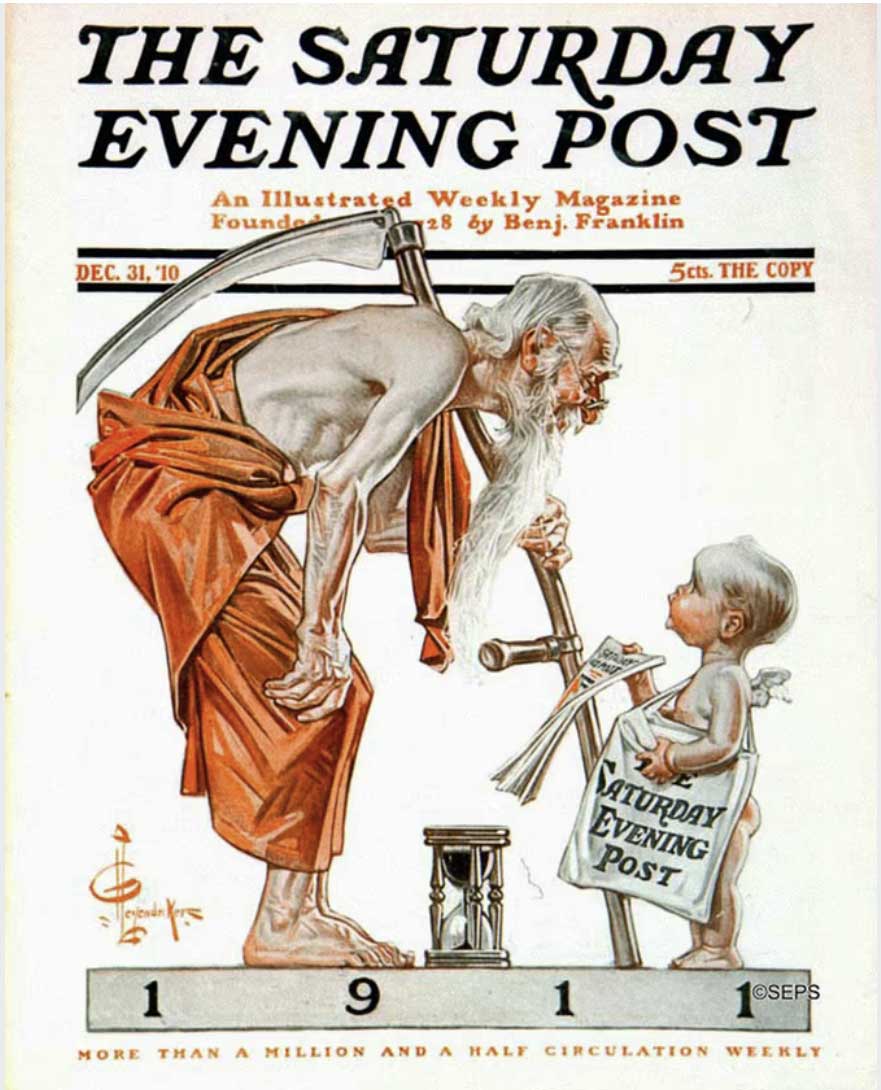
In this Saturday Evening Post cover welcoming the year 1911, Father Time bestows to Baby New Year his knowledge gained over the course of the past 12 months. (Image courtesy of the Saturday Evening Post)
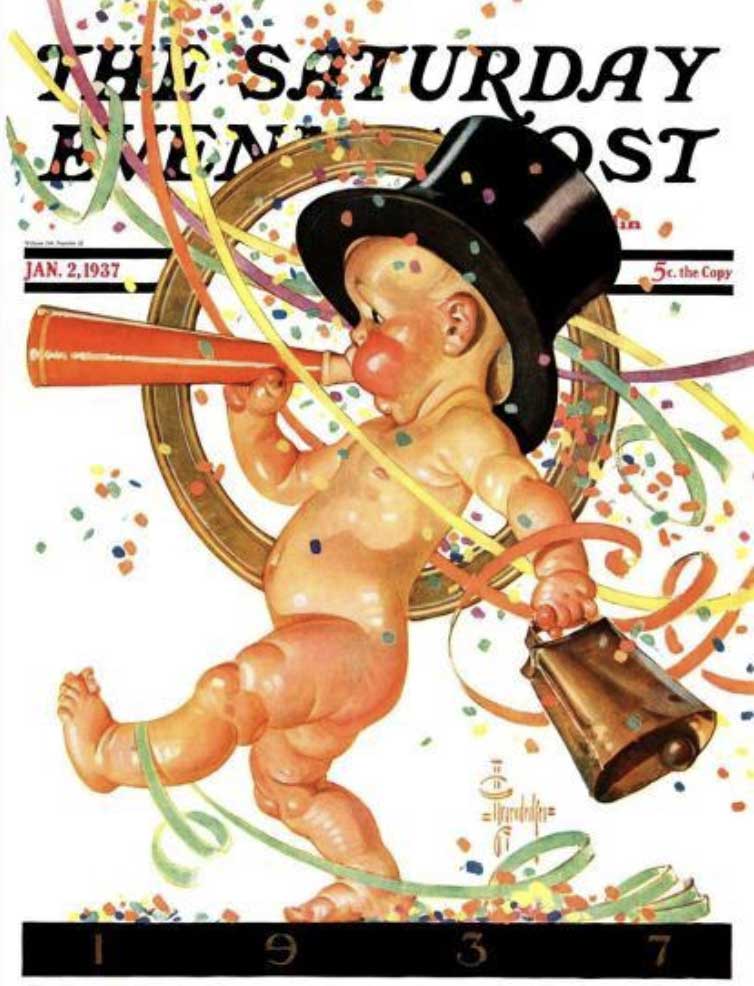
IThis cover of the Saturday Evening Post, published in 1937, was one of dozens penned by illustrator J.C. Leyendecker, who also acted as a mentor to artist Norman Rockwell. (Image courtesy of the Saturday Evening Post)
In ephemera and media
At the turn of the century, both figures would be regularly printed on greeting cards and postcards (many of which sell on a variety of websites today for just a few dollars apiece). Americans in the 20th century would come to recognize Baby New Year and Father Christmas thanks to the talents to illustrator J.C. Leyendecker (a mentor to Norman Rockwell); Leyendecker drew the pair of characters for the Saturday Evening Post between 1907 and 1943.
The two characters leaped off the printed page and onto the small screen in 1976, with the release of the stop-motion animated film “Rudolph’s Shiny New Year,” in which Father Time and Santa Claus join forces to rescue an escaped Baby New Year named ‘Happy,’ who ran away after being teased by others for having big ears, according to a 2021 article by Ashley Leath on countryliving.com.
Compora, Yuko writes, says that though we stil recognize these two iconic characters today, we now associate the new year with our own goals and aspirations instead.
“The spirit of rebirth or renewal is still present, but people apply it to themselves instead of looking for an artistic representation,” Compora says in the Readers Digest article. “That’s why people begin the new year with resolutions designed to improve their lives.”
Contact Corbin Crable at editor@discovervintage.com.