
June 2026
SMACK DAB IN THE MIDDLE
Here comes the bride (and groom)
by Donald-Brian Johnson
Poor Spencer Tracy. As Elizabeth Taylor’s hapless dad in 1950’s “Father of the Bride,” he not only gave away his daughter, but also plenty of cash. MGM’s ads said it all: “The Bride gets the THRILLS! Father gets the BILLS!”
Just a few years earlier, with “wartime weddings,” things were a lot more austere. The wedding dress? Perhaps Mom’s carefully preserved gown, altered and called back into service. The groom’s “tux?” Most likely a military uniform. And the wedding reception? Probably a simple event, held in a church basement decked out with crepe paper streamers.
After World War II, however, the country raced full speed ahead into a new and exciting future. With wartime restrictions lifted, there was an “urge to splurge.” If that meant treating your daughter to the fairy-tale wedding of her dreams, well. . . like Dad Spencer in “Father of the Bride,” the only thing to do was to grin and bear it.
That new face on 1950s newsstands, the “bridal magazine,” brought out the romantic in every bride-to-be. Should the wedding dress have lots of heirloom lace? Of course! (All that lace on Grace Kelly’s 1956 gown was 125 years old!) A diamond for the engagement ring? Naturally! (Long before Ian Fleming, De Beers Jewelry declared that “Diamonds are Forever”). Should the wedding be in June? (Sure thing! That tradition dates back to ancient times, when Juno, the Roman goddess of marriage, was said to always bless a June wedding.)
Plenty of planning went into preparing the perfect 1950s wedding. Lilies, gardenias, or orchids in the bridal bouquet? (All three were ‘50s favorites.) What about the main course at the reception? Roast beef, baked ham, or that mid-century mouthful, “Chicken a la King?” (All had their adherents.) And how about the wedding cake? You could have a giant one, in vogue since the days of Queen Victoria, whose own cake weighed 300 pounds. A bride-and-groom “cake topper” was a must, to be kept as a souvenir of the happy day.
If a smaller cake was desired, that went to the immediate wedding party. For everybody else, dessert options included frosted fruit cake, glazed fruit cocktail, or artfully molded Jell-O, embedded with fruit and nuts, and topped with whipped cream.
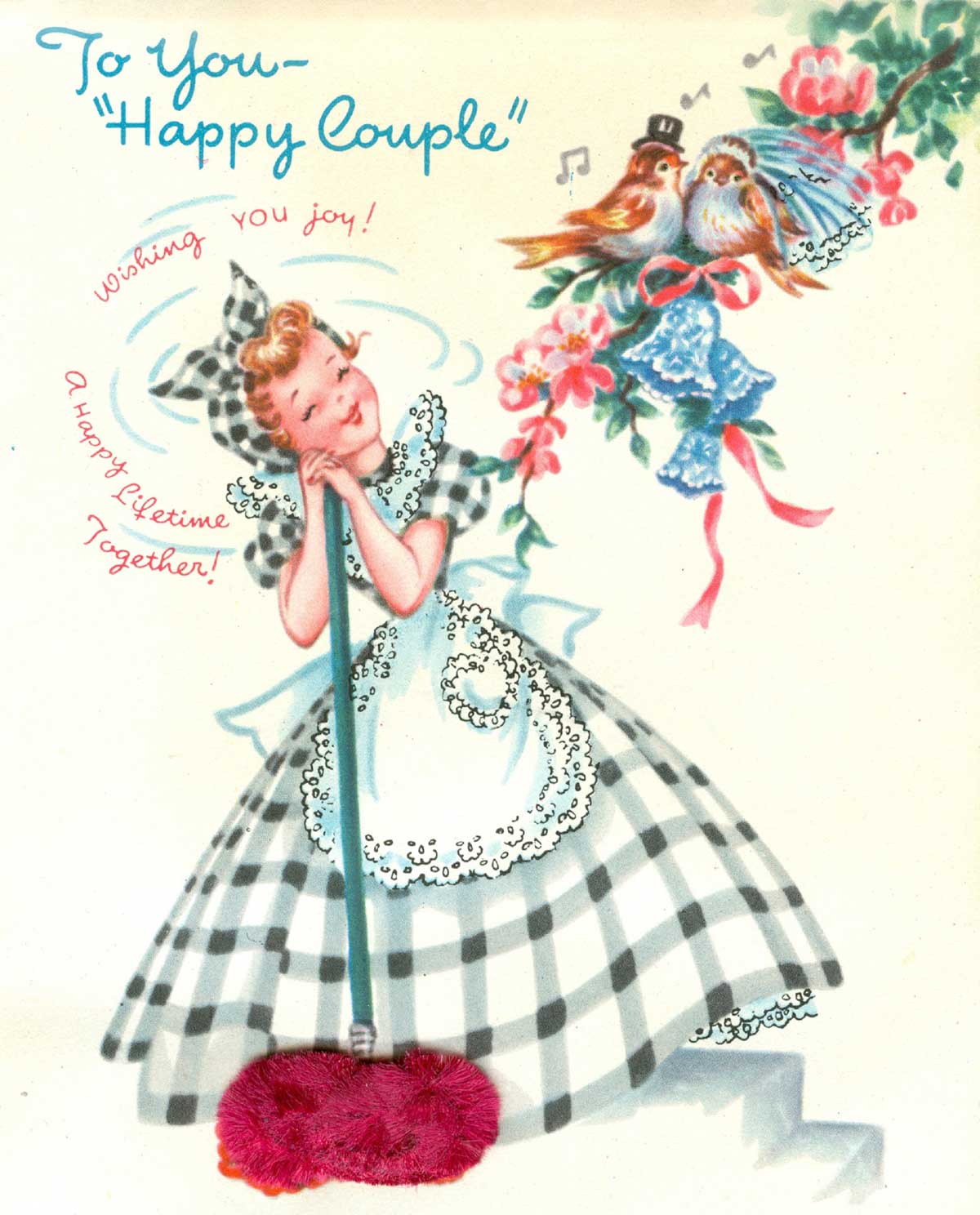
Dreaming of the big day: the bride-to-be stops mopping for a moment to check out a bridal bird pair. The mop head on this Phillips card is actual fabric. (Image courtesy of the author)
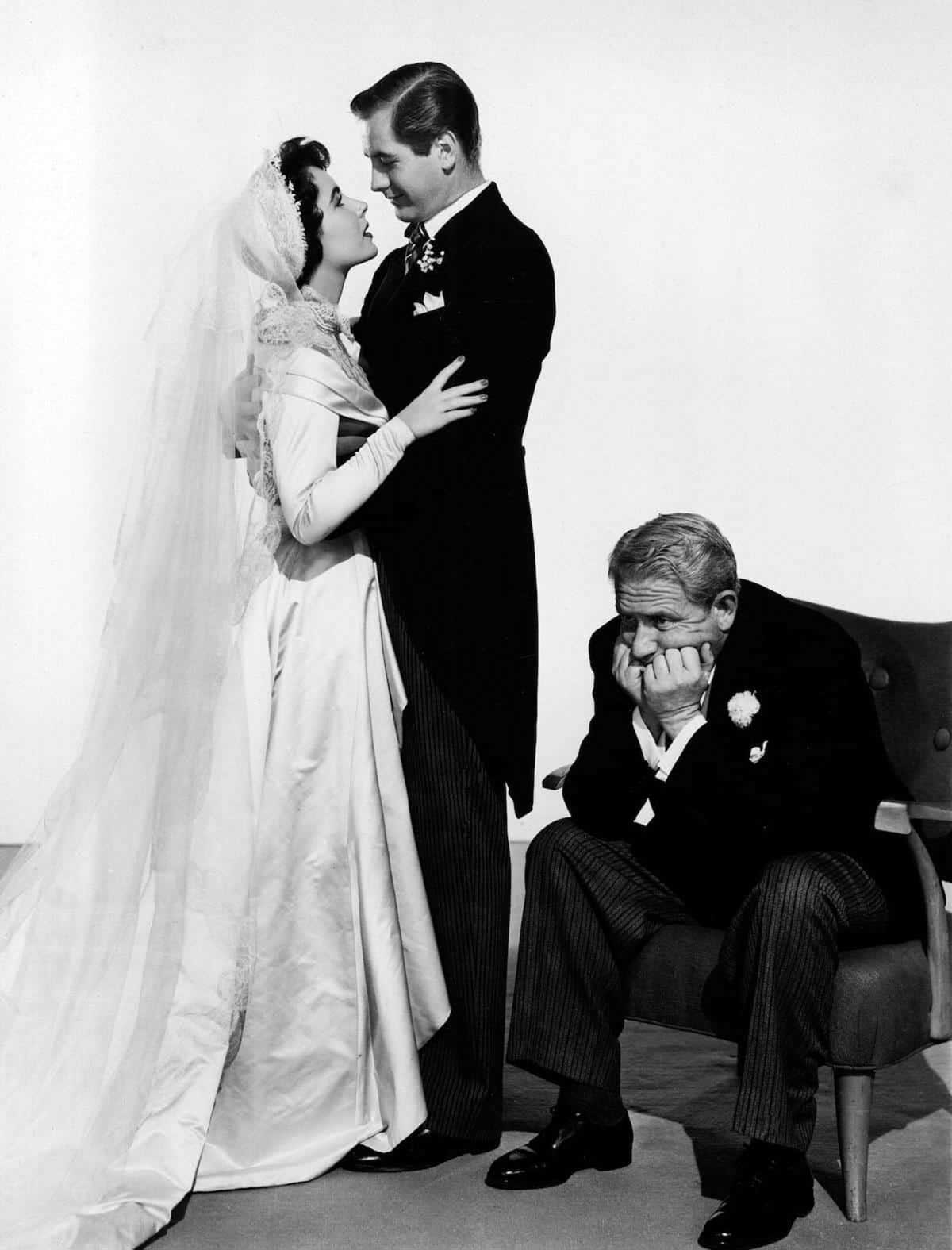
Elizabeth Taylor is the bride, Don Taylor is the groom, and Spencer Tracy is the father stuck paying for everything, in MGM’s 1950 hit, “Father of the Bride.” Taylor’s wedding dress, designed by Helen Rose, inspired many other brides of the ‘50s. (Image courtesy of the author)
Guests had their responsibilities, too. The most important: gifts, which etiquette books advised should be “comparable in value to the reception dinner.” In the early ‘50s, that could run to a hefty three figures (or, about $1.25 per person). Scribbled reminders on the backs of vintage wedding cards give an idea of what the lucky bride hauled in back then, from a “green thistle luncheon cloth,” to a “chrome Nazarene breadplate,” to a “Candlewick heart candy dish.”
Then there were the wedding cards themselves. Card manufacturers (including Gibson, Forget-Me-Not, Rust Craft, American Greeting, and, of course, Hallmark), released cards with themes that would appeal to both giver and recipient. For the traditional, there were gauzy illustrations of brides on stairways, brides and grooms at the altar, and brides and grooms beaming at guests after the ceremony. For those with a sprightly sense of humor, there were depictions of impish bridal pairs dodging glitter “rice,” or of newlyweds enjoying the long-anticipated comforts of “home sweet home.” Card themes not featuring the couple tying the knot focused primarily on flowers, wedding cakes, rings, and, leading off the wedding march, church bells.
Among the added visual embellishments: metallic foil inserts, bridal veils of real net, bows of real ribbon, flocking, raised texturing, glitter, and even the occasional rhinestone. Whether decorous or humorous, wedding cards of the 1950s were intended as exquisitely made keepsakes. That’s good news for collectors, who can enjoy these carefully preserved treasures much as they first appeared. Many remain readily available, and most sell for just a few dollars each. Prices like that would even put a smile on the face of the “Father of the Bride”!
Donald-Brian Johnson is the co-author of numerous Schiffer books on design and collectibles, including “Postwar Pop,” a collection of his columns. Please address inquiries to: donaldbrian@msn.com