
March 2026
SMACK DAB IN THE MIDDLE
Clowning around: Cheery clown collectibles
by Donald-Brian Johnson
“Be a Clown! Be a Clown!
All the world loves a Clown!”
- Cole Porter, 1948
OK, maybe not “all the world.” If memories of “Pennywise,” the evil clown in Stephen King’s It, still have you shuddering, then you and Cole Porter might find yourselves at odds. For everyone else, those brightly painted faces, big red noses, multicolored costumes, and oversized shoes mean good times are on the way!
Circuses. Carnivals. Parades.
All sorts of charity events. If it seems like clowns are everywhere, well—they are. And they’ve been hopping out of those little cars and spreading their particular brand of joy for ages.
The first clowns entertained the imperial courts of Egypt (2400 B.C.) and China (1000 B.C.). In some early societies, court clowns even served a triple purpose, as funnymen, magicians, and religious figures. By the time clowning made its way to the theatres of ancient Greece and Rome, the clown characterization had evolved to that of a country bumpkin. And, while court jesters amused royalty with their antics (not to mention those jingling caps and shoes) during the Middle Ages, Shakespeare’s “Fools,” in his Elizabethan plays, brought bumpkins back to prominence.
Hmmm. These don’t sound much like “Bozo,” do they? Where was the whiteface? The wild wig? Enter Joseph Grimaldi.
In the early 1800s, Grimaldi took the London stage by storm. His costumes were a bizarre mix of colors. His face was plastered in white, accented by red cheek highlights. The wig was there, too--not carrot-y like Bozo’s, but a blue Mohawk. He did high leaps and headstands. He sang and offered impersonations. He even presented a boxing match—with himself! Viewing Grimaldi’s success, other clowns quickly slapped on the whiteface, pulled on the baggy pants and wigs, and climbed aboard the circus wagon. Clowning was no longer just the filler during the main event. Thanks to Grimaldi, clowning now was the main event. By the mid-20th century, no circus was complete without a clown (or better yet, a whole carful of them).
Modern clowns came in many types. There were “tramp clowns” like Emmett Kelly and Charlie Chaplin. Rodeo clowns. Sophisticated whiteface clowns like “Frosty” Little. Much less sophisticated whiteface clowns like Bozo and Ronald McDonald. (Here’s an interesting clownfact: did you know that weatherman Willard Scott once played both Bozo and Ronald McDonald?)
And, of course, there were “evil clowns,” from Pennywise to Batman’s “The Joker,” eager to scare us silly (There’s even a name for clown fright: it’s “coulrophobia”).
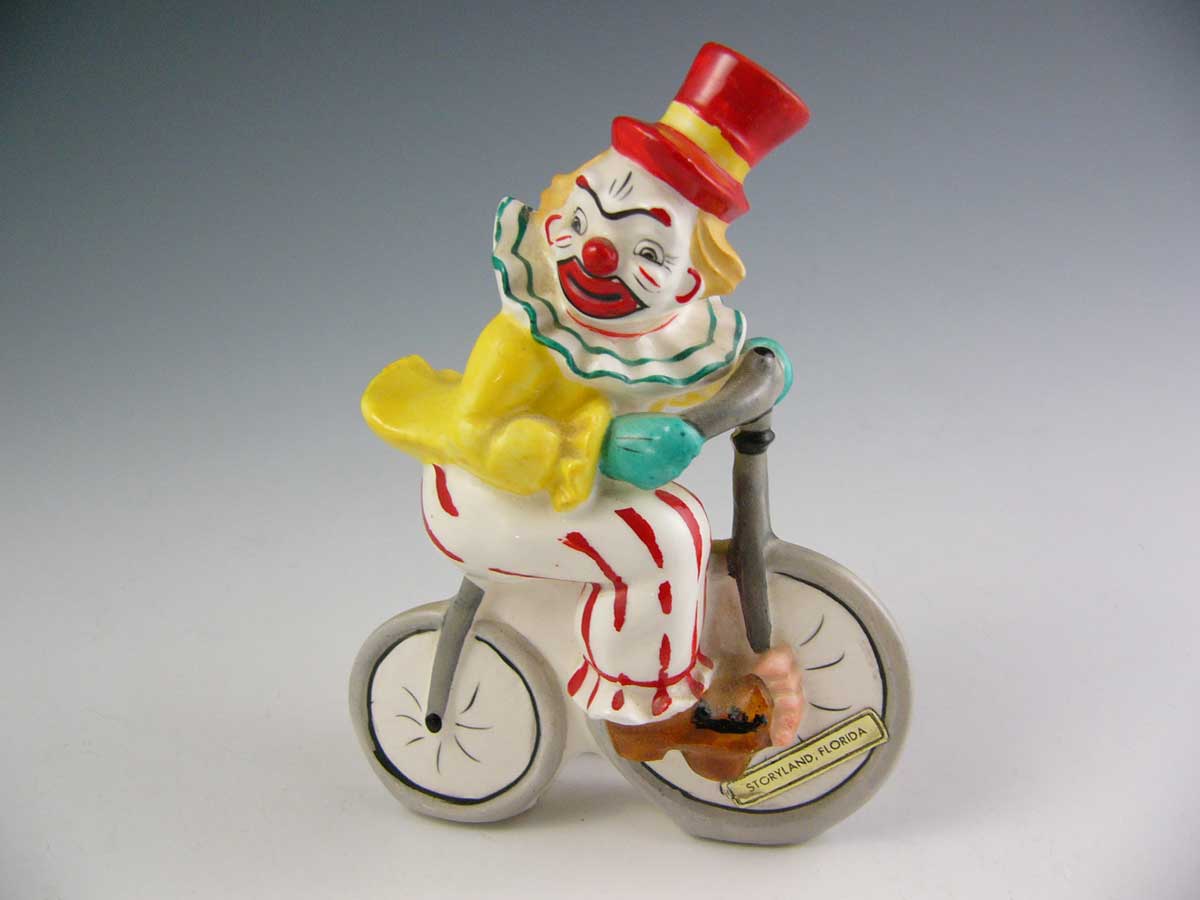
Clown on bicycle souvenir figurine with “Storyland, Florida,” sticker. By Yona, 6” h. (Image courtesy of the author)
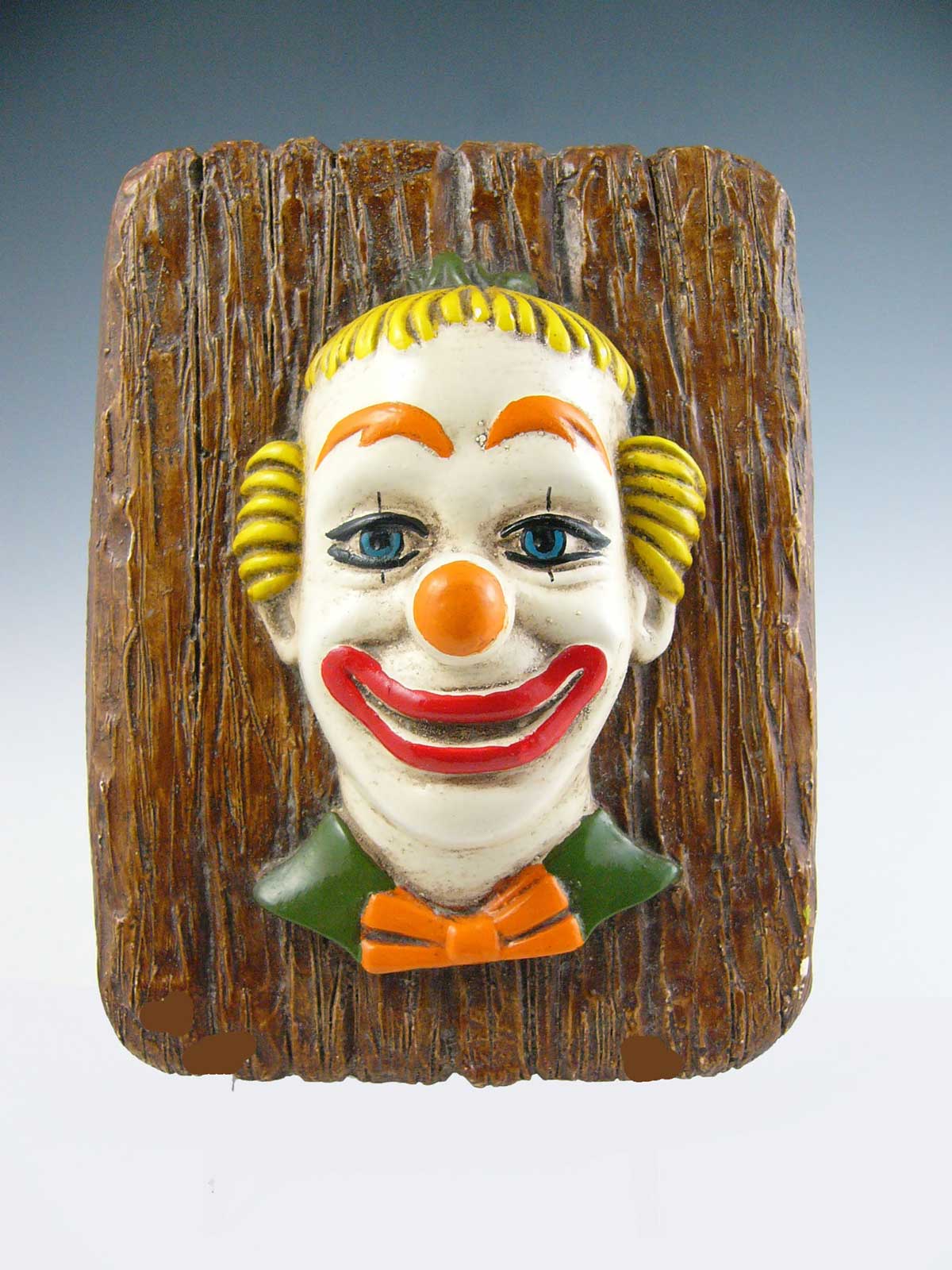
Ready to brighten any room: plaster clown wall plaque, 8-1/2” h. (Image courtesy of the author)
But regardless of type, audiences loved clowns, and so did artists. The no-holds-barred nature of colorful clown makeup and costuming meant no-holds-barred artistic interpretations of clowndom. There were ceramic clowns. Glass clowns. Tin, pot metal, plastic, marble, and plaster clowns. And, since clowns could do almost anything onstage, so could clown figurines. Clowns were posed banging drums, roller skating, twirling canes, riding bikes, and riding piggyback. But why stop at just static poses? There were so many helpful functions a clown could perform. Among the many: clown banks, juicers, decanters, ashtrays, salt-and-peppers, mugs, napkin rings, spoon rests, tea sets, cookie jars, planters, vases, egg cups, table lamps, and lighting fixtures.
Although many clown figurines were imported or unmarked, some design “names” celebrated red noses, including Shawnee, McCoy, Royal Copley, Royal Halburton China, Royal Doulton, and Murano. Prices remain something to smile about, ranging from $15 to $100, with works by those “names” on the higher end. Since most clown figurines were mass-produced, their grinning faces often turn up at estate sales, auctions, antique shops, and online. You’ll find them all definite day-brighteners (well, maybe not Pennywise). And always remember:
Donald-Brian Johnson is the co-author of numerous books on design and collectibles, including “Postwar Pop,” a collection of his columns. Please address inquiries to: donaldbrian@msn.com
Donald-Brian Johnson is the co-author of numerous Schiffer books on design and collectibles, including “Postwar Pop,” a collection of his columns. Please address inquiries to: donaldbrian@msn.com