

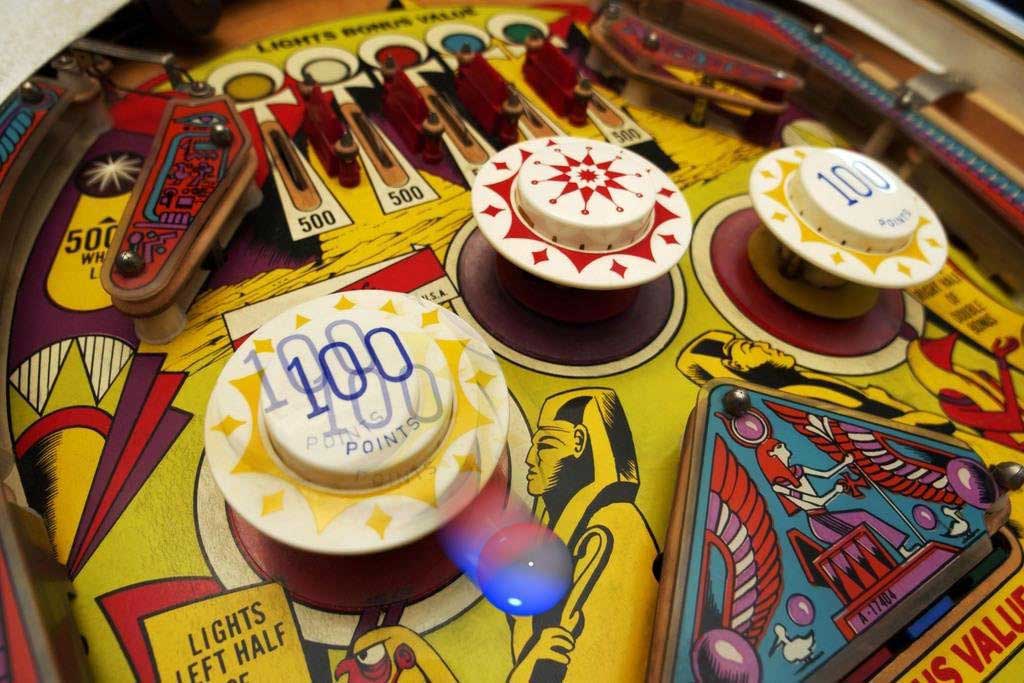
Pinball Wizard Pinball machines stay in the game even 100 years after initial release
Detail of a vintage pinball machine. (Image courtesy of Design Market)
Jan/Feb 2024
Cover Story
Pinball Wizard
Pinball machines stay in the game even 100 years after initial release
by Corbin Crable
Clack! go the flippers as the ball is launched. Pop! go the bumpers as the metal ball weaves its way through obstacles. And then the bells – ding, ding, accompanied by the many flashes of light to signify your victory.
Close your eyes and you can see the lights and hear those sounds coming from the pinball machine in the old arcade, bar, or restaurant you used to visit every weekend — the place where you and your friends spent countless hours feeding the machine one quarter after another in the hopes of attaining bragging rights of becoming a pinball champion.
A cost-effective diversion
Though the game was invented in France in the late 18th century, the coin-operated pinball machines we know today were created during the Great Depression as a cheap form of entertainment for Americans who craved a diversion from the nation’s economic woes.
“It was a low-cost game that anyone could play and get some respite from the hardships of everyday life,” according to an article on Betson.com. Betson is a manufacturer and seller of arcade games.
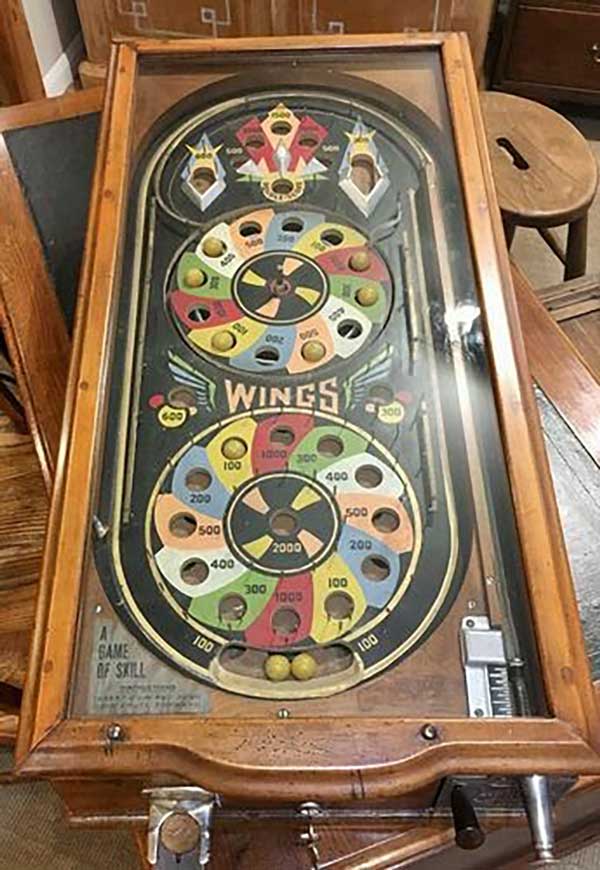
An antique pinball machine
An antique pinball machine produced by Rockola in 1933. (Image courtesy of In a Nutshell Antiques and Interiors)
In those early days, the game bore many names, such as Ballyhoo, Baffle Ball, and Bingo. Early companies that produced the machines included the Bingo Novelty Co. and D. Gottlieb & Co., According to Betson, by 1936, the name pinball had finally stuck.
The first electronic pinball machine hit the market in 1933, and the machines installed in public places quickly proved to be a draw. Players could win prizes for achieving the highest scores. But along with the skilled players also came the cheaters, who would pick up the table and shake it in order to affect the game’s outcome.
“To counteract this, the tilt mechanism was invented in 1935 by Harry Williams, the founder of the Williams Manu-facturing Co.,” the Betson.com article explains. “Today, pinball machines have two tilt devices: one for tilting side to side and one for ‘slam tilt,’ when a player bangs the machine with their hand.”
By the end of the decade, there were an estimated 145 pinball machine companies throughout the country; however, the sheer number of them created intense competition, and many were forced to shutter their doors due to market saturation.
And, like many industries of the time, production of pinball machines came to a halt with the outbreak of World War II in 1939 – those that remained in business by the end of the war six years later were indeed fortunate.
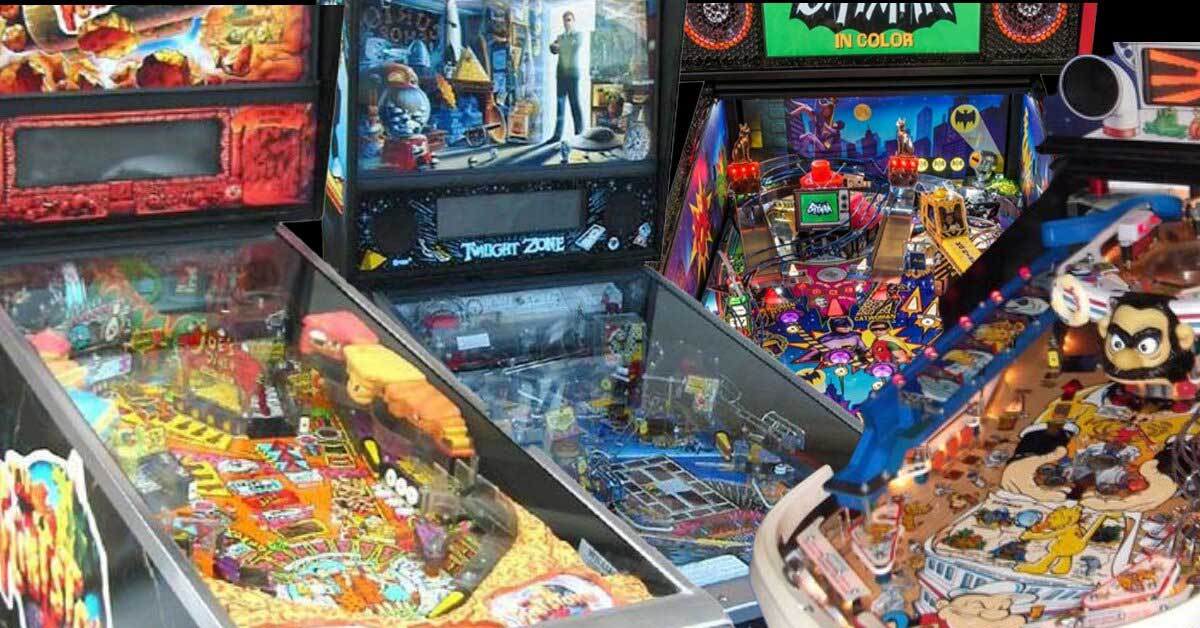
Many themed pinball machines
Many themed pinball machines manufactured in the last 50 years are inspired by TV shows and films.( Image courtesy of MeTV)
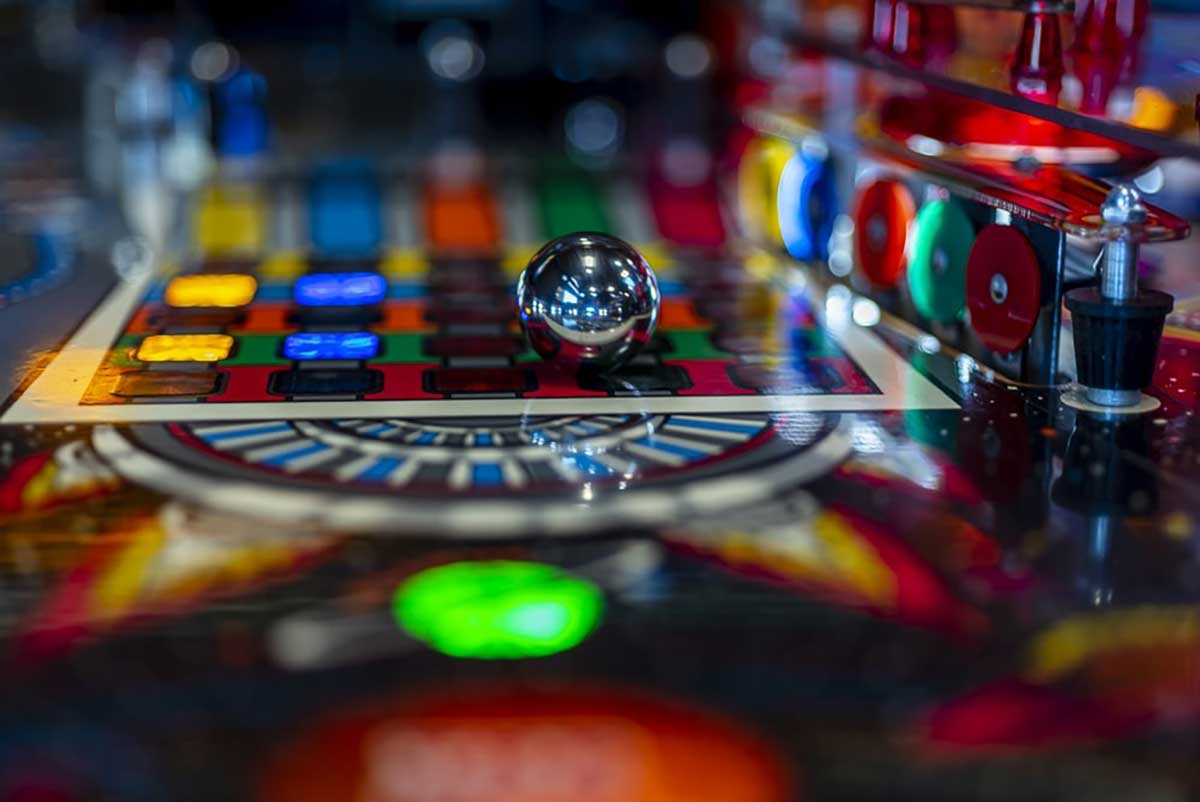
The metal ball rolling around under the glass
The sound of the metal ball rolling around under the glass of a pinball machine still brings back memories for many, says the owner of the Pinball Hall of Fame in Las Vegas. (Image courtesy of Pastime Pinball)
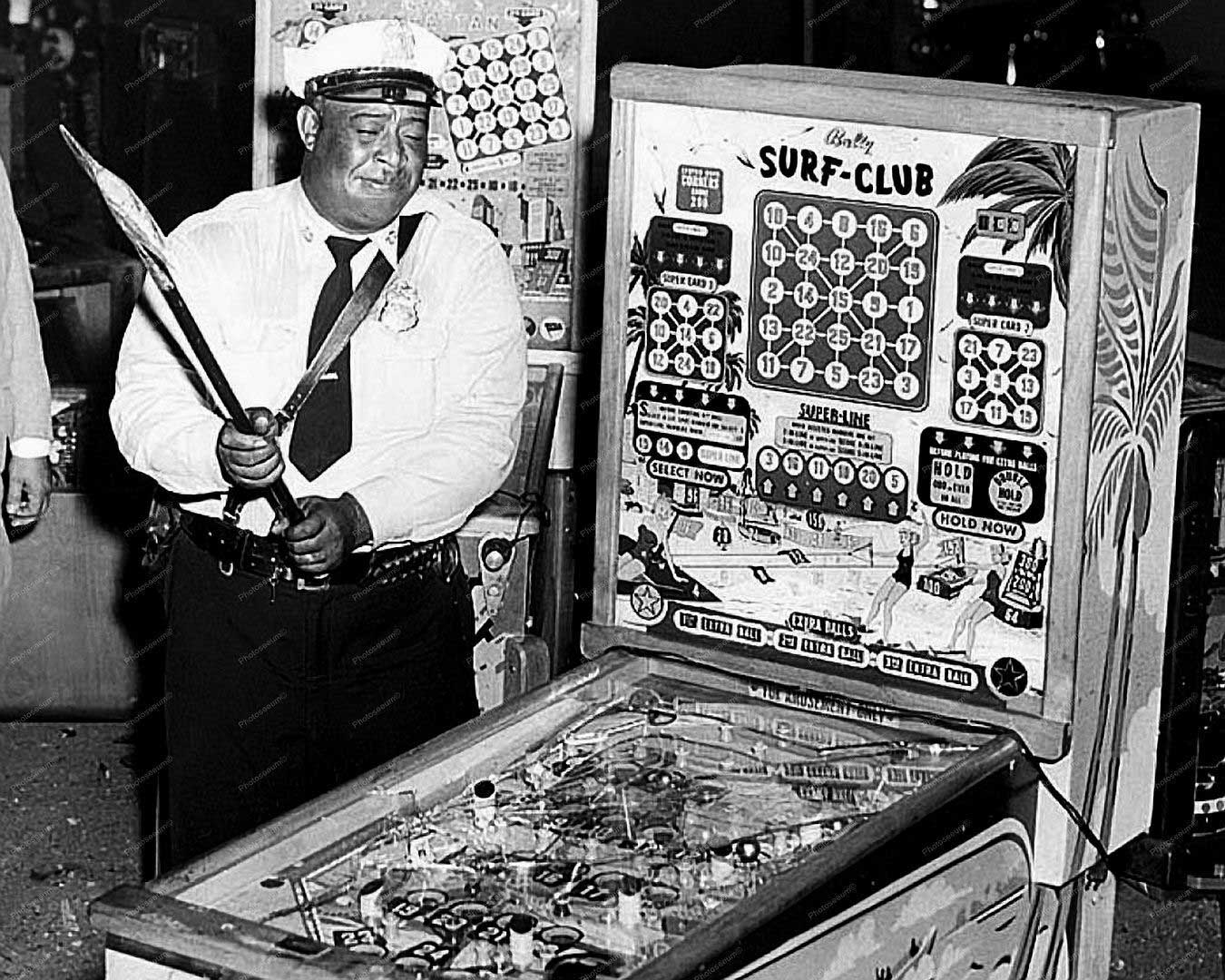
Smashed by one of New York’s finest
A Bally Surf Club pinball machine, circa 1954, about to be smashed by one of New York’s finest, during pinball’s Golden Age. (Image courtesy of eBay)
The Golden Age: 1948-58
Following the war, however, pinball’s Golden Age was born, and the game’s popularity soared.
Historians generally agree that the game’s very best years came between 1948 and 1958, with D. Gottlieb & Co. inventing the flipper in 1947. Those early flippers were much smaller than the ones with which we’re familiar today, invented in the 1970s.
In addition to pinball’s growth and development, however, also comes controversy leading up to those Golden Age years. Up to that point, betting on pinball games was commonplace, and in the early 1940s, New York City banned the game. Other major U.S. cities followed suit, including Los Angeles, New Orleans, and Chicago, where most pinball manufacturers operated and where the mob has a stronghold on the industry.
New York City’s mayor went out of his way to make it known that the game was unwelcome in the “City That Never Sleeps.”
“The police raided multiple public spaces with these machines, such as bowling alleys and amusement centers,” according to the Betson article. “NYC’s Mayor Fiorello LaGuardia gathered with police chiefs and smashed these pinball machines in front of the press.”
New York City’s ban was finally lifted in 1976.
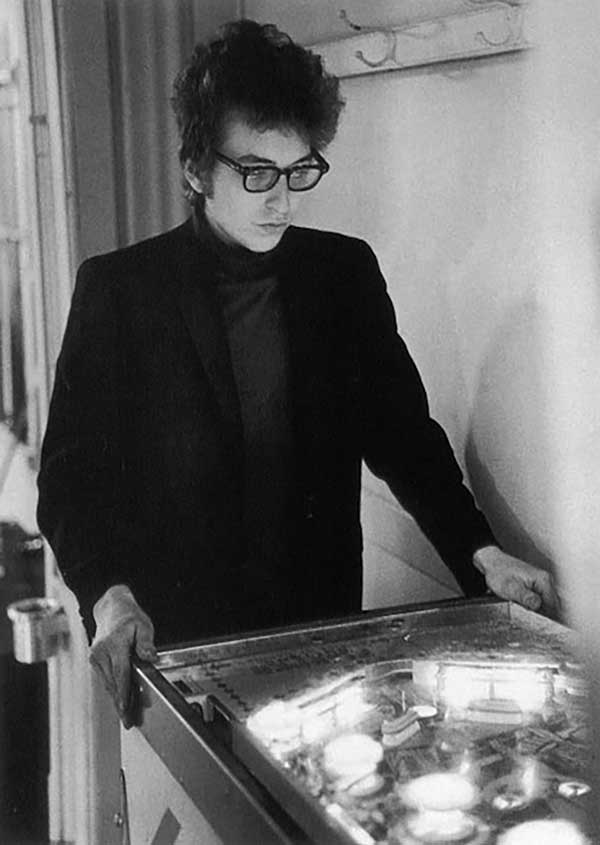
Anyone with a quarter in their pocket ... Bob Dylan
Pinball remains a cheap form of entertainment, available to anyone with a quarter in their pocket. Pictured: Singer Bob Dylan, playing pinball in 1965. (Image courtesy of dangerousminds.net)
“Sure plays a mean pinball”
One of pinball’s largest pop culture moments came in February 1969, when The Who recorded their hit song “Pinball Wizard,” featured on their rock opera album Tommy, released that same year. Written by Pete Townshend, the song is sung from the perspective of an unnamed pinball champion, who sings of the incredible skill displayed by Tommy Walker, the title character of The Who’s rock opera by of the same name:
He ain’t got no distractions
Can’t hear those buzzers and bells
Don’t see lights a flashin’
Plays by sense of smell
Always gets a replay
Never seen him fall
That deaf, dumb, and blind kid
Sure plays a mean pinball
The decade of the 1970s saw the pinball industry struggle as video games began to take hold on the public’s attention – and their dollars. D. Gottlieb & Co., once a domineering force in pinball, went out of business as competitor Bally and Williams developed themed pinball machines based on popular movies and TV shows, including The Twilight Zone, Starsky & Hutch, and Charlie’s Angels. An Addams Family pinball machine, made in 1992, remains the company’s most popular, with more than 20,000 units made. Musicians and bands saw pinball machines bearing their likeness, too, including KISS, Jefferson Airplane, and Led Zeppelin.
By decade’s end, only one big company had survived the arrival of video games and video game arcades– Stern Pinball, creator of most themed pinball machines. The company continued to produce machines throughout the late 20th century and into the early 21st. They still build themed pinball machines touting TV shows and films today.
Keeping the game alive
Collectors and pinball enthusiasts keep vintage machines in good repair throughout the country. One family-owned business, Pinrescue.com, restores and sells vintage mechanical pinball machines from their New Jersey-based headquarters. Closer to home, the Iowa Pinball Club collects, restores, and preserves pinball machines and other coin-operated games, with buyers set up across the country (so the machines do not need to be shipped by the seller).
The Iowa Pinball Club celebrates its 20th anniversary in business this year.
Pinball lovers and seasoned players keep the game alive, too, with their participation in one of the many conventions and tournaments that take place each year. The largest is organized and sponsored by the International Flipper Pinball Association, which organizes events and competitions at the local, state, national, and international levels. According to the IFPA’s website, currently, the top two world pinball players are American, with Colorado’s Escher Lefkoff in second place (currently age 20, he occupied the top spot for years and has played pinball since the age of five). In first place is 19-year-old Jason Zahler of New Jersey, who has played since the age of 7, born nearly a century after the modern iteration of the game was invented. And, according to the IFPA’s calendar, Tulsa, OK, will be the site of several tournaments in 2024.
“These memories come flooding back”
Pinball’s popularity and ability to thrive in the age of video games boils down to one secret: memories.
“What is driving the boom? Much of it is nostalgia,” according to a May 2023 article on games.slashdot.org. “A generation raised on pinball in arcades in the 1980s and 1990s are now at an age where they have disposable income, and kids with whom they want to play the games they played as children.”
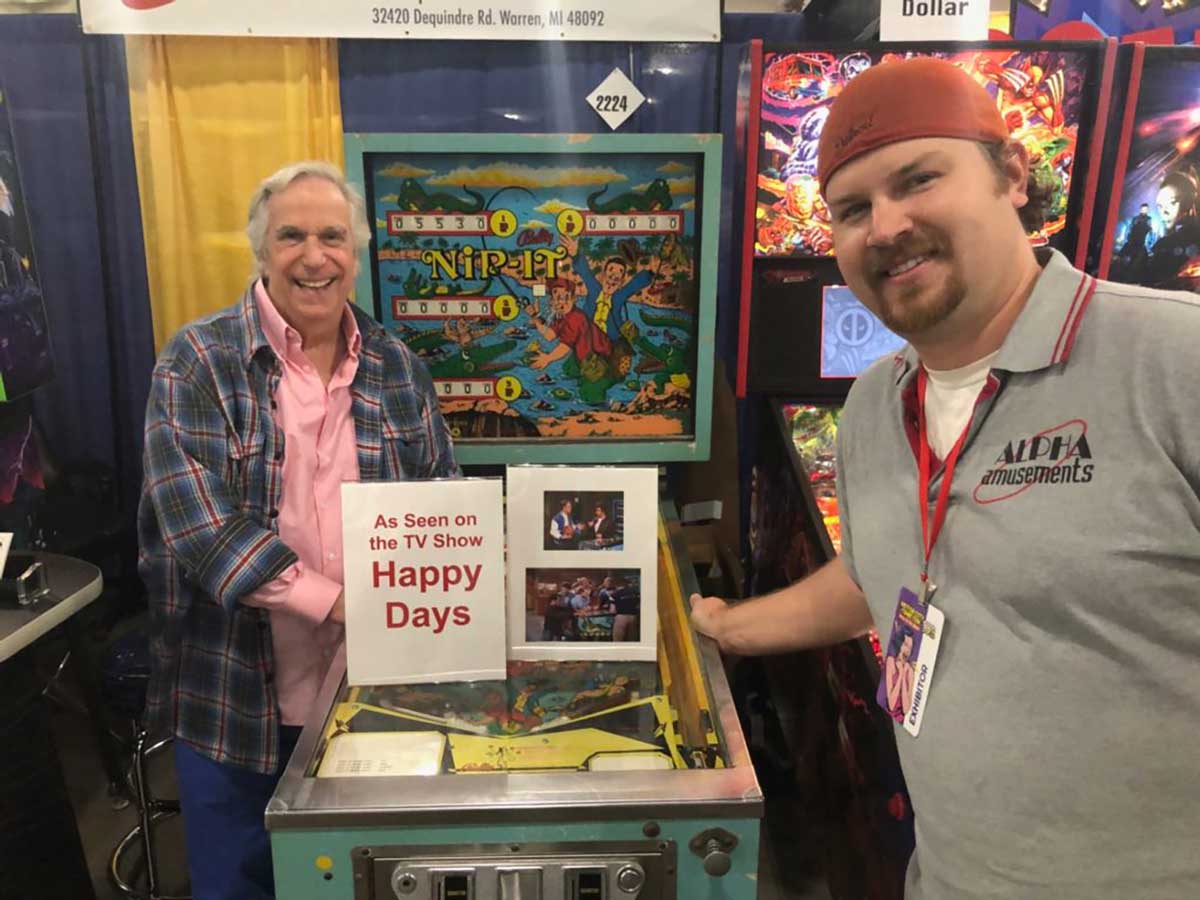
Aaaayyyy! Actor Henry Winkler poses with a Nip-It pinball machine
Aaaayyyy! Actor Henry Winkler poses with a Nip-It pinball machine at a pop culture convention in 2019. Released by Bally in 1973, the pinball machine is similar to the one played by the Fonz in “Happy Days.” On the right is convention vendor Chris Pascaretti. (Image courtesy of John Pascaretti and replaymag.com.)
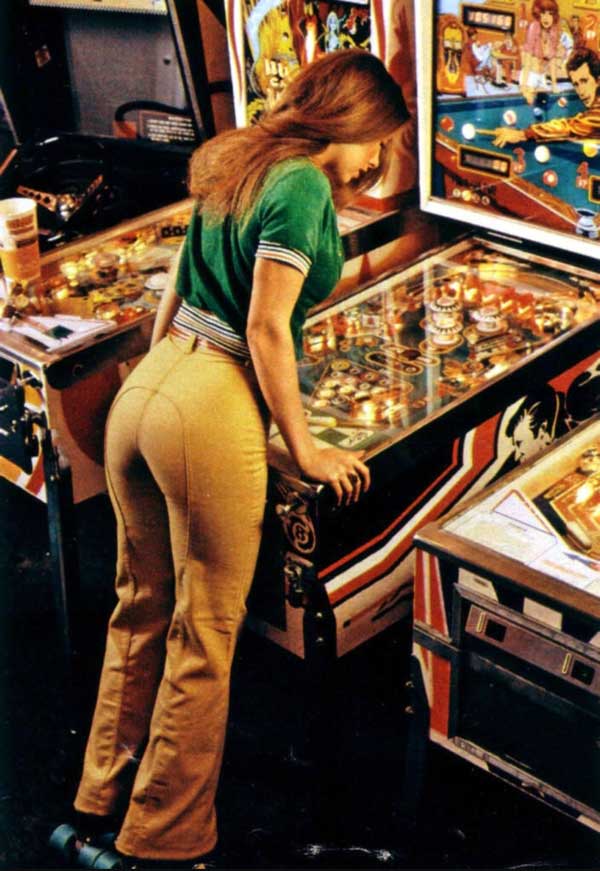
A woman plays pinball
A woman plays pinball in an arcade in the late 1970s. (Image courtesy of Reddit)
In Las Vegas, the Pinball Hall of Fame resides in a 27,000-square-foot building close to the iconic “Welcome to Fabulous Las Vegas” sign. The building, home to restored machines from the 1930s through the 1950s, is ground zero for that nostalgia, says owner Tim Arnold, quoted in a May 2021 article by Kerry Callahan on the PR website The Feast of Friends.
“(Visitors) walk past a machine that they’ve completely forgotten about,” Arnold said. “They see it again, and all these memories come flooding back. And they just lock up. They’ll sit there and point at the machine [and say], ‘So this is the machine I was playing the first time I kissed a girl,’” Arnold said. “We see that every day
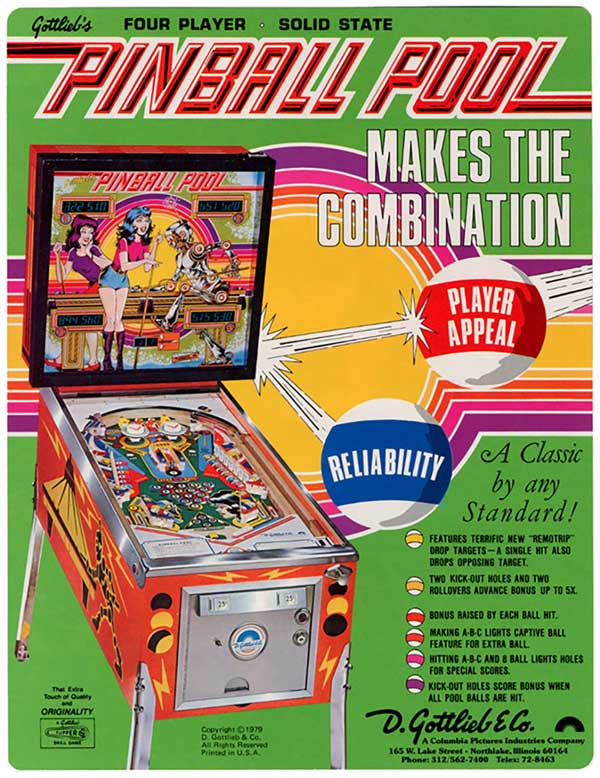
A 1978 advertisement
A 1978 advertisement for Pinball Pool from Gottlieb. (Image courtesy of Vintage Industrial Style
Pinball players flock to KC for championship
Kansas City welcomed pinball players and enthusiasts alike in late January for the International Flipper Pinball Association’s Annual IFPA State Championship Series finale.
More than 1,000 players from across the U.S., in both men’s and women’s categories, descended on the 403 Club, the venue that hosted the event.
A Jan. 19 article on the website of KSHB 41 quotes the owner of the venue.
“When I tell people that we host the Kansas State Pinball Championship, they’re like, that’s such a thing?” said Artie Scholes, the owner of 403 Club. “Yes, it is.”
With players as young as 8 – Scholes’ son, Oliver — competing during the action, the event proved to be a draw for enthusiasts of all ages.
For more information on this and other tournaments, visit www.ifpapinball.com.
Your home away from home Vintage campers ready for summer adventures
May 2022 Cover Story Your home away from home Vintage campers ready for summer adventures by Corbin Crable As temperatures grow warmer and nature calls out to you for yet another summer adventure, many longtime camping enthusiasts are gassing up their vintage campers...

America the Beautiful
April 2022Cover Story America the Beautiful Ad campaigns deter littering, encourage preservation of country’s natural beautyby Corbin CrableIt’s hard to believe that what we know as recycling today was largely unfamiliar to Americans just a few decades ago. You likely...
Magic between the pages Children’s literature enjoys a storied history
March 2022Cover Story Magic between the pages Children’s literature enjoys a storied history by Corbin CrableYou remember them fondly from your childhood – you joined them on their adventures in the fantasy worlds they inhabited, and they sparked your imagination, as...

Hail to the Chief -Presidential libraries seek to inform, preserve leaders’ legacy
February 2022Cover Story Hail to the Chief Presidential libraries seek to inform, preserve leaders’ legacyby Corbin CrablePresidents’ Day This Presidents’ Day, stick to your New Year’s resolution of taking the time to learn something new and take advantage of a visit...
Like, totally rad!: Gen X collectibles – remain popular, plentiful
January 2022 Cover Story Like, totally rad!: Gen X collectibles - remain popular, plentiful by Corbin Crable Generation X like I am For those of us of a certain age, the power of nostalgia remains a strong draw when we consider the pop culture influences of our...
‘Tis the Season for Gifting
December 2021 Cover Story ‘Tis the Season for Gifting by Corbin Crable Affordable Gifts for the Antique Lover The holidays, traditionally a time of reflection on days gone by as a new year approaches, hold plenty of opportunities to gift little pieces of the...
Keep It Simple – Kansas museum’s exhibit features works from Midcentury Modern designer Paul McCobb
November 2021Cover StoryKeep It Simple - Kansas museum's exhibit features works from Midcentury Modern designer Paul McCobbby Corbin Crable Midcentury Modern Design The Johnson County (KS) Museum has brought back the simplicity and style of midcentury modern...
You spin me ‘round | Record revival introduces new generation to the sound of vinyl
Image courtesy of https://onthesamepageelt.wordpress.comOctober 2021Cover StoryYou spin me ‘round : Record revival introduces new generation to the sound of vinylby Corbin Crable Vinyl Record's Time to Shine If media formats are cyclical, the early 21st century...